Search

band annie's Weblog

I have a parallel blog in French at http://anniebannie.net

Month

January 2013

Syria’s Agony: The Photographs That Moved Them Most

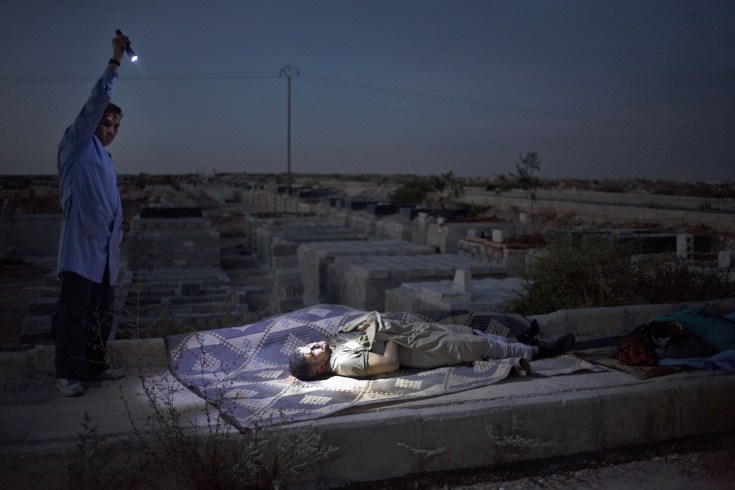
 Maysun—EPA / Oct. 13, 2012 Maysun "I was taking pictures at Dar al-Shifa Hospital. Every day was a slaughter, and still is. Only three of the nine floors of the building are usable. On the ground floor is a small room that served as a morgue. There were two bodies that had not been identified — one didn't have a head. After several days, they were loaded into the back of an old van and driven to a large cemetery. We barely had light. There was no one to bury them, so they decided to leave the bodies on the ground, covered with a blanket. As we were driving back to the hospital, Ahmad, an FSA fighter, couldn't stop telling me, 'Ya haram! Ya haram! We must bury them! Dogs will eat them!' We returned to the cemetery at nightfall. While trying to bury them in a mass grave, a plane made several passes over us. We had to turn off all the lights — a flashlight and the glow from our cell phones. The bodies were buried as quickly as we could, without names or ceremonies or mourning. Several days later, I found out Ahmad went missing after the Syrian army bombed the hospital." Read more: http://lightbox.time.com/2012/12/10/photographing-syrias-agony-the-images-that-moved-them-most/#ixzz2H5EtH6ZM

Maysun—EPA / Oct. 13, 2012
Maysun
“I was taking pictures at Dar al-Shifa Hospital. Every day was a slaughter, and still is. Only three of the nine floors of the building are usable. On the ground floor is a small room that served as a morgue. There were two bodies that had not been identified — one didn’t have a head. After several days, they were loaded into the back of an old van and driven to a large cemetery.
We barely had light. There was no one to bury them, so they decided to leave the bodies on the ground, covered with a blanket. As we were driving back to the hospital, Ahmad, an FSA fighter, couldn’t stop telling me, ‘Ya haram! Ya haram! We must bury them! Dogs will eat them!’
We returned to the cemetery at nightfall. While trying to bury them in a mass grave, a plane made several passes over us. We had to turn off all the lights — a flashlight and the glow from our cell phones. The bodies were buried as quickly as we could, without names or ceremonies or mourning.
Several days later, I found out Ahmad went missing after the Syrian army bombed the hospital.”
Read more: http://lightbox.time.com/2012/12/10/photographing-syrias-agony-the-images-that-moved-them-most/#ixzz2H5EtH6ZM

Syria has always been a tough place to cover for journalists. Confidently authoritarian with a ruthlessly formidable security and intelligence apparatus, Syria has long been one of the most policed of Arab police states. So when some Syrians defied their government to take to the streets in the southern city of Dara‘a in March 2011, the temptation to cover the story was overwhelming for many, including myself.

The story of the Syrian uprising is ultimately the tale of regular citizens silencing the policeman in their heads, breaking their own personal barriers of fear to speak, to demonstrate, to demand, to reject, to no longer be afraid, to live in dignity. It’s about what these people will do, what they will endure, and what they are prepared to become to achieve their aims.

It is also the story of a significant portion of the population that considers the regime of President Bashar Assad the country’s best option, because they believe in its Baathist secular ideology or directly benefit from its patronage or don’t have confidence in Assad’s opponents and fear what may come next. Understanding what this segment of the population will accept in terms of state violence, the narratives they choose to believe and their concerns is a critical component of the story, though one that is harder to obtain, given the paucity of press visas issued by Damascus.

The only way to tell the Syrian story, really tell it, is to be on the ground with the men, women and children who are central to it, whether in Syria on in the neighboring states that many Syrians have fled to. It isn’t easy to do — the Committee to Protect Journalists, based in New York City, has dubbed Syria the “most dangerous place for journalists in the world” — but it is essential. Nothing beats being there. There is no compensating for seeing, feeling, touching, capturing, living the story.

The images here are a testament to the power of being on the ground, of sharing and capturing a moment for posterity, of translating an element of a person’s life through imagery.

Take a look at the photos. Can you place yourself in these situations? Can you imagine what it must be like? What do you feel when you look at the images? Are you drawn into them, or are you repulsed? Can you relate to them, or are they too alien? This is the power of translating on-the-ground reporting to an audience. This is why we must and will continue to document the Syrian uprising from inside the country when we can, and we — members of the foreign press corps — are not alone. Sadly, as is often the case, local journalists (both professional and citizen) have disproportionately borne the brunt of the casualties in this crisis. Still, this story is not about members of the media and what we go through to tell it; it’s about the Syrians who entrust their testimonies, their experiences, their hopes, their fears, their images to us in the hope that they will help explain what is happening in one of the most pivotal states in the Middle East.

—Rania Abouzeid

This collection of testimonies is the third in a series by TIME documenting iconic images of conflict. See “9/11: The Photographs That Moved Them Most” and “Afghanistan: The Photographs That Moved Them Most” for more.

Abouzeid is a Middle East correspondent for TIME. Reporting by Vaughn Wallace.

Read more: http://lightbox.time.com/2012/12/10/photographing-syrias-agony-the-images-that-moved-them-most/#ixzz2H5FOSt9b

A little late, but so good !

Hasbara fail: the ambassadors mutiny

by Annie Robbins and Phil Weiss on January 3, 2013 37


Some late developments from Israel only solidify the impression that this country is working hard to destroy its international reputation and simply cannot help itself because of internal pressures from rightwing politicians.

First, annexation of the West Bank is being pushed aggressively so that Likudniks can win the Israeli election, in complete disregard of international opinion. Harriet Sherwood in the Guardian:

Prominent members of Israel‘s ruling Likud party have proposed the annexation of part of the West Bank as the battle for rightwing votes intensifies before the general election in less than three weeks.

Government minister Yuli Edelstein told a conference in Jerusalem that the lack of Israeli sovereignty over Area C – the 60% of the West Bank under full Israeli military control in which all settlements are situated – “strengthens the international community’s demand for a withdrawal to the pre-1967 lines”.

About that international opinion: Here is a delicious story in Ynet about the Israeli ambassadors complaining to the home office about the crap they have to push to the world, and a Netanyahu aide slapping them down:

[Ambassador to the UN Ron] Prosor, one of the highest ranking Israeli diplomats in the world, asked [National Security Council head Yaakov] Amidror what was the rationale behind timing the decision to promote construction in area E1 (between Jerusalem and Ma’aleh Adumim)  after the UN resolution to upgrade the Palestinian Authority to an observer state status.

Prosor’s fellow ambassadors, who found it difficult to explain to the world the basis of Israel’s foreign policy on the matter, applauded Prosor….

Ambassadors left the conference feeling highly displeased. “It ended in unpleasant tones. Prosor asked a completely legitimate question and was rebuked. We don’t argue that our job is to represent the state, but those who do have to understand the logic behind its decisions.”…

President Shimon Peres also discussed the Palestinian issue on Monday, for the second time this week. A day after declaring Palestinian President Mahmoud Abbas to be a partner for peace and severely criticizing Netanyahu and Lieberman’s handling of diplomacy, the president said that “there is nothing wrong with talking to Hamas, as long as it accepts the terms of the Quartet

A key point in that Ynet piece is that the government has no choice but to annex, and that it knows it is killing itself internationally:

It should be noted that the Foreign Ministry recommended to the government to postpone any counter-measures to the Palestinian bid so as not to focus international attention on Israel, fearing it may be seen as vindictive.
OK, but there is too much internal political pressure not to annex. Again from that Ynet piece: “Amidror said that there was a need to make it clear to the Palestinians that unilateral moves on their part come with a price.” And check this out, from the Times of Israel, echoing that Guardian piece above:

[Likud member of Knesset] MK Yariv Levin advocated a slow but steady de facto annexation of the West Bank, mainly by expanding existing settlements and taking whatever steps were possible to apply laws on Jewish communities beyond the Green Line.

“In this way, we will try, slowly but surely, to expand the circle of settlements, and to afterwards extend the roads that lead to them, and so forth. At the end of this process, the facts on the ground will be that whatever remains [of the West Bank] will be merely marginal appendages,” he said.

Last week, two senior Likud MKs caused an uproar when they stated that the party does not support a two-state solution, despite Prime Minister Benjamin Netanyahu’s 2009 Bar-Ilan University speech, during which he in principle agreed to a demilitarized Palestinian state, if the Palestinians recognized Israel as a Jewish state.

Israel might think it can annex under the radar. But nothing is escaping European attention; this is what their ambassadors have to sell.

The mutiny by the ambassadors may have been sparked by an upstart Israeli thinktank that released a study last week.

“Israel’s public diplomacy apparatus, contrary to its poor reputation, is well-coordinated and highly sophisticated. Israel’s diplomatic isolation, therefore, cannot be attributed to a mythic ‘hasbara problem’; it can only be a product of Israeli policy itself

Haaretz reported on the study: There is causal connection between Israel’s poor international image and the policies of its government.

“Instead of dealing with the connection between the policies of Israel’s government and the country’s image in the world,” [Molad thinktank study] continues, “a myth is taking hold, one which stresses an ‘advocacy problem’ caused by anti-Israel organizations and institutions which exploit double standards and even anti-Semitic tendencies in the international community in order to damage Israel.”

The study insists that “inflating anti-Israel propaganda on the one hand, and inflating criticism of Israeli advocacy on the other hand, deflects public attention away from the causal connections between the erosion of Israel’s image and of its international status and the policies of its government.”

And interestingly, Haaretz even suggested that the ambassadors should bring the study up:

Next week in Jerusalem, the Foreign Ministry will hold its annual conference of the country’s ambassadors around the word. During past meetings, former Foreign Minister Avigdor Lieberman regularly upbraided and insulted Israel’s ambassadors, the participants of the conference. He claimed that instead of explicating Israel’s policies and positions more assertively, and defending “national honor,” the country’s diplomats cowered and surrendered around the world. But now Lieberman, facing indictment, has left the Foreign Ministry – and the ambassadors conference this year may serve as a good opportunity to discuss Molad’s findings.

About Annie Robbins and Phil Weiss
Philip Weiss is Founder and Co-Editor of Mondoweiss.net.

source

Assad: challenge Syria at your peril

Syria’s president, Bashar al-Assad, has warned that Western action against his country would cause an “earthquake” that would “burn the whole region”.

President Assad admitted that 'many mistakes' had been made by his forces in the early part of the uprising, but insisted that only terrorists' were now being targeted

President Assad admitted that ‘many mistakes’ had been made by his forces in the early part of the uprising, but insisted that only terrorists’ were now being targeted Photo: EPA
Andrew Gilligan

By , in Damascus

8:43PM BST 29 Oct 2011

Comments794 Comments

In his first interview with a Western journalist since Syria‘s seven-month uprising began, President Assad told The Sunday Telegraph that intervention against his regime could cause “another Afghanistan”.

Western countries “are going to ratchet up the pressure, definitely,” he said. “But Syria is different in every respect from Egypt, Tunisia, Yemen. The history is different. The politics is different.

“Syria is the hub now in this region. It is the fault line, and if you play with the ground you will cause an earthquake … Do you want to see another Afghanistan, or tens of Afghanistans?

“Any problem in Syria will burn the whole region. If the plan is to divide Syria, that is to divide the whole region.”

Thousands of anti-government demonstrators took to the streets in two Syrian cities on Friday to demand the imposition of a Libyan-style no-fly zone over the country. According to the United Nations, at least 3,000 civilians, including 187 children, have been killed during protests against the regime. Thousands more have been imprisoned. The government says 1,200 members of the security forces have also died.

President Assad admitted that “many mistakes” had been made by his forces in the early part of the uprising, but insisted that only “terrorists” were now being targeted.

“We have very few police, only the army, who are trained to take on al-Qaeda,” he said. “If you sent in your army to the streets, the same thing would happen. Now, we are only fighting terrorists. That’s why the fighting is becoming much less.”

On Friday alone, however, opposition groups claimed that 40 people were killed by the regime, and government troops shelled a district of Homs, a centre of opposition.

Seventeen soldiers also died in overnight clashes with suspected army deserters in the city, which foreign journalists are forbidden to enter.

Syria was condemned yesterday by Arab League foreign ministers for its “continued killings of civilians”.

The number of protesters appeared to fall earlier this month, but has increased again after the death of Col Gaddafi gave opposition groups new heart. A general strike affected much of the southern part of the country.

President Assad insisted that he had responded differently to the Arab Spring than other, deposed Arab leaders. “We didn’t go down the road of stubborn government,” he said. “Six days after [the protests began] I commenced reform. People were sceptical that the reforms were an opiate for the people, but when we started announcing the reforms, the problems started decreasing e_SLps This is when the tide started to turn. This is when people started supporting the government.”

Some Damascus-based opposition leaders say the reforms, which include laws ostensibly allowing demonstrations and political parties, are a start, but not enough. However, the leaders of the main protests say they are meaningless and President Assad must go.

“The problem with the government is that their dialogue is shallow and just a tool to gain time,” said Kadri Jamil, of Kassioun, a Damascus-based opposition group. “They have to act to begin real dialogue because the security solution has failed. We have one to two months before we pass the point of no return.”

One Homs-based opposition activist said: “Killing people is not an act of reform. We aren’t calling for economic or even political reform under Assad, but for the departure of this bloodstained president and free elections.”

President Assad said: “The pace of reform is not too slow. The vision needs to be mature. It would take only 15 seconds to sign a law, but if it doesn’t fit your society, you’ll have division … It’s a very complicated society.”

He described the uprising as a “struggle between Islamism and pan-Arabism [secularism], adding: “We’ve been fighting the Muslim Brotherhood since the 1950s and we are still fighting with them.”

In interviews in Damascus, some without government minders, secular Syrians and members of the country’s substantial Christian and Alawite minorities said they supported the Assad regime for fear of their positions under a new government. Those attending a large demonstration in support of the regime last Wednesday did not appear to be coerced, according to independent observers.

However, interviews, even some with minders present, revealed widespread and vocal discontent over corruption and living standards.

source

“How to defend Bashar Assad in 10 easy steps

Borzou Daragahi, lundi 31 décembre 2012, 17:34 ·

This is my guide for Syria analysts and journalists who want to defend Bashar Assad while continuing to retain their credibility in the West.

1. Keep mentioning Jubhat al Nasra and other Islamic jihadi groups without mentioning that the vast majority of armed groups are not nearly as extreme, are mostly locally based folks defending their towns and villages.

2. When referring to the armed opposition keep using the magic word: AL QAEDA

3. Make cursory mention of the regime’s brutality (you won’t have any credibility if you don’t) but avoid resurrecting the roots of the conflict in peaceful opposition to Bashar’s dictatorship. Avoid mention of wanton use of air power against civilians in bread lines and in their homes.

4. Keep talking about NATO, the Gulf countries and Western support for opposition; that will boost Bashar’s anti-imperialist creds among the campus leftists.

5. Focus on faults of incompetent and disorganized Syrian opposition abroad instead of networks of activists and homegrown civil society already establishing governance inside.

6. Frame Russia as an honest broker trying to peacefully resolve conflict instead of a shrewd chess player that doesn’t give a damn about Syrian civilians and murdered tens of thousands of Chechens in an attempt to put down a rebellion in the 1990s.

7. Keep warning about consequences of Syria state’s collapse: sectarian war, refugees in Europe, rise of an Islamist state.

8. Keep raising rare instances of rebel misconduct and faked videos and frame them as emblematic of the overall opposition.

9. Make the opposition look intransigent; they’re the ones who won’t agree to a peaceful settlement, not the president who did no reforms for 10 years and dispatched shabiha to murder peaceful protesters when they spoke out.

10. Pray to God (even if you are an athiest) that the rebels don’t get to Damascus, open up the files and find out what you did for the regime, the details of conversations on how you got your visas and your access to officials.”

Zaatary : Syrian children refugees – أرواح بريئة – من مخيم الزعتري

Blog at WordPress.com.

Up ↑