Search

band annie's Weblog

I have a parallel blog in French at http://anniebannie.net

Month

October 2012

In Praise of Hatred, By Khaled Khalifa, trans. Leri Price

This novel of repression and subversion in Syria explores the lure of fanaticism

Saturday 15 September 2012

Khaled Khalifa’s third novel was banned on publication in Syria, even though its political turbulence never arrives in the present day but focuses on the decade following 1970, when the Muslim Brotherhood became locked in deadly battle with the state’s Baathist party. The battle ended in 1982, in an attempted uprising by the Brotherhood which the government crushed in Hama, levelling parts of the city and leaving between 10,000 and 25,000 people (mainly civilians) dead or wounded in a singularly brutal intervention.

Neither the Muslim Brotherhood nor the Baath is mentioned by name in the novel, but it is clear what Khalifa’s points of references are, and also why this book was seen as a threat to the current beleaguered regime. Historians might trace a line from the troubles that erupted around Aleppo in the Seventies to the conflict on its streets today.

An unnamed female narrator is the central fanatic of the story. That Khalifa has chosen to profile fanaticism from a feminine perspective, rather than the more predictable “male martyr”, is this book’s great innovation. It is a courageous endeavour with sometimes exhilarating, sometimes off-key results.

Religious fanaticism offers the narrator the “pleasure of absolute certainty” and to fan its fires, she must mobilise her capacity for hate. The veiled young woman, growing up in the cloistered environment of her grandparents’ home, excels at cultivating hate, which comes to feel as passionate and purposeful a force as love. At one point, “I realised hatred was worthy of praise, as it lives within us exactly as love does. It grows moment by moment in order to settle finally into our souls, and we don’t want to escape it even when it causes us pain.” Even when she finds herself imprisoned, there is a peculiar sisterhood of hate between the incarcerated women.

Her religious fervour is pitted against an erotic awakening and these two also do battle until the end. She gives in to the thrill of her emerging sexuality and her – sometimes lesbian – carnal impulses, but then pulls away and berates her weakness. Khalifa writes compellingly about this troubled eroticism in parts, but strays into clumsy contrivance or hyperbole at other times.

While the story is ostensibly a domestic one about the narrator and her wealthy household of aunts who must choose between a life of self-denying spinsterhood or rebellious marriage, at its core it is about violence: the religiously motivated violence of the Muslim Brotherhood, and the counter-violence inflicted by a secular government. The two forces are locked into a mutual cycle of hatred, each atrocity sparking the next.

Khalifa is said to have spent 13 years working on the book, a finalist for the International Prize for Arabic Fiction. “The main thing I wanted to get at was the struggle of two fundamentalisms,” he has said. The novel captures not just the tragedy in this, but the self-defining “heroism” for those willing to live and die for their cause.

source

Syrian refugees in Hatay, Turkey

Garbage Warrior [Full Length Documentary]

[youtube http://youtu.be/YrMJwIedrWU?]

About Garbage Warrior

What do beer cans, car tires and water bottles have in common? Not much unless you’re renegade architect Michael Reynolds, in which case they are tools of choice for producing thermal mass and energy-independent housing. For 30 years New Mexico-based Reynolds and his green disciples have devoted their time to advancing the art of “Earthship Biotecture” by building self-sufficient, off-the-grid communities where design and function converge in eco-harmony. However, these experimental structures that defy state standards create conflict between Reynolds and the authorities, who are backed by big business. Frustrated by antiquated legislation, Reynolds lobbies for the right to create a sustainable living test site. While politicians hum and ha, Mother Nature strikes, leaving communities devastated by tsunamis and hurricanes. Reynolds and his crew seize the opportunity to lend their pioneering skills to those who need it most. Shot over three years and in four countries, Garbage Warrior is a timely portrait of a determined visionary, a hero of the 21st century.

see also Democracy Now show

Aref Dalila: Negotiation is Forbidden

Syrian opposition figure Aref Dalila (C) attends the opening session of “The National Conference for Syria Salvation” in Damascus 23 September 2012. (Photo: Khaled al-Hariri)

By: Marah Mashi

Published Thursday, October 11, 2012

Syrian opposition veteran Dalila tells Al-Akhbar that the regime is as unserious about dialogue with its home-based critics as it ever was, despite allowing some to hold a conference in Damascus.

Damascus – Aref Dalila, the veteran opposition figure and member of the National Coordination Committee for Democratic Change in Syria (NCC), has no time for those who use the latter epithet merely to try to absolve themselves of responsibility for the crisis.


“If there really is a conspiracy, as claimed, you have to ask why those who hold to the idea of a conspiracy did not prepare in advance to counter it and safeguard against it,” he remarks. There are indeed conspiracies being played out in Syria, he says, by individuals “who seek to serve their personal interests and acquire more of what they do not deserve.” But the crisis in the country is an “objective phenomenon,” and the blame for it lies with the regime, which “created conditions that enable every possible conspiracy and plot to be hatched.” 

Dalila draws parallels with the former Soviet Union, where “the suppression of freedom of opinion enabled corruption to become endemic, leading to its internal collapse without any external aggression.”

What we are witnessing today is “a mixture of a revolution, an armed insurgency, and a conspiracy,” says the economist and former political prisoner, “but primarily it is a revolutionary movement. It is a continuation of the long struggle of the Syrian people…. against corruption and for change and political and economic reform,” which has always been countered with “savage repression” by the authorities.

So why has it been unsuccessful? “The reason the struggle in Syria has not been resolved is because the regime acted to militarize it,” he affirms.

Full article here

Jon Stewart’s Theater of the Absurd

[Screen shot of [Screen shot of “The Daily Show with Jon Stewart.”]
Soon after King Abdullah II ascended the throne of Jordan in 1999, he began using media and advertising campaigns to distinguish himself from his father King Husayn and to present his policies to his subjects.  While for decades King Husayn’s picture appeared all over the country – garbed in bedouin, military, and Western costume – almost immediately, Abdullah trumped his father in sheer size of display by propping up an enormous poster of himself along University Road in Amman. He followed that act by erecting the largest flag pole in the world on a summit in the capital; the project seems to have been so successful a replica now dominates the skyline over the town of Aqaba. In the years since, he has plastered the country with multimillion dollar campaigns for “Jordan First” and “We Are All Jordan,” developed by the global ad agency Satchi and Satchi. Abdullah and Queen Rania have also used American television shows to sell themselves and their image of Jordan to American viewers. Gaining American support has now become a multimedia project, as the two seek to present themselves as moderate Middle Eastern leaders struggling to modernize their country and remain as allies of the US government.

The latest act in this scenario saw King Abdullah make a return appearance to the Daily Show with Jon Stewart on Tuesday night, 25 September, 2012. Stewart afforded Abdullah the rare honor of extending the interview through two segments of the on-air show and then posting nine additional minutes to the show’s website. In this three-act play, Abdullah presented a coherent thesis about his role in the Middle East in general and in Jordan specifically. In this performance, buttressed by Stewart’s startling acquiescence, Abdullah is the wise elder statesman guiding the young people of the region toward a democracy that mimics the successful one built in the United States. He is a father figure recognizing that his people will make mistakes as they proceed but willing to stand in to protect them from the extremists who could lead them astray. However, this story only makes sense if performed in front of a narrowly targeted audience:  one made up of Americans who know little about Jordan and for whom the image of Abdullah has become familiar and comforting. Both his vocabulary and themes he outlined come straight from a simplified reading of American political history and play on frequent explanations of Arab behavior discussed in the American press.

Full article and videos here

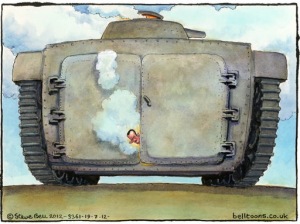
The Fall of the House of Asad

steve bell’s asad
by Robin Yassin-Kassab

This review of David Lesch’s book was written for the Scotsman.

Until his elder brother Basil died in a car crash, Bashaar al-Assad, Syria’s tyrant, was planning a quiet life as an opthalmologist in England. Recalled to Damascus, he was rapidly promoted through the military ranks, and after his father’s death was was confirmed in the presidency in a referendum in which he supposedly achieved 97.29% of the vote. Official discourse titled him ‘the Hope.’

Propaganda aside, the mild-mannered young heir enjoyed genuine popularity and therefore a long grace period, now entirely squandered. He seemed to promise a continuation of his father’s “Faustian bargain of less freedom for more stability” – not a bad bargain for a country wracked by endless coups before the Assadist state, and surrounded by states at war – while at the same time gradually reforming. Selective liberalisation allowed for a stock market and private banks but protected the public sector patronage system which ensured regime survival. There was even a measure of glasnost, a Damascus Spring permitting private newspapers and political discussion groups. It lasted eight months, and then the regime critics who had been encouraged to speak were exiled or imprisoned. Most people, Lesch included, blamed the Old Guard rather than Bashaar.

“I got to know Assad probably better than anyone in the West,” Lesch writes, and this is probably true. Between 2004 and 2008 he met the dictator frequently. His 2005 book “The New Lion of Damascus” seems in retrospect naively sympathetic. He can be forgiven for this. Most analysts (me included), and most Syrians, continued to give Bashaar the benefit of the doubt until March 2011.

Read more of this post

Robin Yassin-Kassab | October 11, 2012 at 10:12 am | Tags: David Lesch | Categories: book review, Syria | URL: http://wp.me/pytsp-ww

From the FT : Syrian massacre veiled in silence

From the Financial Times: Syrian massacre is veiled in silence

The killings in Daraya by regime forces attracted worldwide condemnation at the time – but there have been few words and little action since…

http://www.ft.com/intl/cms/s/0/1dd947a2-10a3-11e2-a5f7-00144feabdc0.html#axzz28ruEDmWT

A tribute to Meshal Temo تحية الى مشعل تمو

[youtube http://youtu.be/v4D5Np2saX4?]

Mechal Temo, a Syrian Kurdish leader, Mechal was assassinated by the Syrian regime Security Forces, during his funeral in Amuda district, a statue of Havez al Assad was brought down to ground and demonstrators raised Mechal’s casket in its place before burial.

Blog at WordPress.com.

Up ↑