Search

band annie's Weblog

I have a parallel blog in French at http://anniebannie.net

Month

September 2012

Inside the strange Hollywood scam that spread chaos across the Middle East | Max Blumenthal

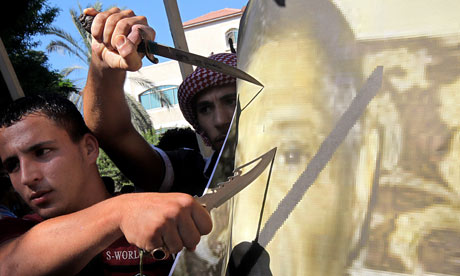
Palestinians protest against The Innocence of Muslims. Officials confirmed ‘Sam Bacile’ was an alias used by Nakoula Basseley Nakoula. Photograph: EPA

Did an inflammatory anti-Muslim film trailer that appeared spontaneously on YouTube prompt the attack that left four US diplomats dead, including US ambassador to Libya Christopher Stevens? American officials have suggested that the assault was pre-planned, allegedly by of one of the Jihadist groups that emerged since the Nato-led overthrow of Libya’s Gaddafi regime. So even though the deadly scene in Benghazi may not have resulted directly from the angry reaction to the Islamophobic video, the violence has helped realize the apocalyptic visions of the film’s backers.

Produced and promoted by a strange collection of rightwing Christian evangelicals and exiled Egyptian Copts, the trailer was created with the intention of both destabilizing post-Mubarak Egypt and roiling the US presidential election. As a consultant for the film named Steve Klein said: “We went into this knowing this was probably going to happen.”

The Associated Press’s initial report on the trailer – an amateurish, practically unwatchable production called The Innocence of Muslims – identified a mysterious character, “Sam Bacile”, as its producer. Bacile told the Associated Press that he was a Jewish Israeli real estate developer living in California. He said that he raised $5m for the production of the film from “100 Jewish donors”, an unusual claim echoing Protocols of the Elders of Zion-style fantasies. Unfortunately, the extensive history of Israeli and ultra-Zionist funding and promotion of Islamophobic propaganda in the United States provided Bacile’s remarkable statement with the ring of truth.

Who was Bacile? The Israeli government could not confirm his citizenship, and for a full day, no journalist was able to determine whether he existed or not. After being duped by Bacile, AP traced his address to the home of Nakoula Basseley Nakoula, a militant Coptic separatist and felon convicted of check fraud. On September 13, US law enforcement officials confirmed that “Sam Bacile” was an alias Nakoula used to advance his various scams, which apparently included the production of The Innocence of Muslims.

According to an actor in the film, the all-volunteer cast was deceived into believing they were acting in a benign biblical epic about “how things were 2,000 years ago”. The script was titled Desert Warrior, and its contents made no mention of Muhammad – his name was dubbed into the film during post-production. On the set, a gray-haired Egyptian man who identified himself only as “Sam” (Nakoula) chatted aimlessly in Arabic with a group of friends while posing as the director. A casting notice for Desert Warrior listed the film’s real director as “Alan Roberts”. This could likewise be a pseudonym, although there is a veteran Hollywood hand responsible for such masterpieces as The Happy Hooker Goes Hollywood and The Sexpert who goes by the same name.

Before Nakoula was unmasked, the only person to publicly claim any role in the film was Klein, an insurance salesman and Vietnam veteran from Hemet, California, who emerged from the same Islamophobic movement that produced the Norwegian mass murderer Anders Behring Breivik. Styling themselves as “counter-Jihadists”, anti-Muslim crusaders like Klein took their cues from top propagandists like Pamela Geller, the blogger who once suggested that Barack Obama was the lovechild of Malcolm X, and Robert Spencer, a pseudo-academic expert on Muslim radicalization who claimed that Islam was no more than “a developed doctrine and tradition of warfare against unbelievers”. Both Geller and Spencer were labeled hate group leaders by the Southern Poverty Law Center.

Klein is an enthusiastic commenter on Geller’s website, Atlas Shrugged, where he recently complained about Mitt Romney’s “support for a Muslim state in Israel’s heartland”. In July 2011, Spencer’s website, Jihad Watch, promoted a rally Klein organized to demand the firing of Los Angeles County sheriff Lee Baca, whom he painted as a dupe for the Muslim Brotherhood.

On his personal Facebook page, Altar or Abolish, Klein obsesses over the Muslim Brotherhood, describing the organization as “a global network of Muslims attacking to convert the world’s 6 billion people to Islam or kill them”. Klein urges a violent response to the perceived threat of Islam in the United States, posting an image to his website depicting a middle-American family with a mock tank turret strapped to the roof of their car. “Can you direct us to the nearest mosque?” read a caption Klein added to the photo.

In 2011, during his campaign to oust Sheriff Baca, Klein forged an alliance with Joseph Nasrallah, an extremist Coptic broadcaster who shared his fear and resentment of the Muslim Brotherhood. Nasrallah appeared from out of nowhere at a boisterous rally against the construction of an Islamic community center in downtown Manhattan on September 11, 2010, warning a few hundred riled-up Tea Party types that Muslims “came and conquered our country the same way they want to conquer America”.

Organized by Geller and Spencer, the rally was carefully timed to coincide with the peak of the midterm congressional election campaign, in which many rightwing Republicans hoped to leverage rising anti-Muslim sentiment into resentment against the presidency of Obama.

Through his friendship with Nasrallah, Klein encountered another radical Coptic separatist named Morris Sadek. Sadek has been banned from returning to his Egypt, where he is widely hated for his outrageous anti-Muslim displays. On the day of the Ground Zero rally, for instance, Sadek was seen parading around the streets of Washington, DC, on September 11, 2010, with a crucifix in one hand and a Bible implanted with the American flag in the other. “Islam is evil!” he shouted. “Islam is a cult religion!”

With another US election approaching, and the Egyptian government suddenly under the control of the Muslim Brotherhood, Klein and Sadek joined Nakoula in preparing what would be their greatest propaganda stunt to date: the Innocence of Muslims. As soon as the film appeared on YouTube, Sadek promoted it on his website, transforming the obscure clip into a viral source of outrage in the Middle East. And like clockwork, on September 11, crowds of Muslim protesters stormed the walls of the US embassy in Cairo, demanding retribution for the insult to the prophet Muhammad. The demonstrations ricocheted into Libya, where the deadly attack that may have been only peripherally related to the film occurred.

For Sadek, the chaos was an encouraging development. He and his allies had been steadfastly opposed to the Egyptian revolution, fearing that it would usher in the Muslim Brotherhood as the country’s new leaders. Now that their worst fears were realized, Coptic extremists and other pro-Mubarak dead-enders were resorting to subterfuge to undermine the ruling party, while pointing to the destabilizing impact of their efforts as proof of the government’s bankruptcy. As Sadek said, “the violence that [the film] caused in Egypt is further evidence of how violent the religion and people”.

For far-right Christian right activists like Klein, the attacks on American interests abroad seemed likely to advance their ambitions back in the US. With Americans confronted with shocking images of violent Muslims in Egypt and Libya on the evening news, their already negative attitudes toward their Muslim neighbors were likely to harden. In turn, the presidential candidates, Obama and Romney, would be forced to compete for who could take the hardest line against Islamic “terror”.

A patrician moderate constantly on the defensive against his own right flank, Romney fell for the bait, baselessly accusing Obama of “sympathiz[ing] with those who waged the attacks” and of issuing “an apology for America’s values”. The clumsy broadside backfired in dramatic fashion, opening Romney to strident criticism from across the spectrum, including from embarrassed Republican members of Congress. Obama wasted no time in authorizing a round of drone strikes on targets across Libya, which are likely to deepen regional hostility to the US.

A group of fringe extremists had proven that with a little bit of money and an unbelievably cynical scam, they could shape history to fit their apocalyptic vision. But in the end, they were not immune to the violence they incited.

According to Copts Today, an Arabic news outlet focusing on Coptic affairs, Sadek was seen taking a leisurely stroll down Washington’s M Street on September 11, soaking in the sun on a perfect autumn day. All of a sudden, he found himself surrounded by four angry Coptic women. Berating Sadek for fueling the flames of sectarian violence, the women took off their heels and began beating him over the head.

“If anything happens to a Christian in Egypt,” one of them shouted at him, “you’ll be the reason!”

source

The West Will Have to Compromise on Syria

Posted on 09/13/2012 by Juan

Søren Schmidt writes in a guest column for Informed Comment:

Syria is neither Egypt nor Libya – and the conflict can therefore not be solved as it was in Egypt and Libya respectively.

The conflict in Syria worsens with each day that passes, and by now more than 20,000 people have been killed. At the same time, the parties are more keenly opposed than ever. The regime will have to go in the long run, but nobody knows how to get rid of it and get started on a democracy.

In Egypt, Mubarak was defeated by the mobilization of large masses of people demonstrating in Tahrir Square. In the confrontation between the regime and the masses of people, it was the regime that blinked first. The military quite simply did not have the stomach to beat back so many people, and in one fell swoop the regime’s authority vanished.

In Libya, Gaddafi was so isolated in his own country that the Libyans were able to defeat him militarily with a little help from the West.

But neither of these solutions can be applied in Syria, for two reasons.

First of all, the situation in Syria is a proper civil war between the country’s Sunni majority (65%) and the Alawi minority (10%) that the Assad clan belongs to; while the remaining minorities (Christians, Druze, Kurds and Shia: 25%) either support the regime or keep themselves on the sidelines. Since the conflict can not be described, as it was in Egypt or Libya, only as a conflict between the regime and the people, but also between two parties, each of which represents an important social force, the opposition is not able to challenge the regime through mass mobilization.

The close cooperation between the Syrian opposition and the Muslim Brotherhood as well as Saudi-Arabia has only worsened the problem and reinforced the Alawites perception that they are fighting with their backs to the wall. Add to this that the opposition has not been receptive to the desire of the Syrian Kurds to have their particular non-Arabic identity respected and, finally, that the opposition has failed to formulate a policy that would rally the urban middle class to its cause. Therefore mass mobilization will not be what topples the regime in Damascus.

The alternative to mass mobilization is a long, arduous fight to defeat the regime by military means. However, without outside help this will become a lengthy affair, since the regime has significant resources and a strong will to fight back. An external intervention force would also most probably have to count on being attacked by Alawite militias, while at the same time having to defeat the regime’s forces.

But that is not all: Syria is an important link in the so-called resistance alliance, which in addition to Syria consists of Iran, Iraq and Hezbollah in a deterrence alliance against Israel. Syria’s alliance partners will therefore do whatever they can to prevent pro-Israel, Western powers from taking out an important link in this alliance.

The diplomatic ad hos group of countries, the so-called “Friends of Syria,” – did not want participation by Iran, and has instead embraced traditional foes of Iran like Saudi-Arabia and Qatar. This has, naturally, reinforced the Iranian perception that the fight against Assad is also a fight against Iran. While the West sees the fight against Assad as a fight for democracy, the Iranian regime see it rather as a geo-political fight against them. For this reason, a military solution cannot break the Gordian knot either. At least not without laying most of Syria waste in the process.

In this situation there seem to be two possibilities. Either the parties can continue the current civil war, and when exhausted eventually, perhaps many years hence, agree that a compromise would be better – or they can reach that same compromise now, before the destruction becomes more extensive, the number of dead increases further and the sectarian hatred becomes too entrenched.

However, this will demand some new thinking:

First of all, the Alawites (and the other minorities) must have guarantees that the fall of the regime will not be at their expense. Words and paper are easy, but the only actor who may credibly guarantee that minority interests will be secured after the fall of Assad is the Syrian military. Not the civilian security apparatus, but the part of the Syrian Army that still sees itself as a national institution and not just as an extension of the regime. The Syrian military should therefore be a party to any agreement concerning a transition from the present to a new government (as was also the case in Egypt and in Tunisia whose militaries also played an instrumental role in the transition). The only influence on the military apart from the present regime is Iran (and to some degree Russia).

Secondly, the West has to distance itself from the regional conflict between Iran and Israel, which has as its root cause that the Israelis continue to relate to their neighbors by means of military domination rather than finding a solution that all parties can live with. Said in another way: Israel has yet to accept the establishment of an independent and viable Palestinian state. As long as that remains the case, Israel will be seen as an enemy by Hamas and Hezbollah, which Iran for its part will insist on supporting. But there is nothing forcing the West to be hitched to the Israeli wagon in the conflict with Iran. After all, the West wants democratization in the Middle East and the establishment of an independent Palestinian state. The conflict between Israel and Iran ought therefore not to be allowed to hinder the inclusion of Iran in the attempt to find a solution for Syria.

The Egyptian President, Mohammed Morsi, has recently suggested that Egypt, Turkey, Saudi-Arabia and Iran get together to find a solution to the Syrian tragedy. The West ought to support Morsi’s initiative and replace romantic, revolutionary notions with a pragmatic approach to the Syrian people’s wish for democracy, and at the same time decouple its policy from Israel’s self-inflicted conflicts with its regional neighbors.

_______
Søren Schmidt is Associate Professor at Aalborg University in Denmark

source

Anti-Islam film: What we know

An obscure slapstick film said to be entitled Innocence of Muslims or Life of Muhammed has been cited as the cause for riots at US diplomatic posts in Egypt and Libya.

But the existence of the purported filmmaker, Sam Bacile, allegedly a 52-year-old Israeli-American real estate developer, has not been proven.

In interviews with the AP news agency and the Wall Street Journal, a man calling himself “Sam Bacile” said he had raised about $5m to produce the film. He also was quoted describing Islam as “a cancer”, and claimed he had raised money from “about 100 Jewish donors” to make the video.

But the interview subject did not even give the same age during his two known press interviews, as he told the AP he was 56.

The man said the amateur, two-hour-long film had involved dozens of actors and was produced in California in 2011. But new reports suggest neither any prior social media presence by the director nor any IMDB page for the film.

The director of the California Film Commission – which issues permits for films that are shot in the state, told the Huffington Post that no permit was ever granted to someone by the name “Sam Bacile”.

‘Desert Warrior’

The trailer for the film – which itself is so far unavailable to the public – portrays Islam’s Prophet Muhammad as a fraud and a womaniser, and depicts him having sex. The entire film has only been shown once in public, at a theatre in Hollywood, said the source who identified himself as “Bacile”.

He also explained he made the film because “after 9/11 everybody should be in front of the judge”, AP reported. “Even Jesus, even Muhammad.”

But actors who participated in the filming now say they had no idea the film was even about Muhamad or Islam. The original casting call was reportedly for a film called “Desert Warrior” by director Alan Roberts.

And all the film’s religious references were actually dubbed after the original shooting.

“Bacile” is now reportedly in hiding, even though reports suggest that the name is merely cover for a larger group, or a pseudonym for someone who may be neither Israeli nor Jewish – but who cited such an identify to inflame tensions.

One of the actresses who says she was tricked into being in the film says “Bacile” told her on set that he was Egyptian, and that he spoke Arabic to other men present.

Reuters has reported that Egypt’s Coptic Orthodox church issued a statement condemning some Egyptian Christians living aboard who it said had financed “the production of a film insulting Prophet Muhammad”.

In Egypt and Libya, public anger at the video spilled over on Tuesday, leading to the death of the US ambassador in Benghazi, Libya and the evacuation of embassy workers in Cairo.

Spread on social media

How did an obscure film trailer come to have international ramifications? It was first posted on YouTube by a user called “sam bacile” in July 2012, and has received about 450,000 views to date.

The trailer began to get more attention in September. On September 4, the same user posted a version dubbed in Arabic, which has garnered tens of thousands of views.

Morris Sadek, a Coptic Christian born in Egypt but who lives in the US, told AP he had been promoting the film on his website. He also tweeted a link to the trailer on September 9.

Sadek, the head of the National American Coptic Assembly, is known for his vehemently anti-Islam views, and told the Wall Street Journal that “the violence that it [the film] caused in Egypt is further evidence of how violent the religion and people are”.

Terry Jones, the Florida pastor whose burning of Qurans in 2011 spurred riots across the Muslim world leading to several deaths, also reportedly promoted the film.

The Arabic version of the trailer received heavy media coverage in Egypt last week, including by controversial hardline TV host Khaled Abdallah, who reported on the film on September 8.

A clip of the show was posted to YouTube on September 9, where it has received almost 400,000 views so far.

“The operation behind this film appears to be extreme Egyptian Copts who want to discredit the Morsi government and create a provocation,” journalist Max Blumenthal told Al Jazeera.

“They oppose the revolution and are aligned with Christian right groups who have an apocalyptic, theocratic agenda and who are inciting against Muslim-Americans,” Blumenthal said, adding, “They put Muslims in the US in danger, they put Copts in Egypt in danger, and they’re putting US diplomats in danger.”

YouTube clip blocked

The Afghan government on Wednesday temporarily blocked YouTube in an effort to discourage people from watching the clip. YouTube also blocked the video in Egypt, agency reports said.

In a statement issued on Wednesday, the company said: “We work hard to create a community everyone can enjoy and which also enables people to express different opinions.

“This can be a challenge because what’s OK in one country can be offensive elsewhere.

“This video – which is widely available on the web – is clearly within our guidelines and so will stay on YouTube. However, given the very difficult situation in Libya and Egypt we have temporarily restricted access in both countries.

“Our hearts are with the families of the people murdered in [Tuesday’s] attack in Libya.”

Observers say Google has grown more averse to removing videos. After its 2006 acquisition of YouTube, it was accused of censorship in several high-profile controversies.

“They’re squeezed on all sides,” said Rebecca MacKinnon, a fellow at the New America Foundation. “But because of pressure from a lot of people who feel they made the wrong decisions, they now generally err on the side of keeping things up.”

In recent years, Google has used technology to filter out videos in certain countries to comply with local regulations.

source

Reading as Witness

Samar Yazbek’s US Tour click on link

I am in the middle of reading Samar Yazbek’s A Woman in the Crossfire: Diaries of the Syrian Revolution (trans. Max Weiss, available next month), and it is very possibly the most painful book-experience I have ever had. Every few pages, I am so overwhelmed that I need to put the book down and stare out the window.

I am usually a fairly hardy reader: My husband resented me for giving him Elias Khoury’s award-winning Yalo (2000), trans. Humphrey Davies (2009), which unrelentingly explores the nature of — and relationship between — torture, violence, and story. I feel a bit cold-hearted to say it, but I appreciate the book’s art. Algerian author Anouar Benmalek’s Abduction, trans. Simon Pare (2011), is based on a true story. The book piles horror atop horror. But it’s a discussion of horror, a look at horror.

Because of the level of craft and shaping in those books, I was able to read them at a critical distance. Even though they discussed (real, and real-seeming) horrors, they also gave me a sort of philosophical…enjoyment, I suppose.

A Woman in the Crossfire is not shaped. This is not because it’s nonfiction: If you read Cairo: My City, Our Revolution, you’ll find that Ahdaf Soueif’s revolution diary received careful and thoughtful shaping. Perhaps this is all the shaping Yazbek could manage. Or perhaps it’s her diary’s most fitting form.

Yes, yes, books about horrors — let’s say Primo Levi’s If This is a Man can be pleasurable readerly and philosophical experiences. But reading A Woman in the Crossfire is not pleasurable in any straightforward way. Or at least not in the first 130 pages.

I suppose, in many other books of witness, there is a pleasure in seeing “how things turned out” and “learning from the experience” and having a catharsis of one’s own.

But Crossfire has not “turned out,” of course. It feels like a writer’s thoughtful but hurried diary smuggled out of a situation that’s currently ongoing. It’s not quite news; it’s not quite art. We are listening to witness testimonies along with Yazbek. We hear about a fight with her daughter, about how Yazbek woke up in the middle of the night screaming. We follow her, stumbling, into prison. We follow her, stumbling, back out again.

Somehow, reading this feels like I, too, am now participating.

Of course, when I write that, it feels ridiculous.  I am not participating.  Perhaps I have learned something (although I already had a pretty strong sense that one should neither give PR assistance to Bashar al-Assad nor sell him fancy shoes or weapons). But mostly, I have shared in some people’s pain. Is there some point to secretly, in my own home, sharing in people’s pain? I don’t know. But once you’ve started, and you’ve found that you care about these people — these characters, these people — it’s also difficult to stop.

source

Amazing Child Prodigy in PIANO Grade5 (5Age) – Flood Time – Air 師承邱世傑

[youtube http://youtu.be/e3oNVmSaMsE?]

The Bush White House Was Deaf to 9/11 Warnings – NYTimes.com


As I’ve always suspected, heard from officials in the know — a must-read by Kurt Eichenwald in NYT on the Bush administration’s scandalous negligence of the Bin Laden threat because it was obsessed with Saddam:

The direct warnings to Mr. Bush about the possibility of a Qaeda attack began in the spring of 2001. By May 1, the Central Intelligence Agency told the White House of a report that “a group presently in the United States” was planning a terrorist operation. Weeks later, on June 22, the daily brief reported that Qaeda strikes could be “imminent,” although intelligence suggested the time frame was flexible.

But some in the administration considered the warning to be just bluster. An intelligence official and a member of the Bush administration both told me in interviews that the neoconservative leaders who had recently assumed power at the Pentagon were warning the White House that the C.I.A. had been fooled; according to this theory, Bin Laden was merely pretending to be planning an attack to distract the administration from Saddam Hussein, whom the neoconservatives saw as a greater threat. Intelligence officials, these sources said, protested that the idea of Bin Laden, an Islamic fundamentalist, conspiring with Mr. Hussein, an Iraqi secularist, was ridiculous, but the neoconservatives’ suspicions were nevertheless carrying the day.

In response, the C.I.A. prepared an analysis that all but pleaded with the White House to accept that the danger from Bin Laden was real.

“The U.S. is not the target of a disinformation campaign by Usama Bin Laden,” the daily brief of June 29 read, using the government’s transliteration of Bin Laden’s first name. Going on for more than a page, the document recited much of the evidence, including an interview that month with a Middle Eastern journalist in which Bin Laden aides warned of a coming attack, as well as competitive pressures that the terrorist leader was feeling, given the number of Islamists being recruited for the separatist Russian region of Chechnya.

And the C.I.A. repeated the warnings in the briefs that followed. Operatives connected to Bin Laden, one reported on June 29, expected the planned near-term attacks to have “dramatic consequences,” including major casualties. On July 1, the brief stated that the operation had been delayed, but “will occur soon.” Some of the briefs again reminded Mr. Bush that the attack timing was flexible, and that, despite any perceived delay, the planned assault was on track.

Yet, the White House failed to take significant action. Officials at the Counterterrorism Center of the C.I.A. grew apoplectic. On July 9, at a meeting of the counterterrorism group, one official suggested that the staff put in for a transfer so that somebody else would be responsible when the attack took place, two people who were there told me in interviews. The suggestion was batted down, they said, because there would be no time to train anyone else.

And then people laugh when you suggest Bush should have been impeached. In fact, it’s him and his senior team (Rice, Cheney, Hadley, Rumsfeld etc.) who should be held to account. It’s still not too late, 11 years after the attacks.

source

AP: Anti-Muslim filmmaker in hiding after protests

 September 12, 2012 2:35 AM
Egyptians protest outside U.S. Embassy in Cairo TuesdayEgyptians protest outside U.S. Embassy in Cairo Tuesday (AFP/Getty Images)

(AP) LOS ANGELES — An Israeli filmmaker went into hiding Tuesday after his movie attacking Islam’s prophet Muhammad sparked angry assaults by ultra-conservative Muslims on U.S. missions in Egypt and Libya, where one American was killed.


Speaking by phone from an undisclosed location, writer and director Sam Bacile remained defiant, saying Islam is a cancer and that the 56-year-old intended his film to be a provocative political statement condemning the religion.

full article here

Bashar

[youtube http://youtu.be/kZNrVosRZnE?]

Members of the Syrian Center for Media and Freedom of Expression Released for Time Served

par لجان التنسيق المحلية في سوريا, mardi 11 septembre 2012, 12:29 ·

A military judge in Damascus issued a verdict releasing Syrian Center of Media and Freedom of Expression members Yara Bader, Razan Ghazzawi, Sana’ Zitani, Mayada Al-Khalil, Bassam Al-Ahmad, Juan Farso, and Ayham Ghazzoul for time served.


The judge also dismissed charges against activist Hanadi Zahloul, indicating that she had merely been a visitor at the Center at the time it was stormed and its members were arrested.


It should be noted that on February 16, 2012, the Air Force Intelligence Service stormed the Center’s headquarters, arresting four staff members and several visitors. Three days after the arrests, activists Hanadi Zahloot, Razan Ghazzawi, Sana’ Zitani, Mayada Khalil, and journalist Yara Badr (the wife of journalist Mazan Darwish) were released, only to be arrested again on April 22. They were subsequently transferred to a military court along with staff members Ayham Ghazzool, Juan Farso, and Bassam Al-Ahmad, who were held in Adra Prison for 20 days before they were tried and released.


The aforementioned detainees were charged with inciting demonstrations and illegal possession of leaflets with intent to distribute, in accordance with the provisions of Article 335 of the Peaceful Protest Law of 2011 and Article 148 of the Military Penal Law.


The military judge had issued to the Air Force Intelligence Service a formal request for information regarding the Center’s operating license. The judge had further requested that Mazen Darwish, a journalist, serve as a public witness. However, the case had to be postponed several times due to the Air Force Intelligence Service’s failure to respond to the request until August 8, 2012. The Center had been practicing without a license; the judge therefore decided to overlook the request and proceed with the trial.


The fate of the five detainees, Mazen Darwish, Hassan Gharir, Abdulrahman Hamada, Hani Al-Zetani, and Mansour Al-Omari, is still unknown. Leaked information indicates that blogger Hussein Gharir was transferred to the Air Force Intelligence headquarters at Tahrir Square and that he has started a hunger strike. In addition, it is believed that Mazen Darwish and his colleagues were transferred to the Fourth Division headquarters in Mazzeh

source

Blog at WordPress.com.

Up ↑