Search

band annie's Weblog

I have a parallel blog in French at http://anniebannie.net

Month

August 2012

#Airflotilla3

Press Conference: Welcome to Palestine Mission Press Conference in Amman

AUGUST 26, 2012 BY AIRFLOTILLA2 0 COMMENTS

Sunday, August 26, 2012

ImageT

A bunch of Journalists, Jordanians and internationals, attended Sunday at noon local (10hGMT, 11:00 Paris time) a press conference of the Welcome to Palestine Mission in Amman (Jordan).

The press conference has taken place at the Jordanian Train Unions HQ. The director of Trad Union and other two representatives of the Jordanian labor movement supported the Welcome to Palestine Mission and depicted it as a valuable step of international solidarity to uphold the Palestinians right of movement and receiving international visitors.

he delegates, who currently over 100 volunteers coming from several European countries, France, Spain, and United States will take the direction of Palestinian Territories-Jordanian border at King Hussein Bridge (Allenby Bridge) directly after the press conference

The Mission arrival to the Occupied West Bank is expected at 15H local time (12:00 GMT, 14:00 Paris time)

Welcome to Palestine Mission

CAPJPO-EuroPalestine

Syria Victory is on the way

[youtube http://youtu.be/vveI12vaAQ8?]

Syria: Cutting out the Middle Man

What hope for democracy after Assad?

By Tam HusseinPublished 25 August 2012 9:32

Young Syrians demonstrate in Aleppo on 24 August. (Getty Images.)

As the Assad regime nears its end, Syrians are facing an uncertain political landscape. Transcending Sectarianism and establishing democratic institutions are probably their biggest challenge. Syrians are expected to graft democracy on to a bodypolitik used to authoritarian rule. Hardly fair, considering it took Britain a civil war and centuries of trial and error.

It is especially difficult, when some like the late Prof. Elie Kedourie, believe that the Middle East do not have a genuinely Democratic tradition as understood by the West. Arguably, that is not the problem; with education, social media and advertising campaigns it can be learnt quickly. The problem that Syria faces and indeed the region, is the culture of Wasta.

Often Wasta is loosely translated as “cronyism” but it is more than that. One thing Wasta is not; is the corruption you might see in Damascus’ passport office, where a mustachioed officer blatantly accepts bribes for his services.  Rather, it is a way of behaving. For instance, if a man wants to marry, the last thing he should do is to approach the family directly and ask for the girl’s hand. Respect requires that he employs a Wasta or a Wasit, usually a family friend of standing, to go and have an informal ahwe, coffee, to sound the family out.  It protects both sides; it shows the suitor to be earnest, honourable and chivalric whilst deflecting any doubt about the girl’s virtue.

In the Middle East, Sharaf or honour still plays a role. Whilst these lines are certainly blurred in the city, in the provinces where kinship ties are strong this mode of behavior is still prevalent.  In some parts particularly where tribal affiliations play a role it is used to avert blood feuds and conflict which otherwise can last years as Rafik Schami in The Dark Side of Love, shows. Wasta then, has its uses. However, it is by no means unique to Arab culture, read Carlo Levi’s Christ Stopped at Eboli, to see its effect in southern Italy. Dove Izraeli points out in Business Ethics in the Middle East, that it is known as Protektzia in Israel. As Cunningham and Sarayah, in Wasta: the Hidden Force in Middle Eastern Society, point out it occurs in cultures with strong kinship ties.

When Wasta enters the political domain however, it is problematic. Although there are few studies on how Wasta works in Syria. Anyone who has worked in Syria knows that Wasta is the best method of cutting red tape. However, there is enough on Jordan and Lebanon to give us an idea of its effect on political culture. An idea of its prevalence can be had from a study commissioned by the Jordanian Royal family in 2006. 86 percent of civil servants stated that Wasta was useful. 56 percent admitted to using them and 77 percent said it was useful for recruitment.

In the Syrian context the culture of Wasta has been employed masterfully. The regime has favoured its own and not just Alawites.  The Tlass, a Sunni family from Rastan with strong links to the Assad family, grew rich owning Syria’s largest publishing house, agri-business and swathes of real estate. The Assad regime deliberately promotes families loyal to them to keep power. It has created an inefficient bureaucracy designed to keep large number of Syrians in employment and beholden to the state as well as promoting party loyalists. In such a system, one has no choice but to resort to kinship ties and informal channels to achieve one’s ends. Moreover, the absence of a free press that cannot scrutinize appointments and the fact that the economy is closed means that Wasta in Syria flourishes. The consequences of Wasta then, reinforce patron-client relationships inimical to the democratic process.

In Lebanon which is ostensibly a democracy, Wasta has evolved into such sophisticated heights that it has become part of the political landscape. The Zu’ama system as it is known circumvents democracy. Leading patron families treat their local powerbase like little Medici landlords, they mobilize the support of their communities to further their political and thereby, their communal interests. Walid Jumblatt, inheritor of his father’s “socialist” PSP party, serves the interests of the Druze community. Saad Hariri, from a prominent Sunni family inherited his role following his father’s assassination. Fouad Siniora, the former Prime Minister owes his position partly to being chairman of Hariri’s holding company Group Mediterrané.

Wasta relationships not only distort political process but can subvert the law. The money laundering scandal of the Madina bank in 2003 is a good example; everyone from Syrian and Iraqi Ba’athists, Islamic banks to leading Lebanese families escaped the judiciary partly due to family networks consigning the whole affair to oblivion. It also results in unfair business advantage. In Syria, Rami Makhlouf a cousin of Assad, according to Reuters, dominate the Syrian economy with vast interests in oil, gas, real estate and telecoms. He exercises immense power and influence and anyone wanting to do businesses goes through Mr. Makhlouf. It begs the question in a country where such cronyism has become the modus operandi how could Democracy flourish even if it was established?

Any post-Assad government can, if the political will is there, change attitudes. Education, public broadcasting campaigns must continue. The provinces must be given a real stake in the country. There has to be a genuinely free press where transparency is demanded. At government level, the bureaucracy must be more streamlined. Employees must be qualified with hefty penalties for corruption. This combined with economic liberalization where companies inculcate corporate values, transparency and professionalism rather than the old boy network will certainly go a long way.

Whilst solutions are there, policy makers must also realize that the democratic project takes time. Democratic institutions don’t just end with parliament but requires investment, nurturing and a holistic approach. There also have to be an acceptance that Syrians are not going to break their cherished kinship ties, Wasta at some level may be around for a long time. And whatever democracy that does emerge may not be the sort that the West expects. The end result may not be a Western style democracy but one with its own peculiarities and traditions. Overall though, not combating Wasta in the political sphere could result in Syria becoming another Lebanon or worse; where another leading family comes to power and governs for decades promoting their supporters followed by another cycle of violence and instability.

source

Syrian revolution film by Matthew VanDyke

[youtube http://youtu.be/SqnNH-PDR78?]

Anamorphosis

[Shrouded corpses of Haditha massacre victims. Photo from Hammurabi Human Rights Group]
Shrouded corpses of Haditha massacre victims. Photo from Hammurabi Human Rights Group

Anamorphosis

I.

Nov 19, 2005

Haditha, Al-Anbar Province, Iraq
Kilo Company, Third Battalion, First Marine Division
. . .
Twenty-four unarmed Iraqi civilians
Including:
A seventy-six year old amputee
In a wheelchair
Holding a Qur’an
A mother and child bent over
Six children ranging in age from one to fourteen
. . .

Execution style

II.

December 2005

The U.S. military paid $2,500 (condolence payments) per victim to families of fifteen of the dead Iraqis. A total of $38,000.

III.

“Shoot first, ask questions later” were Sgt. Wuterich’s orders to his men as they searched nearby homes after a roadside bomb attack killed one Marine and injured two others.

IV.

December 21, 2006

Eight marines are charged.

V.

June 17, 2008
Six had their cases dropped and a seventh was found not guilty.

VI.

January 23, 2012

Staff Sgt. Frank Wuterich, 31, of Meridien, Connecticut, pleaded guilty to negligent dereliction of duty as the leader of the squad. The manslaughter charges were dropped.

VII.

January 24, 2012

Wuterich was sentenced to a reduction in rank. He received a general discharge under honorable conditions. No jail time.

VIII.

Asked if he would have done anything differently that day, Salinas, one of the witnesses, said: “I would have just utilized my air to just level the house”
Another witness, Dela Cruz, admitted that he urinated on the skull of one of the Iraqis he and Wuterich had shot.

IX.

August 19, 2012

Meridien, Connecticut
Wuterich, who lives in California, returned home to Meridien, Connecticut, for a golf tournament organized by local veterans for his benefit.
“The tournament was organized by veterans groups including the Polish Legion of American Veterans, the American Legion and Marine Corps League Silver City Detachment.
Bill Zelinsky, commander of the Polish Legion Sons Detachment, said combat veterans he’s spoken with don’t find fault with Wuterich’s actions in Haditha.
“Any of the veterans in this club that I spoke to said they would have handled the situation the same way Frank did,” Zelinsky said. “I have to believe he did the right thing.

X.

Haditha, Al-Anbar Province, Iraq
The twenty four corpses are at home
in The Martyrs’ Graveyard
“Graffiti
on a wall in one of the deserted homes
of one of the families reads:
“Democracy assassinated the family that was here.””*

[Anamorphosis: a distorted projection or drawing that appears normal when viewed from a particular point or with a suitable mirror or lens (OED).]

* Marjorie Cohn, “The Haditha Massacre: No Justice for Iraqis.”

Source

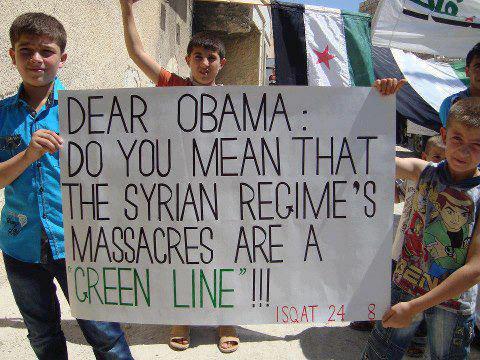
Obama on Syria : chemical weapons are a red line

Medical staff torture patients in Homs, Syria

Herak Syria

[youtube http://youtu.be/s3QyFgIRZ9Q?]

how many times have we seen these scenes? palestinians, lebanese, syrians…. fleeing herak village, dera’a province. the women report the men of the village being butchered. tank fire is heard intermittently

Syrian Novelist Nihad Sirees: ‘Creative Writing is Stalled Today’

Many thanks to Max Weiss for translating this excellent interview with novelist Nihad Sirees for Jadaliyya and for bringing it to my attention. It was originally published in Al-Safir as “Nihad Sirees: I am with fundamental change but I am afraid of revolutions.” In it, Sirees — who recently decided that he must leave Aleppo, Syria – agrees with Ahdaf Soueif about it not being a time for fiction:

Creative writing is stalled today. Not just for me, but for many other writers. The imagination withdraws to an interest in tangible reality. The superstars of writing today are those who write articles about “the events in Syria” or “the Syrian crisis” and, finally, “the Syrian revolution.” People have come to prefer reading posts on Facebook, the latest breaking news, or even a rumor to reading a story, even if its subject matter is the revolution. People are nervous about the country, about reality itself. They rush to read any article analyzing or interpreting what is going on. The best thing one can do is to be brief, and to cast some light on what is happening. I have written some stories and conducted a few interviews about the revolution, publishing some of them here in Egypt. When I posted one or two of them to Facebook, I noticed that this is not the time for imagination but for analytical and journalistic talk. Moreover, the matter concerns me personally and so my mind is now consumed by the latest news story and by trying to understand what is happening and by predicting what is going to happen much more than literary or artistic creation.

Sirees also talks about his novel, The Silence and the Roar (2004), which is being translated by Weiss and will isA come out from Pushkin Press in January of next year. He said:

The German translation.

It observes the phenomenon of authoritarianism. I diagnosed it and wondered about its origin. I purposefully made fun of the dictator in order to participate in tearing off his halo of veneration and then to topple him. Publishing that novel was an act surrounded with danger but I was not worried because that is my role as a writer. Some of those who read it knew how bold it was. In fact, a diplomat who knew Arabic well asked me whether the men of the regime even read literature in Syria! But I never sent it to Syrian publishing houses, which I was supposed to do first in order to get official permission, sending it straight away instead to Dar al-Adab (in Beirut), which published it without any hesitation.

The novel has attracted attention in a number of different countries and languages, and Sirees read an excerpt in German translation at a recent Swiss literary festival. However, when the Syrian official news reported on it:

The broadcast by the Syrian state news agency about my reading reported I had read selections from my novel, State of Passion, which is completely different in subject matter. That novel looks at a situation of female-female love in Aleppo. I think that the news agency, as usual, wanted to say that everything in Syria was fine and that our esteemed writers continue to be interested in matters of love.

Sirees also talks about the relationship between artist and regime, which is interesting to think about with any sort of regime or government, and any sort of artist:

Furthermore, the regime provided huge subsidies for art, especially television drama, and it became concerned with the interests of artists. So its representatives forged friendships with them. A large proportion of those who work in this sector are close to men of the regime and the security apparatus. Intellectuals in Aleppo are no different from their counterparts in Damascus but as a result of the shrinking cultural and artistic voice of the city, you do not hear their opinions clearly. I understand you are referring to one writer in particular who worked after March 2011 to implement the policies of the regime, a writer for whom the regime had done huge favors and now he had to return them. Generally speaking, this is how the regime functions.

Sirees in English:

A translation of Sirees’s حالة شـغف (here called A Case of Passion, here A State of Passion) both times by Khaled al-Jbaili.

Sirees’s twitter feed (@nihadsirees), often in English, mostly news links of late, as you might expect from above.

The Silence and the Roar:

The first three chapters of ”الصمت والصخب” on Sirees’s website.

source

Blog at WordPress.com.

Up ↑