Search

band annie's Weblog

I have a parallel blog in French at http://anniebannie.net

Month

July 2012

The Palestinian Minority in Israel : Systematic Discrimination

Siedlungsbau Palestinian workers wait for Israeli soldiers to open the gate of a separation barrier between the Jewish settlement of Modiin Elite and the west bank village of Harbeta to return home after the day's work in Israel, 15 March 2012 (photo: Oded Balilty/AP/dapd)

The Israeli government and its advocacy groups like to boast of the country’s supposed democratic, multicultural way of life. In reality, Palestinians in Israel experience systematic discrimination in such a way that calls into question the validity of the “Jewish and democratic” formulation. By Ben White

It has been received wisdom in the West for decades to see Israel as “the only democracy in the Middle East”. In recent times, however, Israeli policies have been subject to increased criticism, particularly in Europe – and specifically in terms of military action in the West Bank and Gaza Strip, the territories occupied since 1967.

Yet whether criticising “disproportionate” strikes or highlighting the radical Jewish settler movement, substantial Western disapproval of Israeli policies is restricted to the territory where it is assumed a Palestinian state will someday be created.

Ignored by this analysis are the 20 per cent of Israel’s citizens who are Palestinian, a minority increasingly targeted by Israel’s security-political establishment. Addressing this knowledge gap and examining the issues facing Palestinians in Israel since 1948 sheds light on the core of the conflict.

Confiscation and expulsion

With Israel’s establishment, around 85 percent of Palestinians inside the borders of the new state were expelled and became refugees; those who remained are now 1 in 5 of Israel’s citizenry (whose identity has been intentionally obscured with the “Israeli Arab” label).

photo: AP
“With Israel’s establishment, around 85 percent of Palestinians inside the borders of the new state were expelled and became refugees.” Pictured: Palestinian Ahmed Elaian, 86, shows the keys of his home in Israel, abandoned during the 1948 war, on Nakba Day The Israeli government and its advocacy groups like to boast of the country’s supposed democratic, multicultural way of life. In reality, Palestinians in Israel experience systematic discrimination in such a way that calls into question the validity of the “Jewish and democratic” formulation.

The amount of land belonging to Palestinian refugees that was expropriated by Israel’s ‘Absentee Property Law’ amounts to around 20 per cent of the country’s total pre-1967 territory. The body of refugees includes roughly one in four Palestinian citizens who, as “present absentees”, have also had their lands and property confiscated by the state.

Provoking mass evictions

These policies meant that by the mid-1970s, the average Palestinian community in Israel had lost between 65 and 75 per cent of their land. Since 1948, over 700 Jewish communities have been established in Israel (not including settlements in the West Bank and Gaza) – but only seven for Palestinian citizens (and those as a means of resettling the Bedouin population in the Negev desert).

While the Israeli government talks of “developing” the Negev, tens of thousands of Bedouin live in dozens of ‘unrecognised villages’. They suffer from home demolitions and a lack of basic infrastructure. A serious new threat is the Prawer plan, with planned mass evictions meaning up to 70,000 Arab citizens face forced relocation and the destruction of their villages.

Significant authority over areas like land ownership and rural settlement is invested in bodies that are constitutionally mandated to privilege Jews, while residency in 70 per cent of Israeli towns is controlled by admissions committees that filter out those deemed “unsuitable” for the “social fabric” of the community. These small communities, particularly in the Negev and Galilee, play a crucial role in maintaining Jewish spatial hegemony (many of whom also sit on the land of destroyed Palestinian villages).

Segregation policies

Discrimination is systematic. The Education Ministry spends more than five times as much on Jewish students as Palestinian students.

photo: AP
“The uncomfortable truth is that Israel is democratic for Jews, and Jewish for Palestinians.” A Palestinian youth watches demonstrators clash with Israeli troops as they mark the “Land Day” in east Jerusalem on 30 March 2012. At the annual “Land Day” rallies Israeli Arabs and Palestinians protest what they say are discriminatory Israeli land policies Public officials, including Members of Knesset and cabinet members, routinely and publicly express racism towards Palestinians with impunity. Shin Bet, the domestic intelligence agency/secret police, openly fights peaceful and legal efforts by Palestinian citizens to challenge the Jewish nature of the state.

The uncomfortable truth is that Israel is democratic for Jews, and Jewish for Palestinians, as evidenced by the racist priorities shaping immigration, land, planning, development budgets and more. To point to a handful of Arabs in the Knesset, football teams and on television is nothing better than shallow propaganda.

Denying rights on the basis of ethnicity

Laws and policies designed to benefit one group of people over another and enforce separation fit the description of apartheid under international law. This year, the UN Committee on the Elimination of Racial Discrimination (CERD) has slammed Israel, condemning “segregation” in both Israel’s pre-1967 borders, as well as in the Occupied West Bank.

No amount of diversions by Israel’s supporters can hide the grim, daily reality of occupation and colonialism. From the Jordan River to the Mediterranean Sea, a de facto one state has emerged, a regime which grants or denies rights and privileges on the basis of ethnicity.

This is not a democracy, and the sooner the tough questions are asked – and Israeli policies identified and resisted for what they are – the more likely it is that a post-colonial future can emerge where Palestinian rights are realised and both peoples share the land on an equal footing.

Ben White

© Qantara.de 2012

Ben White is a freelance journalist, writer and activist, specialising in Palestine/Israel. He has been visiting the region since 2003 and his articles have been widely published in the likes of The Guardian’s Comment is free, Al Jazeera, New Statesman, Salon, Christian Science Monitor, and others. His most recent book, ‘Palestinians in Israel: Segregation, Discrimination and Democracy’, was published by Pluto Press in January 2012, with a foreword by Member of Knesset Haneen Zoabi.

Editor: Lewis Gropp/Qantara.de

source

Nawar Qassem: Challenging the Discourse of Sectarianism in Syria

Posted by ⋅ July 1, 2012 ⋅ Leave a Comment

I am very honored to host this post by Budour Hassan, a Palestinian anarchist law student living in Palestine. She writes about Nawar Qassem, a Syrian activist who was detained on June 28th by the Assad regime. You can follow Budour on twitter @Budour48.

– – – –

Nawar Qassem: Challenging the Discourse of Sectarianism in Syria

It is an arduous task to write about someone you have never met or talked to, but it is even harder to explain how that complete stranger has invaded your thoughts and haunted your dreams.

Nawar Qassem, an incredibly courageous young man from Tartous, has turned into just another number on an endless list of nameless detainees in Syria. I first read about Nawar on Twitter upon his arrest – or abduction, to be precise – by Syrian regime forces from his parents’ house on Wednesday June 28th. Nawar had been shot in the thigh earlier this month and his injury requires a surgery outside Syria. Sounds like a tediously familiar story, doesn’t it?

As desperately as we try to deny it, most of us have normalized mass-killings in Syria. We have lost count of the number of martyred, injured, detained, disappeared and displaced Syrians since the start of the Syrian uprising. In today’s Syria, a day is considered relatively “quiet” if the death toll does not exceed 50.

In today’s Syria, the sudden, painless death by a sniper’s bullet is a luxury many Syrians dream of: before his arrest, citizen journalist Hassan al-Azhari from Latakia said that he preferred death over arrest. But even that was too much to ask. He was arrested and tortured to death.

In today’s Syria, the basic rights of paying farewell to your loved ones, mourning them in peace, and burying them properly are privileges that thousands of bereaved families have been deprived of.

In today’s Syria, having a name is a curse in life and death. Few dissidents afford to reveal their identity out of fear of persecution, arrest and torture. At times, even the dead must remain unnamed since the mere mention of their names may be too great a threat for their families and comrades.

In today’s Syria, martyrs have become numbers flashing across our TV screens and their stories remain untold. Think of the man who was killed a few days before his wedding. Think of the medical students who were shot dead a day before their graduation. Think of the little girl who fled the heavy shelling on Baba Amr only to be murdered along with her entire family in Deir Ezzour.

In today’s Syria, there are tens of thousands of detainees; most of them do not get Facebook pages calling for their release or trending campaigns raising awareness to their plight.

In today’s Syria, only one side bears the burden of proof. And no, it is not the side that has enslaved Syrian citizens for four decades. The oppressed in Syria have to protest, document the protest, get shot and shelled, treat the injured, live-stream the shelling while risking their lives in the process only for couch “anti-imperialists” to reject their reports blithely because they are anonymous peasants who do not have celebrity status or hundreds of thousands of Twitter followers like Tahrir Square’s superstars; because their reports are unsubstantiated; because some of the pictures posted in social media are outdated or unverified which must mean that the entire uprising is fake or exaggerated. It matters not that with so many massacres across Syria, we get virtually identical images of charred corpses and graphic injuries. It matters not that spreading unverified or false photos and news is not by any means exclusive to the Syrian uprising, but rather transpires everywhere including in Palestine; it matters not that the very people demanding utmost accuracy from Syrian protesters in the name of integrity unthinkingly quote sources sympathetic with the Syrian regime.

In today’s Syria, massacres and protests define towns and cities with the stench of death replacing the scent of jasmine.

Why, then, at a time when massacres and mass arrests became a routine, has Nawar Qassem’s story occupied my mind and touched me so profoundly? Perhaps because it challenges the paradigms and stereotypes that have come to characterize the Syrian uprising and dominate the discourse over Syria. Nawar is an Alawite. And it is painful that we are obliged to mention a person’s sect to show that the revolution is not a Sunni insurrection. Nawar is a Syrian Alawite who has been active in the revolution since its outbreak. Nawar has dedicated his time and energy to assist Homsi refugees, working in Tartous, a city that has been a stronghold for the regime. Nawar is a Syrian Alawite non-violent activist meaning that he faces a serious risk of torture and an extremely vengeful, wrathful punishment at the hands of his jailers.

It is precisely because Nawar Qassem does not fit the accepted narrative that you will not hear about him in the media. Writing about a guy from the “minorities”, who is one of many activists working behind the scenes, does not sell copies like the “Sunni market” story. Speaking about solidarity and unity in Syria is not as contentious as publishing Adnan Arour’s disgustingly sectarian statements. Covering the protests of Salamiyeh – a mixed town of Ismailis, Sunnis, and Shia Twelvers, all of whom have been protesting since the very beginning of the uprising as well as aiding the injured and the displaced – does not serve the narrative that “minorities” staunchly support the regime.

By no means am I trying to paint the Syrian uprising as a utopia or as a perfect uprising. It is not. The revolution has indeed been stained by sectarian sentiments and random violence at times. While it is the regime that is chiefly responsible for sowing sectarianism and driving revolutionaries into armed – and at times religious-motivated – resistance after months of largely peaceful protests, sweeping the flaws of Syrian society and the Syrian revolution under the rug is wrong. So, too, is condoning sectarianism and any crimes committed by the Free Syrian Army against civilians.

The Syrian uprising is our window into the Syrian society; after years of being accustomed to viewing the Syrian society through the eyes of the regime, we finally got the chance to see a different, unfiltered Syria with all its flaws, tensions, heroism and accomplishments. Despite the savagery of the Syrian regime and the insistence to portray the revolution as a civil war, acts of sheer courage, creative non-violent resistance and inspiring – albeit criminally under-covered – solidarity shine through amidst the incitement and hate-mongering.

Nawar Qassem was shot and arrested because he shakes the very foundation of a regime built on fear mongering and divide and rule tactics.

The Syrian regime proves again that the clever signs of Kafranbel, the cartoons of Ali Ferzat, the lens of Bassel Shehadeh’s camera and the roaring chant of “The Syrian people are one” pose a much greater threat to its existence than any armed battalion.

source

Shin Bet Arrests Israeli Druze at Syrian Border, Slaps Gag on Media Reporting

by , July 02, 2012

The Syrian news service, SANA, reported on June 29 that Israel’s Shin Bet security service arrested Dr. Eyad Jamil al-Jawhari, a resident of the Golan village of Majdal Shams. Jawhari is completing medical studies inside Syria and was returning home via the Golan border crossing when he was arrested. His family, who had been awaiting his arrival, was told he had been arrested. He is currently being held in the Shabak section of Kishon prison, where numerous Palestinian security detainees are interrogated.

The Shin Bet has secured a gag order on reporting about the incident, so no Israeli media outlet has reported the story. When and if they do, they will not be able to use the detainee’s name because of the gag. This Syrian media report notes that Jawhari has already appeared in the Nazareth court and that his detention has been extended. That means it’s likely he was arrested at least a few days ago.

This is a critical period and explains the Israeli gag. Opacity allows Israel to proceed with a minimum of public scrutiny. It is the time when the suspect likely is refused access to counsel, and when he’s likely to be tortured, as happened in the cases of Dirar Abusisi and Ameer Makhoul. These were both Palestinians arrested by the Shin Bet under gag, which I succeeded in breaking with the help of Israeli sources. That is why I’m publishing this report as urgently as I can. It’s critical that the news be reported widely outside Israel, as this may exert some pressure on the authorities not to mistreat Jawhari under cover of silence and darkness.

There could be two plausible reasons for his detention: given the civil war raging inside Syria, Israeli security forces are eager to obtain any intelligence they can about the situation. Therefore, someone returning from Syria would be a perfect source and worthy of detention and debriefing. The Shin Bet would first approach and ask him to collaborate. But if he refused, it’s plausible that Shin Bet would arrest him.

But given what we know of the incident at this point, I’d say it’s more likely that the security police determined that Jawhari had “nationalist sympathies” (an Israeli catchword for Palestinians who are too outspoken in their political views) and possibly had contact with individuals inside Syria who are verboten as far as Israel is concerned. Perhaps he met someone connected with Hamas or Hezbollah. A charge of contact with an “enemy organization” can bring very long prison sentences. Makhoul accepted a 9-year prison sentence for allegedly meeting a Hamas operative in Jordan at an environmental conference. The actual individual, Hassan JaJa, is a landscape designer in Amman, and the Shin Bet never proved he had any Hezbollah affiliation.

But the truth is that it wouldn’t even take that much for the Shin Bet to persecute you. All you have to do is be a prominent activist supporting the movement for civil rights for Israel’s Palestinian, Druze, or Bedouin minorities.

Israel’s Druze community is generally considered quite loyal to the state and so rarely suspected of such sympathies. But some communities in the Golan retain strong ties to Druze living on the other side of the Syrian border, which would make the security services suspect them of dual loyalty, or not having any loyalty at all (to Israel).

I’ve put out word to Israeli prisoners’ rights activists to try to determine which prison holds Jawhari. From there, we will be able to notify the human rights community of what has happened, and they can try to help make his case more public and transparent.

On a different subject, I reported here recently on the 2010 execution of East Jerusalem Palestinian, Ziad Jilani, by Israeli border police. When the Israeli court and police refused to prosecute those who murdered Jilani, his widow, Moira, appealed to the attorney general. Two days ago, he released a voluminous document rejecting her appeal and refusing to open a criminal investigation. The legal memo, though it didn’t go so far as to say the murder was justified, denied a credible case could be made for murder or any criminal act. It whitewashed the incident and rewarded impunity a legal victory.

source

We took their fingernails out with pliers and we made them eat them. We made them suck their own blood off the floor’: Grisly accounts from inside Syria’s ’27 torture centres’

  • Human Rights Watch report released as Syrian President Bashar Assad says he regrets the shooting down of a Turkish jet by his forces last month
  • Group says tens of thousands of people had been detained across Syria by intelligence agencies
  • Detainees are beaten with batons and cables, burned with acid, sexually assaulted, and their fingernails torn out, claims the report
  • ‘The reach and inhumanity of this network of torture centres are truly horrific,’ says Human Rights Watch researcher

By Anthony Bond

PUBLISHED: 09:14 GMT, 3 July 2012 | UPDATED: 17:46 GMT, 3 July 2012

Syrian intelligence agencies are running torture centres across the country where detainees are beaten with batons and cables, burned with acid, sexually assaulted, and their fingernails torn out, a report released today has said.

Human Rights Watch identified 27 detention centres that it says intelligence agencies have been using since President Bashar al-Assad’s government began a crackdown in March 2011 on pro-democracy protesters trying to oust him.

The New York-based rights group found that tens of thousands of people had been detained across Syria. It conducted more than 200 interviews with people who said they were tortured.

Scroll down for video

Torture: With Dulab the victim is forced to bend at the waist and stick his head, neck, legs and sometimes arms into the inside of a car tireTorture: This graphic shows one of the methods used by Syrian intelligence agencies to torture detainees. With Dulab the victim is forced to bend at the waist and stick his head, neck, legs and sometimes arms into the inside of a car tire
Awful: Some of those being held in the torture centres would be beaten with objects including cables, whips, sticks, batons and pipesAwful: Some of those being held in the torture centres would be beaten with objects including cables, whips, sticks, batons and pipes
Painful: Shabeh is another torture method which was used on detainees. It involved hanging the victim from the ceiling by the wristsPainful: Shabeh is another torture method which was used on detainees. It involved hanging the victim from the ceiling by the wrists

This included a 31-year-old man who was detained in the Idlib area in June and made to undress.

He told the group: ‘They started squeezing my fingers with pliers. They put staples in my fingers, chest and ears. I was only allowed to take them out if I spoke. The staples in the ears were the most painful.’

‘They used two wires hooked up to a car battery to give me electric shocks. They used electric stun-guns on my genitals twice. I thought I would never see my family again. They tortured me like this three times over three days,’ he said.

The report was released as it emerged Syrian President Bashar Assad claims he regrets the shooting down of a Turkish jet by his forces last month.

Inhumane: This map shows the various locations are descriptions by some of those who claimed they were tortured by Syrian intelligence agenciesInhumane: This map shows the various locations and descriptions by some of those who claimed they were tortured by Syrian intelligence agencies

Turkish newspaper The Cumhuriyet quoted Mr Assad as saying: ‘I say 100%, I wish we did not shoot it down.’

The Human Rights Watch report found that tens of thousands of people had been detained by the Department of Military Intelligence, the Political Security Directorate, the General Intelligence Directorate, and the Air Force Intelligence Directorate.

The reports documented by the group match those of a former Syrian intelligence officer who told how he was routinely ordered to torture prisoners.

Speaking to CNN, the former officer, who later fled to Turkey with his family, said: ‘Whatever we wanted the prisoner to say, he would say.  We took their fingernails out with pliers and we made them eat them. We made them suck their own blood off the floor.’

Unbearable: Basat al-reeh involves tying the victim down to a flat board with the head suspended in the air so the victim cannot defend himselfUnbearable: Basat al-reeh involves tying the victim down to a flat board with the head suspended in the air so the victim cannot defend himself
Abuse: Electrocution was also used on those being held in the 27 torture centresAbuse: Electrocution was also used on those being held in the 27 torture centres
Harsh: Falaqa involves beating the detainee with sticks, batons, or whips on the soles of the feetHarsh: Falaqa involves beating the detainee with sticks, batons, or whips on the soles of the feet
Horrific: Human Rights Watch has identified 27 detention centres that it says intelligence agencies have been using since President Bashar al-Assad's government began a crackdown on pro-democracy protestersHorrific: Human Rights Watch has identified 27 detention centres that it says intelligence agencies have been using since President Bashar al-Assad’s government began a crackdown on pro-democracy protesters

Human Rights Watch documented more than 20 torture methods that ‘clearly point to a state policy of torture and ill-treatment and therefore constitute a crime against humanity.’

The group called for the U.N. Security Council to refer the issue of Syria to the International Criminal Court (ICC) and to adopt targeted sanctions against officials carrying out abuse.

‘The reach and inhumanity of this network of torture centers are truly horrific,’ Ole Solvang, emergencies researcher at Human Rights Watch said.

‘Russia should not be holding its protective hand over the people who are responsible for this.’

Russia – an ally of Syria – and China have already vetoed two council resolutions that condemned Damascus and threatened it with sanctions and French U.N. Ambassador Gerard Araud told reporters yesterday that reaching a Security Council consensus to refer Syria to the ICC would be difficult.

‘As France is concerned it’s very clear we are very much in favor of referring Syria to the ICC,’ Mr Araud said.

‘The problem is it will have to be part … of a global understanding of the council and I do think that for the moment we have not yet reached this point,’ he said.

Blockade: A wall of of tyres burns in a street in Damascus' al-Midan neighbourhoodBlockade: A wall of of tyres burns in a street in Damascus’ al-Midan neighbourhood
Upsetting: This image released by the Syrian opposition's Shaam News Network today shows the mass burial of people allegedly killed by Syrian government forces in DoumaUpsetting: This image released by the Syrian opposition’s Shaam News Network today shows the mass burial of people allegedly killed by Syrian government forces in Douma
Protest: An anti-regime demonstration takes place in the Syrian town of Kfar Sousa yesterdayProtest: An anti-regime demonstration takes place in the Syrian town of Kfar Sousa yesterdayU.N. human rights chief Navi Pillay yesterday reiterated her position that the issue of Syria’s conflict should be referred to the ICC in The Hague because crimes against humanity and other war crimes may have been committed.She said both sides appear to have committed war crimes.The United Nations has said more than 10,000 people have been killed during the 16-month Syria conflict.

Troubled: Destruction in the restive central city of Homs can be seen. It was confirmed that at least 78 people were killed in violence across Syria on SundayTroubled: Destruction in the restive central city of Homs can be seen. It was confirmed that at least 78 people were killed in violence across Syria on Sunday
Destruction: A damaged building in the town of Duma. The Syrian army kept up its bombardment of rebel neighbourhoodsDestruction: A damaged building in the town of Duma. The Syrian army kept up its bombardment of rebel neighbourhoods
Devastation: Residential homes which have been completely destroyed are pictured yesterday in the town of DumaDevastation: Residential homes which have been completely destroyed are pictured yesterday in the town of Duma
Grim: The nightmare in Syria continued at the weekend when protesters claimed they were attacked by government forces during a funeral in Deraa on Saturday. The body of a young girl is held by local residentsGrim: The nightmare in Syria continued at the weekend when protesters claimed they were attacked by government forces during a funeral in Deraa on Saturday. The body of a young girl is held by local residents

PRESIDENT ASSAD CLAIMS HE REGRETS SHOOTING DOWN TURKISH JET

Syrian President Bashar Assad regrets the shooting down of a Turkish jet by his forces, a Turkish newspaper said today.

The Cumhuriyet newspaper published the remarks from an exclusive interview with Mr Assad in the Syrian capital, Damascus, on Sunday.

The paper quoted Mr Assad as saying: ‘I say 100%, I wish we did not shoot it down.’

Apologetic: Syrian President Bashar Assad has claimed he regrets the shooting down of a Turkish jet by his forces. An F4 Phantom jet similar to the one pictured was shot down on June 22Apologetic: Syrian President Bashar Assad has claimed he regrets the shooting down of a Turkish jet by his forces. An F4 Phantom jet similar to the one pictured was shot down on June 22

Turkey says Syrian forces downed its jet in international airspace after it briefly strayed into Syrian airspace on June 22.

Mr Assad insists the plane was inside Syrian airspace and flying in a corridor that had been used by Israeli planes three times in the past.

Turkey responded by deploying anti-aircraft missiles on the Syrian border, and has scrambled its jets several times after it said its border was approached by Syrian helicopters.

VIDEO: Warning graphic content. Detainees talk about their horrific ordeals…

The truth of Syrian opposition is lost in the media’s narrative of hate

July 3, 2012

As conspiracy theorists of the left and right muddy the waters with lies and half-truths, as they continue their exclusive focus on the peripheral and utter disregard for the actual, the voices of the Syrians themselves are drowned out. Jadaliyya deserves credit for giving space to these voices and shedding light on the human dimension of the conflict. Amal Hanano is the most compelling of these voices. Here’s from ‘One Year of Hope‘. (I’m borrowing the above title from my good friend Phil Weiss).

The enemy was not one man or even his regime. As questionable motives emerged regionally and internationally, it became very clear that there were no real friends of Syria. As we fought each other, we fought a world that insisted on telling us who we were. Suddenly, everyone was an expert on Syria. Opportunistic pundits sucked the Syrian narrative like leeches, dispensing complex conspiracies, warning of the regional and global political interests at stake while belittling the people’s struggle. Opportunism seeped into the Syrian opposition as well: they splintered into rivaling groups, each betraying the other to prove itself worthy of the Syrian street’s loyalty but in the end, their divisiveness rendered the groups unworthy and incapable of defending those blood-soaked streets. The truth of Syria was lost somewhere in the middle of an axis between east and west, right and left, Sunnis and minorities, along fault lines we had never asked to define us, but they did.

There were other Syrian stories hidden from the stark black-and-white sectarianism and sweeping generalizations repeated over and over in the media — not just of Christian and Alawite revolutionaries, not just of the silent betrayal of Sunni business men in Damascus and Aleppo. Stories from Baba Amr of opposition families who delivered pots of home-cooked meals to sympathetic soldiers at checkpoints and received the pots later, filled with bullets. Or stories of guards who promised prisoners that they would not follow their orders of torture. Or stories of Alawite youth driving through regime checkpoints with bottles of alcohol on the dashboard as decoys only to unload trunks filled with medical supplies to field clinics. These slices of daily interactions between the Syrian people never made it into the “news.” They didn’t fit the narrative of hate we were supposed to follow.

[…]

What I learned hardened and softened me. There were things I will never recover from, like knowing that certain words I had told citizen journalist Rami al-Sayed were the same words he asked never to hear again in the final message he wrote hours before he was killed in Homs. Things I will never forget, like the emails I used to receive from the irreplaceable voice of truth that was silenced forever. Things that I will never get used to, like the sounds of weeping men I have never met, who told me, Amal, I miss my brother, my friend, my father. I learned how to talk about death without cringing and how to say goodbye without crying, how to soothe an activist as he mourned his dead friends while in my heart I was selfishly relieved that death had not claimed him. Not this time.

I began with Hope. But the definition of hope itself had become narrower and smaller. Hope in Syria had become relative. Hope, was that the number of dead today would be smaller than yesterday’s. Hope, was that the knife’s blade was so sharp that the child felt only fear but not pain when it sliced her neck open. Hope, was that a falling mortar ripped apart only stone but spared human flesh. Hope was that the young men whose charred bodies haunted me in my sleep were already dead from torture before they were set aflame.

And as March 15, 2012 rolled by, it seemed every few days brought yet another anniversary, death days instead of birthdays. We relived what had happened one year before as the day brought its fresh casualties — names we would carefully record to celebrate next year. The revolution is now caught between past and present — its recorded memory is written, photographed, and videotaped as if we now fear forgetting as much as we used to fear speaking.

And we knit, together, Syria’s bloody destiny, every murder intertwined with injustice, every revenge a setback, every chant a victory. Our revolution began in a moment of indignity and humiliation too great to bear, like Dickens’ French peasant child crushed under the wheels of nobility. But it also revealed what we had concealed as a people for decades. Our ultimate fear was not the fear of the unknown, or even the fear of tyranny. It was the fear of exposing what we had tried to hide, the universal truth that everyone tries to hide, but this time in history, it was Syria’s lot to rip itself apart and have its secrets revealed to a silently observing, judgmental world: that the best and the worst, wisdom and foolishness, belief and incredulity, light and darkness, the spring of hope and the winter of despair, exist together. Within us all.

Anthony Shadid knew this very well. He knew it is impossible to mend what was left of our country until we found a way to become greater than the sum of our battling contradictions. He knew we had nothing left but our limitless imaginations that were still in chains though we struggled to break free. Our Syria hovers between heaven and earth, oscillates between dreams and nightmares, it moves from revolution to war, from a once promising spring to yet another cruel summer, but despite it all, we hope.

Source

Tests hint at possible Arafat poisoning

Nine-month investigation by Al Jazeera discovers rare, radioactive polonium on ex-Palestinian leader’s final belongings.
Last Modified: 03 Jul 2012 15:54

It was a scene that riveted the world for weeks: The ailing Yasser Arafat, first besieged by Israeli tanks in his Ramallah compound, then shuttled to Paris, where he spent his final days undergoing a barrage of medical tests in a French military hospital.

Eight years after his death, it remains a mystery exactly what killed the longtime Palestinian leader. Tests conducted in Paris found no obvious traces of poison in Arafat’s system. Rumors abound about what might have killed him – cancer, cirrhosis of the liver, even allegations that he was infected with HIV.

A nine-month investigation by Al Jazeera has revealed that none of those rumors were true: Arafat was in good health until he suddenly fell ill on October 12, 2004.

More importantly, tests reveal that Arafat’s final personal belongings – his clothes, his toothbrush, even his iconic kaffiyeh – contained abnormal levels of polonium, a rare, highly radioactive element. Those personal effects, which were analyzed at the Institut de Radiophysique in Lausanne, Switzerland, were variously stained with Arafat’s blood, sweat, saliva and urine. The tests carried out on those samples suggested that there was a high level of polonium inside his body when he died.

“I can confirm to you that we measured an unexplained, elevated amount of unsupported polonium-210 in the belongings of Mr. Arafat that contained stains of biological fluids,” said Dr. Francois Bochud, the director of the institute.

Unsupported polonium

The institute studied Arafat’s personal effects, which his widow provided to Al Jazeera, the first time they had been examined by a laboratory. Doctors did not find any traces of common heavy metals or conventional poisons, so they turned their attention to more obscure elements, including polonium.

About the institute

The study of Arafat’s medical file and belongings was carried out at the University Hospital Centre in Lausanne, Switzerland.

The university’s Centre of Legal Medicine is considered one of the best forensic pathology labs in the world.

It has studied evidence for the United Nations in East Timor and the International Criminal Court in the former Yugoslavia, and it investigated the death of Princess Diana, among other well-known personalities.

It is a highly radioactive element used, among other things, to power spacecraft. Marie Curie discovered it in 1898, and her daughter Irene was among the first people it killed: She died of leukemia several years after an accidental polonium exposure in her laboratory.

At least two people connected with Israel’s nuclear program also reportedly died after exposure to the element, according to the limited literature on the subject.

But polonium’s most famous victim was Alexander Litvinenko, the Russian spy-turned-dissident who died in London in 2006 after a lingering illness. A British inquiry found that he was poisoned with polonium slipped into his tea at a sushi restaurant.

There is little scientific consensus about the symptoms of polonium poisoning, mostly because there are so few recorded cases. Litvinenko suffered severe diarrhea, weight loss, and vomiting, all of which were symptoms Arafat exhibited in the days and weeks after he initially fell ill.

Animal studies have found similar symptoms, which lingered for weeks – depending on the dosage – until the subject died. “The primary radiation target… is the gastrointestinal tract,” said an American study conducted in 1991, “activating the ‘vomiting centre’ in the brainstem.”

Scientists in Lausanne found elevated levels of the element on Arafat’s belongings – in some cases, they were ten times higher than those on control subjects, random samples which were tested for comparison.

The lab’s results were reported in millibecquerels (mBq), a scientific unit used to measure radioactivity.

Polonium is present in the atmosphere, but the natural levels that accumulate on surfaces barely register, and the element disappears quickly. Polonium-210, the isotope found on Arafat’s belongings, has a half-life of 138 days, meaning that half of the substance decays roughly every four-and-a-half months. “Even in case of a poisoning similar to the Litvinenko case, only traces of the order of a few [millibecquerels] were expected to be found in [the] year 2012,” the institute noted in its report to Al Jazeera.

But Arafat’s personal effects, particularly those with bodily fluids on them, registered much higher levels of the element. His toothbrushes had polonium levels of 54mBq; the urine stain on his underwear, 180mBq. (Another man’s pair of underwear, used as a control, measured just 6.7mBq.)

Further tests, conducted over a three-month period from March until June, concluded that most of that polonium – between 60 and 80 per cent, depending on the sample – was “unsupported,” meaning that it did not come from natural sources.

Syria Spirals down

Posted on 07/03/2012 by Juan Cole

The news out of Syria is bad and worse. The regime is being accused of widespread torture, and it is having to fight the rebels on the doorstep of the capital.

Human Rights Watch has mapped out the torture centers used by the Syrian government and identified the various techniques used on dissidents by the secret police. SMH has a good summary. Human Rights Watch says that the evidence is strong that the Syrian state is systematically practicing torture on a significant scale, and points out that this policy is a crime against humanity.

The Syrian military deployed helicopter gunships against Douma on Monday, a town on the outskirts of the capital, Damascus. Syrian troops had already stormed the town and there were bodies in the street, so the helicopters were involved in a mop-up operation.

In a one-day record, some 85 Syrian military personnel escaped to Turkey Monday, along with 300 family members. Six were officers, and one was a brigadier general (a one-star in American terms, i.e. not very high ranking).

Also on Monday, a television anchor for the regime news channel defected, and revealed that he had been for some time providing the opposition with the raw news stories

source

Syria | Douma 29 June12 Aftermath of the Massacre in Al-Hamdan Hospital

[youtube http://youtu.be/P9cvUV7UQnw?]

Syria: Torture Centers Revealed

For 27 Detention Sites: Locations, Commanders’ Names, Torture Methods
JULY 3, 2012
RELATED MATERIALS:

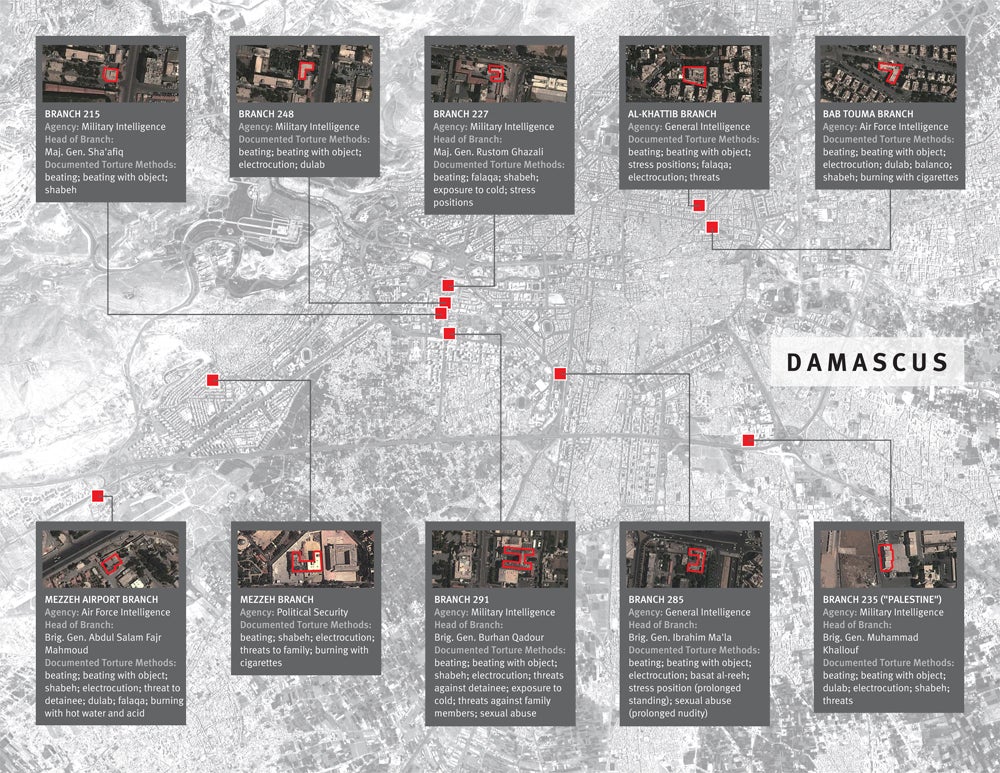
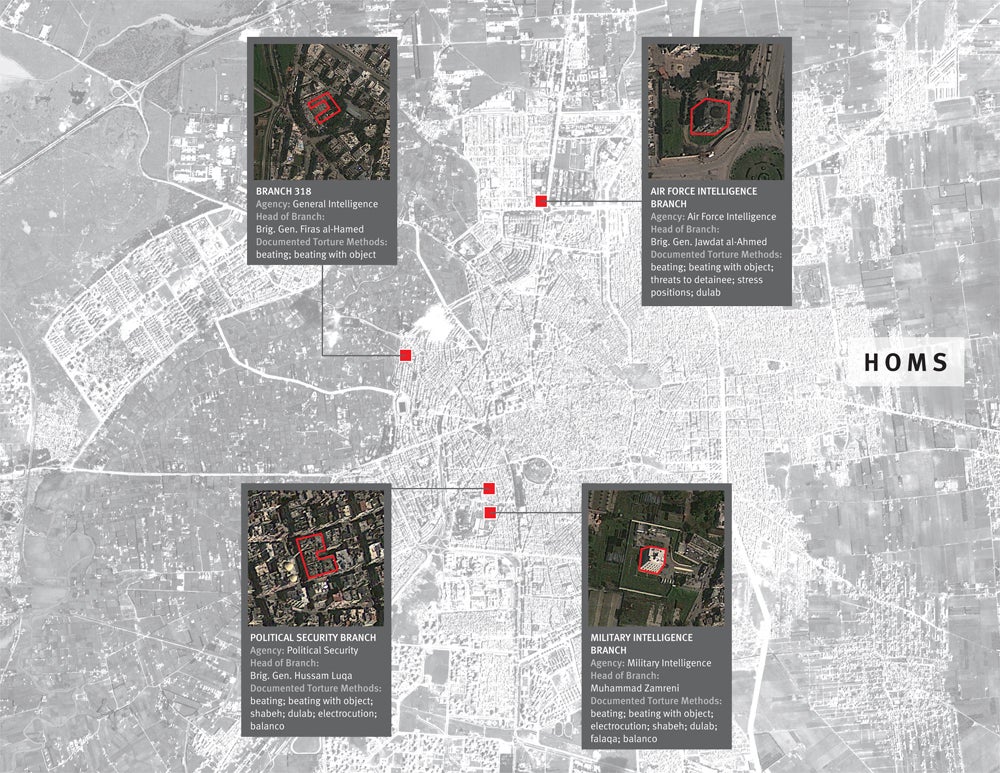
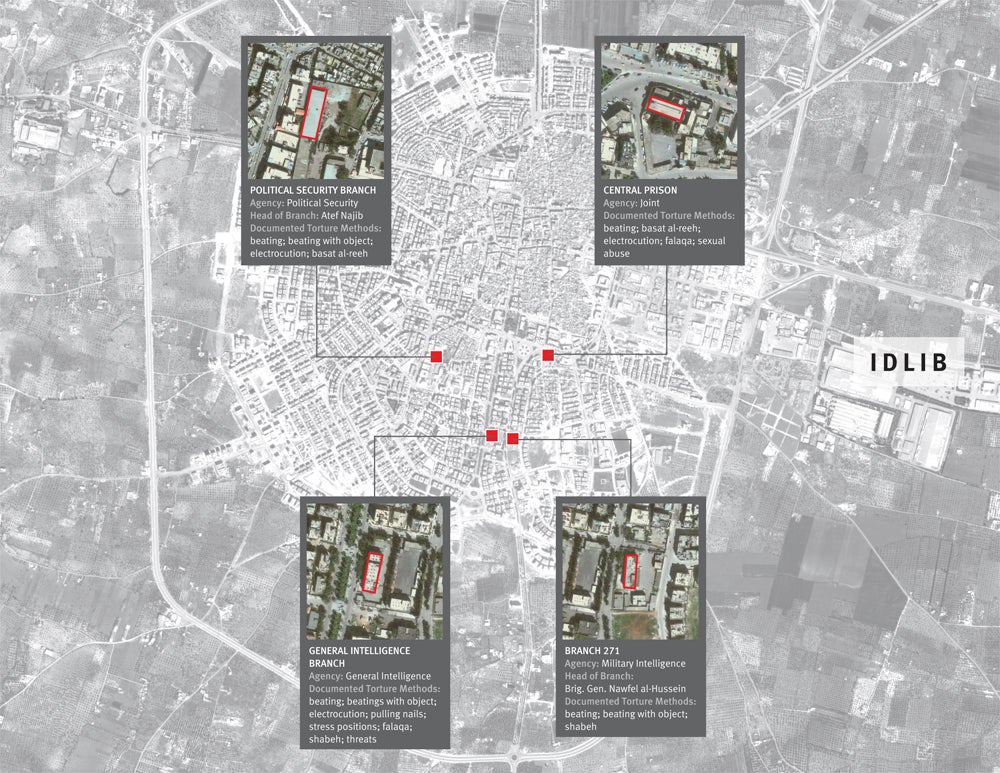
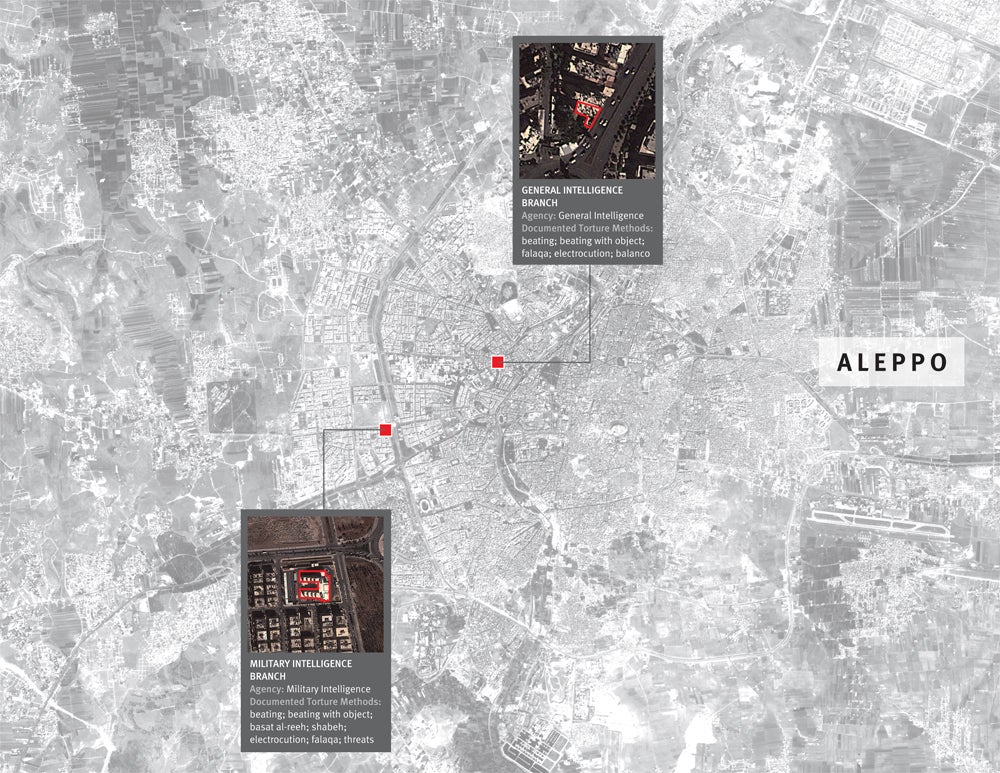
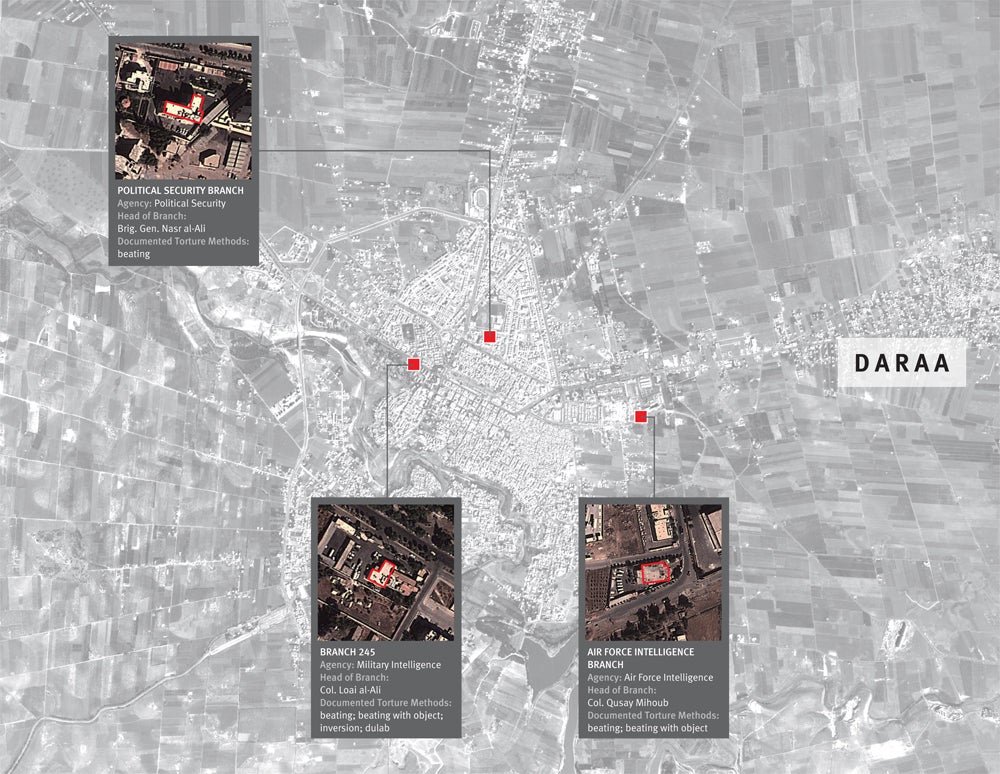
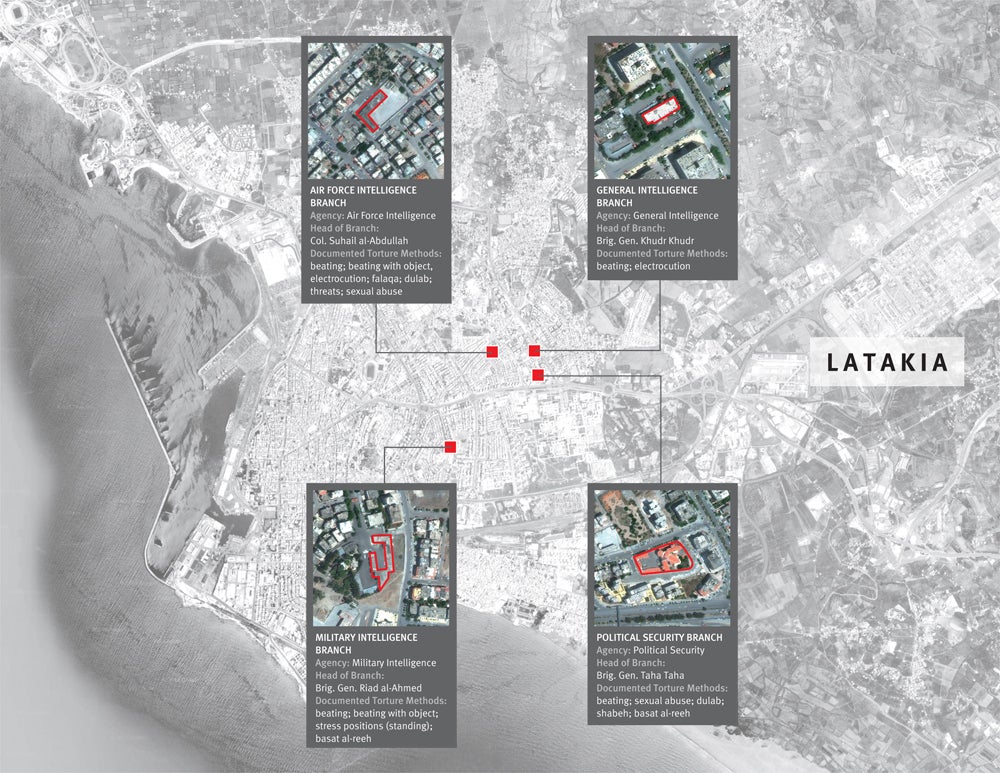
(New York) – Former detainees and defectors have identified the locations, agencies responsible, torture methods used, and, in many cases, the commanders in charge of 27 detention facilities run by Syrian intelligence agencies, Human Rights Watch said in a multimedia report released today. The systematic patterns of ill-treatment and torture that Human Rights Watch documented clearly point to a state policy of torture and ill-treatment and therefore constitute a crime against humanity.

Interactive Map – Click to Launch
(Embed this map on your blog)

The 81-page report, “Torture Archipelago: Arbitrary Arrests, Torture and Enforced Disappearances in Syria’s Underground Prisons since March 2011” is based on more than 200 interviews conducted by Human Rights Watch since the beginning of anti-government demonstrations in Syria in March 2011. The report includes maps locating the detention facilities, video accounts from former detainees, andsketches of torture techniques described by numerous people who witnessed or experienced torture in these facilities.

“The intelligence agencies are running an archipelago of torture centers scattered across the country,” said Ole Solvang, emergencies researcher at Human Rights Watch. “By publishing their locations, describing the torture methods, and identifying those in charge we are putting those responsible on notice that they will have to answer for these horrific crimes.”

Click to view in-depth, satellite images of the torture centers in the following cities: Damascus,HomsIdlibAleppoDaraa, and Latakia.

[youtube http://youtu.be/5lr-dcHOtzo?]

Human Rights Watch called on the United Nations Security Council to refer the situation in Syria to the International Criminal Court (ICC) and to adopt targeted sanctions against officials credibly implicated in the abuses.

The facilities cited in the report are those for which multiple witnesses have indicated the same location and provided detailed descriptions of torture. The actual number of detention facilities used by intelligence agencies is probably much higher.

Almost all the former detainees interviewed by Human Rights Watch said they had been subjected to torture or witnessed the torture of others during their detention. Interrogators, guards, and officers used a broad range of torture methods, including prolonged beatings, often with objects such as batons and cables, holding the detainees in painful stress positions for prolonged periods of time, the use of electricity, burning with acid, sexual assault and humiliation, the pulling of fingernails, and mock execution. Altogether Human Rights Watch documented more than 20 distinct torture methods used by the security and intelligence services.

In most cases former detainees were subjected to a range of these torture methods. A 31-year-old detainee who was detained in Idlib governorate in June described to Human Rights Watch how the intelligence agencies tortured him in the Idlib Central Prison:

They forced me to undress. Then they started squeezing my fingers with pliers. They put staples in my fingers, chest and ears. I was only allowed to take them out if I spoke. The staples in the ears were the most painful. They used two wires hooked up to a car battery to give me electric shocks. They used electric stun-guns on my genitals twice. I thought I would never see my family again. They tortured me like this three times over three days.

While most of the torture victims interviewed by Human Rights Watch were young men between 18 and 35, the victims interviewed also included children, women, and the elderly.

Human Rights Watch research shows that the worst torture has taken place in detention facilities run by the country’s four main intelligence agencies, commonly referred to collectively as the mukhabarat:

  • The Department of Military Intelligence (Shu`bat al-Mukhabarat al-`Askariyya);
  • The Political Security Directorate (Idarat al-Amn al-Siyasi);
  • The General Intelligence Directorate (Idarat al-Mukhabarat al-`Amma); and
  • The Air Force Intelligence Directorate (Idarat al-Mukhabarat al-Jawiyya).

Each of these four agencies maintains central branches in Damascus as well as regional, city, and local branches across the country. In virtually all of these branches there are detention facilities of varying size.

All of the witnesses interviewed by Human Rights Watch described detention conditions that would by themselves amount to ill-treatment and, in some cases, torture – extreme overcrowding, inadequate food, and routine denial of necessary medical assistance. A graphic model depicting an overcrowded cell described by one former detainee illustrates how the conditions fall short of international legal standards.


Diagrams produced by SITU Studio and Forensic Architecture, an ERC-funded project.

The individuals who carried out or ordered crimes against humanity bear individual criminal responsibility under international law, as do those in a position of command whose subordinates committed  crimes that they were aware of or should have been aware of and failed to prevent or punish. This command responsibility would apply not only to the officials overseeing detention facilities, but also to the heads of intelligence agencies, members of government, and the head of state, President Bashar al-Assad.

Because Syria has not ratified the Rome Statute, which created the ICC, the court will only have jurisdiction if the UN Security Council adopts a resolution referring the situation in Syria to the court. Russia and China have previously blocked Security Council efforts to push for accountability.

“The reach and inhumanity of this network of torture centers are truly horrific,” Solvang said. “Russia should not be holding its protective hand over the people who are responsible for this.”

A table with the detention facilities where torture was documented, along with their respective locations, operating agencies, and commanders follows.

Agency Name of Branch City Head of Branch
Military Intelligence Branch 215 Damascus Brig. Gen. Sha’afiq
Military Intelligence Branch 227 Damascus Maj. Gen. RustomGhazali
Military Intelligence Branch 291 Damascus Brig. Gen. BurhanQadour (Replaced Brig. Gen. Yousef Abdou in May 2012)
Military Intelligence Branch 235 (“Palestine”) Damascus Brig. Gen. Muhammad Khallouf
Military Intelligence Branch 248 Damascus Not identified
Military Intelligence Branch 245 Daraa Col. Loaial-Ali
Military Intelligence Aleppo Branch Aleppo Not identified
Military Intelligence Branch 271 Idlib Brig. Gen. Nawfel al-Hussein
Military Intelligence Homs Branch Homs Muhammad Zamreni
Military Intelligence Latakia Branch Latakia Not identified
Air Force Intelligence Mezzeh Airport Branch Damascus Brig. Gen. Abdul Salam Fajr Mahmoud (director of investigative branch)
Air Force Intelligence Bab Touma Branch Damascus Not identified
Air Force Intelligence Homs Branch Homs Brig. Gen. Jawdat al-Ahmed
Air Force Intelligence Daraa branch Daraa Col. QusayMihoub
Air Force Intelligence Latakia Branch Latakia Col. Suhail Al-Abdullah
Political Security Mezzeh Branch Damascus Not identified
Political Security Idlib Branch Idlib Not identified
Political Security Homs Branch Homs Not identified
Political Security Latakia Branch Latakia Not identified
Political Security Daraa Branch Daraa Not identified
General Intelligence Latakia Branch Latakia Brig. Gen. KhudrKhudr
General Intelligence Branch 285 Damascus Brig. Gen. Ibrahim Ma’ala (Replaced Brig. Gen. HussamFendi in late 2011)
General Intelligence Al-Khattib Branch Damascus Not identified
General Intelligence Aleppo Branch Aleppo Not identified
General Intelligence Branch 318 Homs Brig. Gen. Firas Al-Hamed
General Intelligence Idlib Branch Idlib Not identified
Joint Central Prison – Idlib Idlib Not identified

Blog at WordPress.com.

Up ↑