Search

band annie's Weblog

I have a parallel blog in French at http://anniebannie.net

Month

June 2012

Rape in Syria – Al Jazeera Report

[youtube http://youtu.be/sL5qXvFR8sM?]

Trailer “5 Broken Cameras”

[vimeo vimeo.com/15843191]

Struggling to Fill No. 2 Post, Al-Qaeda Resorts to LinkedIn

                                 June 7, 2012

Desperate Times for Terror Group’s HR Dept.

KARACHI (The Borowitz Report) – President Barack Obama has created one job that is proving difficult to fill: the No. 2 post at al-Qaeda.

That’s what they’re saying at the global terror group, whose Human Resources department has recently turned to the social networking site LinkedIn in hopes of filling the slot.

“It used to be that madmen would just walk through the door hoping for a crack at seventy-two virgins,” says Hassad el-Medfaii, director of HR for al-Qaeda.  “Now we have to go looking for these guys, and they all want dental.”

Complicating the terror group’s recruitment efforts for the tricky-to-fill No. 2 position: the recent publicity about President Obama’s so-called “kill list,” which the HR director calls “a big turn-off for a lot of applicants.”

“I’ve had to sit down with them and tell them that the kill list has been totally overblown,” he says.  “No one’s talking about the list of all the people they’ve missed.  It’s way longer.”

Mr. el-Medfaii says that he has spent a lot of time on LinkedIn over the last week “trying to spread the good news about working for al-Qaeda.”

“This is a great job for anyone who likes to travel, especially back and forth between Pakistan and Afghanistan,” he says.  “Plus – and I’m really trying to get the word out about this – we have one of the biggest caches of porn in the world.”

While he says that he has found some “promising candidates” on LinkedIn for the No. 2 position at al-Qaeda, he and his staff are taking extra care in vetting resumes.

“We don’t want to find ourselves in the same kind of mess Yahoo is in,” he says.  Get a free subscription to the Borowitz Report here.

Syria: Mining the Web to Target Activists

June 7, 2012 By

ap_syria_internet_700_07jun12As the situation and armed conflicts in Syria enter a new period of uncertainty and militarization, it increasingly appears the same may well be said about Syria’s Internet.Of course, it’s old news to say that Damascus restricts citizens’ access to the web for its own purposes, deploying filters, blocks, malware and other dirty tricks to impede those critical of the regime. But recently, VOA has begun to get word that something new, and possibly much more grave, may be going on in that nation.While reliable information is difficult to get into or out of Syria, our efforts to learn what’s actually happening there suggest that the regime of Bashar al-Assad is moving to militarize the web, aggressively working to use it as a surveillance tool to target, and punish, opponents of the government.
“As of right now, things are very fluid,” is how one Syrian activist sums up the situation for us.

Fluid…and dangerous.

A military treasure trove

AssadSpying 300x212 Syria: Mining the Web to Target Activists

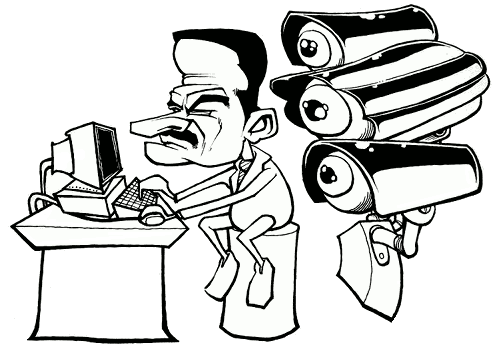
Cartoon image of President Assad spying online (courtesy Free Syrian Computer Society)

“We’ve been receiving distressing reports about what’s happening with the Internet in Syria for about a year now,” says Eva Galperin. “But the reports are getting more and more distressing.”

Galperin is International Freedom of Expression Coordinator at the online free-speech group the Electronic Frontier Foundation, or EFF. For years she and her organization have tracked attempts by repressive regimes to restrict or even cut off people’s access to the digital environment of computers, mobile phones and the Internet. These days, Syria is a subject of constant concern.

Just this week, the EFF reported a new computer bug, apparently deployed by the government, that can turn activist’s computers into weapons for spying. Here’s how it works: a Skype message containing a document is sent to friend’s Skype accounts. The message says it’s a plan to help other activists in the city of Aleppo, the scene of growing turmoil, but it’s actually a “trojan” – a bug that installs itself silently on the target’s computer. Says Galperin, “once inside, it takes control of your computer and logs all of your keystrokes, passwords and screenshots, and sends that information back” to whoever controls it.

The fact that it sends data back to only one IP address tells Galperin that it’s likely a government trick, all to gather information on its citizens.

And for Internet activist Martin Löwdin, that’s an important clue for what the government is up to. “A semi-open monitored Internet is a treasure trove for the security services and military when trying to track and quash dissent,” he tells us.

Löwdin is a member of the group Telecomix, a hacker collective similar in some regards to its more famous cousin Anonymous, but very different in terms of mission. Unlike Anonymous hacks, which can often veer into the personal or juvenile, Telecomix members focus on concrete solutions to keep the web as open and free as possible, especially recently in the “Arab Spring” nations. Back in 2011, when Egyptian officials temporarily erased that nation from the web, it was Telecomix that got the first Internet access routes open for Egyptian activists.

As worrisome as the recent trojans are for Löwdin, his larger worry is the level of Internet monitoring the government is likely conducting.

“To date two or three trojans have been identified, but they don’t seem to be the main problem for Syrians trying to use the Internet. Rather, access to Facebook, Twitter and YouTube being blocked — as well as several filtering and disrupting systems put to heavy use — are the main problems for Syrian Internet users. It is also expected, if unconfirmed, that the traffic that does get through the filters is monitored.”

Syria is known to have very sophisticated systems of web monitoring in place. One of those is a state-of-the-art system from the U.S.-based firm Bluecoat Technologies that allows for very robust filtering of specific content, not just the blunt hammer of totally blocking a site like Facebook. More recently, Damascus was well on its way to installing a system from the Italian firm Area SpA that would have given the government the ability to scan the content of SSL or other encrypted messages. Under pressure, that firm later withdrew from finishing the installation.

The advantage of keeping the web running

SyrianTraceroute 300x257 Syria: Mining the Web to Target Activists

Traceroute from computer inside Syria strongly suggesting government web filtering

The Assad government has a documented history of using information obtained electronically to target and punish critics. Just one example: in the fall of 2011, British journalist Sean McAllister was working with web activists to document what was happening on the ground in Syria. But McAllister was sloppy with his electronic fingerprints – he says he didn’t realize the depth of surveillance efforts there – and he was taken into custody. Some of those McAllister was working with, and whose information was in his devices, have since disappeared; the rest fled.

So just imagine what Assad’s police forces could do with the equivalent of 100, or 1,000, Sean McAllisters.

While the situation may change at any time, it appears at present the government is not slowing access to the web in general or slowing its speed, says Doug Madory, an analyst at the “Internet intelligence” firm Renesys. Last year, when Syria temporarily brought the web to a crawl, it was Renesys that provided the independent verification of what they were doing. “We keep a pretty close eye on Syria,” he says, “and while we have other concerns, at this point it doesn’t look like they’re trying to shut the web down.”

And why would they, asks Martin Löwdin, if those in power believed that the information they could suck from the web outweighed the risks of letting activists communicate and organize online? “They haven’t gone for the ‘Mubarak Kill Switch‘,” he says, adding:

“There have been indications that STE, the Syrian national internet provider, has taken over much of the filtering — this is indicated by the fact that updates to the block lists seemed to come into effect for every ISP at once, rather than the staggered deployment seen earlier (when lists of sites to block were transmitted by fax to each ISP.)”

What Syrians can do

telecomix Syria Syria: Mining the Web to Target Activists

Logo for the hacktivist group Telecomix Syria

Anita Hunt, possibly not her real name, is a self-identified member of the group Global Freedom Movement, another hacker collective associated with Telecomix and focused on Internet freedoms. Hunt reports an increasing crackdown on Internet activity in Syria and also worries about escalating web spying by the government. But, she says, Syrians can fight back with circumvention. “The most common methods of circumvention are still centered on Tor, VPN and proxies,” says Hunt. “The issue with file extensions is not significantly preventing images or video from getting out.”

“Remember: You Are Being Watched,” warns the website of the Free Syrian Computer Society. Activists there provide several recommendations for Syrians to safeguard their privacy online, including using SSL & https, VPNs and services like Tor that safeguard users’ privacy.

All great suggestions, says the EFF’s Eva Galperin. But the most important step, she says, is for Syrians not to fall prey to what she calls privacy nihilism:

“It’s very easy when you’re leaving the house every day and you’re simply risking your life by stepping out onto the street to think ‘Well, they’re spying on me anyway, so I should take no precautions.’ To that I say it’s extremely important to take precautions. It’s one thing to say the government can spy on you; it’s quite another to make it easy for them to do so. Don’t make it easy for them.”

Good advice in fluid times.

Caricature of the day

Bobo ! Look what they did to me !

Six days in Israel, 45 years ago

My Israeli general father knew the 1967 war was an opportunity for peace.

JerusalemIsraelis stand on the Mount of Olives overlooking the old city of Jerusalem. (Kahana Menahem / AFP / Getty Images / May 20, 2012)
By Miko PeledJune 6, 2012

In early June 1967, as I cowered with my mother and sisters in the “safest” room of our house near Jerusalem — the downstairs bathroom — we feared the worst. None of us imagined that the war that had just begun would end in six days. It was inconceivable that the Israeli army would destroy three Arab armies, kill upward of 15,000 Arab soldiers (at a cost of 700 Israeli casualties), triple the size of the state of Israel and, for the first time in two millenniums, give the Jewish people control over the entire land of Israel, including the crown jewel, the Old City of Jerusalem.

Many believe now, as they believed then, that Israel was forced to initiate a preemptive strike in 1967 because it faced an existential threat from Arab armies that were ready — and intending — to destroy it. As it happens, my father, Gen. Matti Peled, who was the Israel Defense Forces’ chief of logistics at the time, was one of the few who knew that was not so. In an article published six years later in the Israeli newspaper Maariv, he wrote of Egypt’s president, who commanded the biggest of the Arab armies: “I was surprised that Nasser decided to place his troops so close to our border because this allowed us to strike and destroy them at any time we wished to do so, and there was not a single knowledgeable person who did not see that. From a military standpoint, it was not the IDF that was in danger when the Egyptian army amassed troops on the Israeli border, but the Egyptian army.” In interviews over the years, other generals who served at that time confirmed this, including Ariel Sharon and Ezer Weitzman.

In 1967, as today, the two power centers in Israel were the IDF high command and the Cabinet. On June 2, 1967, the two groups met at IDF headquarters. The military hosts greeted the generally cautious and dovish prime minister, Levi Eshkol, with such a level of belligerence that the meeting was later commonly called “the Generals’ Coup.”

The transcripts of that meeting, which I found in the Israeli army archives, reveal that the generals made it clear to Eshkol that the Egyptians would need 18 months to two years before they would be ready for a full-scale war, and therefore this was the time for a preemptive strike. My father told Eshkol: “Nasser is advancing an ill-prepared army because he is counting on the Cabinet being hesitant. Your hesitation is working in his advantage.” The prime minister parried this criticism, saying, “The Cabinet must also think of the wives and mothers who will become bereaved.”

Throughout the meeting, there was no mention of a threat but rather of an “opportunity” that was there, to be seized.

Within short order, the Cabinet succumbed to the pressure of the army, and the rest, as they say, is history. The Six-Day War began three days later and was over on June 10, 1967. When the guns fell silent, one general saw yet another opportunity, one that would take most of Israel’s other leaders some decades to recognize. This was my father. A 1995 newspaper profile reconstructed the first weekly meeting that the IDF general staff held after the war. When it came his turn to speak, my father said: “For the first time in Israel’s history, we have an opportunity to solve the Palestinian problem once and for all. Now we are face to face with the Palestinians, without other Arab countries dividing us. Now we have a chance to offer the Palestinians a state of their own.”

His position was well known. He argued in 1969 that holding on to the territory gained in the war was contrary to Israel’s interests: “If we keep these lands, popular resistance to the occupation is sure to arise, and Israel’s army will be used to quell that resistance, with disastrous and demoralizing results.” Over the years, he argued repeatedly that Israeli control in the West Bank and Gaza would turn the Jewish state into an increasingly brutal occupying power (he was right) and could eventually result in a binational state (he may yet be right, as events are moving in this direction). Allowing the Palestinians an independent state of their own, he maintained, would lead to stability and calm.

For 45 years, successive Israeli governments have invested billions of dollars in making the 1967 conquests irreversible, and they have eliminated any chance for the two-state solution to become a reality. Cities, highways, malls and factories have been built in the West Bank in order to settle Jewish Israelis there, while a reign of terror was put in place to govern the Palestinians whose lands were being taken. From denying access to water and land and obstructing free travel, through a maze of discriminatory laws and restrictions, to full-on military assaults, Israel has dedicated huge resources to the oppression and persecution of the Palestinians.

Now once again Israel is faced with two options: Continue to exist as a Jewish state while controlling the Palestinians through military force and racist laws, or undertake a deep transformation into a real democracy where Israelis and Palestinians live as equals in a shared state, their shared homeland. For Israelis and Palestinians alike, the latter path promises a bright future.

Miko Peled is an Israeli activist living in San Diego and the author of the recently published book, “The General’s Son: Journey of an Israeli in Palestine.”

Copyright © 2012, Los Angeles Times

Watch Miko Peled live

The General’s Son:
Journey of an Israeli in Palestine

with

Miko Peled
Israeli Peace Activist

Thursday, 21 June 2012
12:30 – 2:00 p.m.
The Palestine Center

Click here to RSVP now!

dIn 1997, tragedy struck the family of Israeli-American Miko Peled. His beloved niece was killed by a suicide bomber in Jerusalem. That tragedy propelled Peled onto a journey of discovery. It pushed him to re-examine many of the beliefs he had grown up with as the son and grandson of leading figures in Israel’s political-military elite, and transformed him into a courageous and visionary peace activist. The General’s Son is his account of that journey.


Miko Peled
is a writer and Israeli peace activist living in San Diego. His father was the late General Matti Peled, his grandfather Avraham Katsnelson signed the Israeli declaration of independence, and his niece Smadar was killed in a suicide attack in Jerusalem. He is the co founder of the Elbanna- Peled Foundtion in memory of Smadar Elhanan and Abir Aramin. He is a regular contributor to online publications including The Electronic Intifada, The Palestine Chronicle, and his website mikopeled.com.

Copies of the book will be available for purchase.

Watch this event live
from anywhere in the world.

Can’t make it to this event? Stay connected with the events of the Palestine Center even if you cannot make it to Washington, D.C. You can see the events live here. You can also view the video of this and all other Palestine Center events shortly after they take place.

View the videos of previous events online by clicking here

Absent Justice – (Predator Drones)

[youtube http://youtu.be/HMd_ltDaHyY?]

Absent Justice is a fortnightly television series which looks at case studies from around the world relating to human rights and civil liberties violations. Join the presenter as he speaks to some inspiring and courageous individuals as they recount their struggle for justice. This week, presenter Moazzam Begg discusses America’s increasing use of drones. Leading human rights lawyer and Director of Reprieve, Clive Stafford Smith, joins Moazzam in the studio. Every first and third Friday at 9.30pm, only on the Islam Channel (Sky channel 813).

The World Tomorrow – Cypher Punks Clip

[youtube http://youtu.be/PXs7i24c06Y?]

Watch full report here: http://www.youtube.com/user/AssangeWorldTomorrow

A terrifying war is being fought in the digital second world of modern life. Technology designed to soak up individual’s private communications is in constant development. In the age of cyber surveillance where does the boundary between private and public fall — if it still exists at all?

On the front line of this digital conflict are the Cypherpunks, the focus of a two part special of The World Tomorrow beginning with part one this week. Andy Muller Maguhn, Jeremie Zimmerman, and Jacob Appelbaum are all prominent web activists advocating the free circulation of data and knowledge on the web. They are all key figures in the Cypherpunks movement — a movement dedicated to keeping your private data private. In this eye-opening encounter, Julian Assange discusses with them the technical challenge posed by government snooping on personal data, the democratisation of essential encryption technology, and the importance of web activism. As Jacob Applebaum points out, “Now we take our personal lives and we put it all on Facebook. We communicate using the Internet or mobile phones, which are now meshed to the Internet. And military or intelligence agencies have control of that data and are studying it. So this is some kind of militarization of civilian life.”

Blog at WordPress.com.

Up ↑