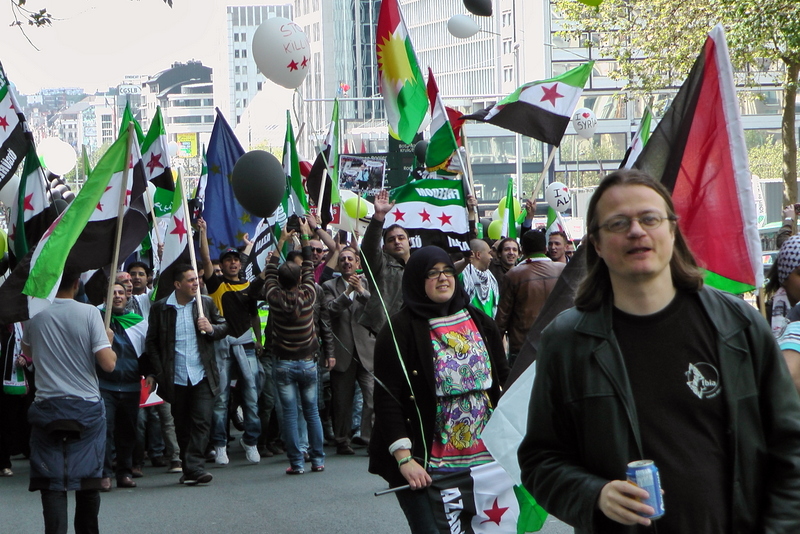
The March
Isabelle Durant speaks (in French)
Extracts from speeches
The March
Isabelle Durant speaks (in French)
Extracts from speeches
2 May 11 2012 by Richard Falk and Noura Erakat
![[Palestinians hold photographs of their relatives jailed in Israel during a support rally for Palestinian prisoners on hunger strike, in the West Bank city of Ramallah, May 5, 2012. Image by Majdi Mohammed/AP Photo.]](https://i0.wp.com/www.jadaliyya.com/content_images/3/LadiesStriking.jpg "[Palestinians hold photographs of their relatives jailed in Israel during a support rally for Palestinian prisoners on hunger strike, in the West Bank city of Ramallah, May 5, 2012. Image by Majdi Mohammed/AP Photo.]")
On his seventy-third day of hunger strike, Thaer Halahleh was vomiting blood and bleeding from his lips and gums, while his body weighs in at 121 pounds—a fraction of its pre-hunger strike size. The thirty-three-year-old Palestinian follows the still-palpable footsteps of Adnan Khader and Hana Shalabi, whose hunger strikes resulted in release. He also stands alongside Bilal Diab, who is also entering his seventy-third day of visceral protest. Together, they inspired nearly 2,500 Palestinian political prisoners to go on hunger strike in protest of Israel’s policy of indefinite detention without charge or trial.
Administrative detention has constituted a core of Israel’s 1,500 occupation laws that apply to Palestinians only, and which are not subject to any type of civilian or public review. Derived from British Mandate laws, administrative detention permits Israeli Forces to arrest Palestinians for up to six months without charge or trial, and without any show of incriminating evidence. Such detention orders can be renewed indefinitely, each time for another six-month term.
Ayed Dudeen is one of the longest-serving administrative detainees in Israeli captivity. First arrested in October 2007, Israeli officials renewed his detention thirty times without charge or trial. After languishing in a prison cell for nearly four years without due process, prison authorities released him in August 2011, only to re-arrest him two weeks later. His wife Amal no longer tells their six children that their father is coming home, because, in her words, “I do not want to give them false hope anymore, I just hope that this nightmare will go away.”
Twenty percent of the Palestinian population of the Occupied Palestinian Territories have at one point been held under administrative detention by Israeli forces. Israel argues these policies are necessary to ensure the security of its Jewish citizens, including those unlawfully resident in settlements surrounding Jerusalem, Area C, and the Jordan Valley—in flagrant contravention of the Fourth Geneva Convention’s Article 49(6), which explicitly prohibits the transfer of one’s civilian population to the territory it occupies.
The mass hunger strike threatens to demolish the formidable narratives of national security long propagated by Israeli authorities. In its most recent session, the United Nation’s Committee for the Elimination of Racial Discrimination concluded that Israel’s policy of administrative detention is not justifiable as a security imperative, but instead represents the existence of two laws for two peoples in a single land. The Committee went on to state that such policies amount to arbitrary detention and contravene Article 3 of the Convention on the Elimination of All Forms of Racial Discrimination, which prohibits “racial segregation and apartheid.” Nevertheless, this apartheid policy has so far escaped the global condemnation it deserves. In general, Palestinian grievances are consistently evaded with the help of media bias that accords faint coverage to signs of resistance, including even this extraordinary non-violent movement mounted by Palestinian victims of institutionalized state abuse.
Although there has not been a principled or total abandonment of armed struggle by Palestinians living under occupation, there has been a notable and dramatic shift in emphasis to the tactics of nonviolence. For years liberal commentators in the West have been urging the Palestinians to make such a shift, partly for pragmatic reasons. Even President Obama echoed this suggestion in his 2009 Cairo address when he said,
Palestinians must abandon violence….For centuries, black people in America suffered the lash of the whip as slaves and the humiliation of segregation. But it was not violence that won full and equal rights. It was a peaceful and determined insistence upon the ideals at the center of America’s founding.
But when Palestinians act in this recommended manner, the West averts its gaze and Israel responds with cynical disregard, dismissing near-death Palestinian hunger strikers as publicity stunts or cheap tricks to free themselves from imprisonment. Today, Palestinians have epitomized the best of American values that reflect the global history of non-violent resistance, as they wage a mass hunger strike, engage in a global boycott, divestment, and sanctions (BDS) movement against Israeli Apartheid, and risk their bodies on a weekly basis in peaceful protests against the Annexation Wall. The latter continues to expand its devastating encroachment upon and around Palestinian lands in defiance of a near unanimous Advisory Opinion of the International Court of Justice as well as countless Security Council Resolutions.
Yet, this America chooses to label the hunger strikers’ prison guards, the architects of racist laws and policies, as well as the engineers of the Apartheid Wall, as the sole and exemplary democracy in the Middle East. Rather than condemn Israel’s colonial practices, which constitute the core of Arab grievances and explain the widespread resentment of the US role in the Middle East, a US Congressional House panel has just now approved nearly one billion US dollars in additional military assistance to augment Israel’s anti-missile defense program. If passed, Israel will receive a record amount of four billion dollars in military aid next year—more than any country in the world.
There is a stark contrast between the round-the-clock coverage given to Chen Guangchen, the blind Chinese human rights activist who escaped from house arrest to the safety of the US Embassy, and the scant notice given this unprecedented Palestinian challenge to the Israeli prison system that is subjecting the protesters to severe health risks, even death. What is more, such hunger strikes are part of a broader Palestinian reliance on a powerful symbolic appeal to the conscience of humanity in their quest for long-denied rights under international law. Said deprivations include a disavowal of a peace process that has gone nowhere for decades, while a pattern of settlement expansion has made any realization of the widely endorsed “two-state solution” increasingly implausible. The prolonged nature of the occupation also steadily transforms what was supposed to be a temporary occupation into a permanent arrangement best understood as a mixture of annexation and apartheid.
In the face of this opportunity to place pressure upon Israel to comply with international law and human rights norms, the international community of governments and inter-governmental institutions has been grotesquely silent as Palestinians place their very lives at sacrificial risk. For its part, the United Nations’ most senior officials said nothing until a group of forty young protesters blocked the entrance of UN offices in Ramallah on 8 May, demanding the issuance of a statement on behalf of the hunger striking prisoners. Together with the help of a global social media campaign to trend #UNclosed, UN Secretary-General Ban Ki-Moon and UNRWA’s director Filippo Grandi have finally issued statements expressing deep concern. Grandi has gone the farthest to urge that Israel either provide trials for the detainees or release them, though his statement has been conspicuously removed from the Agency’s website.
It is hard to deny the irony of tacit approval, at worst, or timid condemnation, at best, in the United Nations, the United States, or elsewhere. In its 2008 Boumedienne decision, the US Supreme Court declared that (arguably) the world’s most villainous and immoral persons are entitled to habeas corpus review in US courts in order to avoid the cruelty of indefinite detention. Yet, Israel’s policy of detaining indigenous Palestinians who inhabit the lands the State seeks to confiscate and settle for more than four decades has denied those Palestinians exactly such legal protection. What are Palestinians to do in the face of such frustrating circumstances? What message does the lack of international support for their strong displays of nonviolence, self-sacrifice, and personal bravery send to them and to their Arab and Muslim counterparts who are once more exposed to blatant US hypocrisy in the region?
Palestinian civil society is now mainly opting for explicit acts of collective nonviolent resistance to register their dissatisfactions with the failures of the United Nations—or inter-governmental diplomacy in general—to produce a sustainable peace that reflects Palestinian rights under international law. The main expression of this embrace of nonviolence is the adoption of tactics used so successfully by the anti-Apartheid campaign to change the political climate in racist South Africa, yielding a nonviolent path to multiracial constitutional democracy. At the present time the growing BDS movement is working to achieve similar results.
Let us recall that successful global nonviolent movements are not restricted to fasts and marches, but include the boycott, non-cooperation, and civil disobedience tactics deployed by Palestinians today. Though President Obama, encumbered as he may be by a domestic election cycle, may feel compelled to ignore Palestinian responses to his call, the rest of the world should not. Certainly, US-based and global citizens should demand that the Western media begin to act responsibly when dealing with injustices inflicted on the Palestinian people, and not sheepishly report human rights abuses only when committed by the adversaries of their state. The media itself is a tactical target and a residual problem. In solidarity with the hunger strikers, civic allies should address the institutional edifice upholding administrative detention. It extends from a discriminatory core and therefore its requisite treatment includes ensuring the enjoyment of internationally guaranteed rights; rights enshrined by the BDS call to action and reified by the movement’s steady and deliberate progression.
I was told a story once. It was about what happens to disgraced generals when they are arrested by the secret police. First they are dragged to the interrogation centre. There, they stand them up in a room, and the lowliest conscript walks up to him and tears off his lapels and insignia. They are thrown at his feet. Then the conscript raises his hand and with one fell swoop he slaps the officer on the face. I don’t know how to express the slap in English with the same weight it is given in Arabic. To give somebody a kaff is, I think, a grave insult. It cuts to the core of you in a way that the lowly punch never could. Whether it hurts more or less is up for debate, but the kaff is the final crossing of the line. There is no going back from it. In Syrian drama, the climax of an altercation between a man and his wife is when he gives her the kaff. The music stops, the face is frozen in shock, and the man immediately regrets what he has done, because he knows his wife will never forgive him, and will never forget. There is never anything to say after the kaff.

Photo: Department of Defense
America’s top military officer condemned in the strongest possible terms a Defense Department course that taught troops to prep for a “total war” on Islam using “Hiroshima”-style tactics.
“It was totally objectionable, against our values and it wasn’t academically sound,” Army Gen. Martin Dempsey, the chairman of the Joint Chiefs of Staff, told reporters at a Pentagon press conference on Thursday. The instructor responsible for the course, Army Lt. Col. Matthew A. Dooley, is “no longer in a teaching status,” Dempsey added — but he is still employed at the Joint Forces Staff College in Norfolk, Va.
Dempsey’s comments were prompted by a Danger Room report on Thursday that described Dooley’s course in detail. For at least a year, Dooley taught an optional course at the college for lieutenant colonels, colonels, commanders and Navy captains that proposed taking a war on Islam “to the civilian population wherever necessary,” which he likened to the bombardment of Dresden and nuclear destruction of Hiroshima and Nagasaki. Guest lecturers in the course encouraged those senior officers to think of themselves as a “resistance movement” to Islam.
Dempsey and his deputy for military education, Marine Lt. Gen. George Flynn, pulled the plug on the course last month. The general said he was “quite thankful” for an unnamed military officer who brought word of the anti-Islam material to his attention. Dempsey and his staff launched an investigation into “what motivated that elective to being part of the curriculum,” as he put it on Thursday, and the general also sent a letter to the heads of every military service and regional command instructing them to jettison any similar material, as per a White House directive issued last fall.
The inquiry, conducted by Army Maj. Gen. Frederick Rudesheim, is scheduled to conclude on May 24. Any disciplinary action against Dooley; the college’s commandant, Maj. Gen. Joseph Ward; or any other officer is contingent on its findings.
“Final judgment should await General Rudesheim’s findings, but it’s not too early to say that these excerpts are offensive (though that word may be a bit mild here),” e-mails Douglas Ollivant, a retired Army lieutenant colonel and Iraq veteran who has taught at the U.S. Military Academy at West Point. “Further, presentations like this do real harm to those trying to carefully distinguish extremism and support for it from otherwise admirable religious devotion.”
The harm perpetuated on student officers “who accepted the implied authority of the instructor,” Ollivant added, “is obvious.”
The military is hardly alone in dealing with anti-Islam instructional material passing itself off as responsible counterterrorism. Over the years, hundreds of documents claiming “mainstream” Muslims are “violent” have made their way into FBI curricula, alongside internal claims that agents working on counterterrorism cases could “bend or suspend the law.”
“Plenty of U.S. military officers and troops were inspired by their service in either Iraq or Afghanistan to learn Arabic or Dari and study the peoples of the region. I left the Army in 2004, as a matter of fact, to pursue a master’s degree in Middle Eastern Studies at the American University of Beirut,” says Andrew Exum, a retired Army captain who now serves as a senior fellow at the Center for a New American Security. “But plenty of other officers and troops began their own amateurish studies of Islam and now, like Lt. Col. Dooley, peddle claims to know the truth about the violence and hatred at the heart of Islam. Pope’s warning that a little learning can be a dangerous thing is certainly relevant here. These hucksters, like the Robert Spencers of the world, know just enough to make themselves sound credible to an uninformed audience and hide their prejudices under a thin layer of amateurish, ideologically motivated scholarship.”
Thursday, May 3, 2012
By Yousef Munayyer
Last week in Tel Aviv, the Israeli Nakba activists group Zochrot (“Remembering” in Hebrew) attempted to recite the names of depopulated Palestinian towns at Israel’s Independence Day celebration. They were repressed.
On the same day, The New York Times published an article recycling Israeli President Shimon Peres’s narrative of the period:
The founding Zionist myth, reflected here by Peres’s words, echoes the American mantra of “manifest destiny” and fits perfectly into the Evangelical Christian narrative: Israel’s creation was a miracle brought about by divine intervention.
But this narrative doesn’t fit the facts. Had editors of The New York Times read their own reporting from the time, they too may have thought twice before uncritically reprinting Peres’s chimerical story.
In an article entitled “Palestine Jews Minimize Arabs: Sure of Superiority Settlers Feel They Can Win Natives By Reason or Force,” the Times reported in 1947, “whatever their degree of superiority complex, however, the Jews are certainly confident of their ability to bring the Arabs to terms—by persuasion if possible, by might if necessary.”
Then, in a 1948 feature story about the Zionist militias entitled, “The Army Called ‘Haganah,’” the Times reported about the Haganah:
In fact, throughout the war, the Zionist forces outnumbered the combined forces of the Arab armies who were under-armed, undertrained and decentralized in comparison. Prior to the start of the war, the Zionists had mapped out the Arab villages throughout Palestine and amassed a data collection effort that was far ahead of the military intelligence capabilities of any Arab state at the time.
If anything, given the realities of history and the disparity of power, it would have been something of a miracle if the Zionists had not been victorious.
This was not the outcome of a divine intervention or mysterious “hidden powers,” as Peres puts it. Rather, this was the expected triumph of an economically and militarily superior state-like Zionist force over a far weaker, disorganized native population with little means of defending themselves.
Peres, of course, should know better. He was one of the tens of thousands of Haganah members The New York Times wrote about 64 years ago. In fact, among other things, he was responsible for arms procurement! Whatever “hidden powers” Peres is talking about were not so hidden to the journalists of the day.
So why perpetuate this myth? Why tell a fairytale about the foundation of the state of Israel?
The answer is simple: challenging the foundational myths of Zionism shakes it at its core. For this reason there are two main Zionist interpretations of this history. There is that of Peres and others who might call themselves “liberal Zionists,” who bask in the mythology because acknowledging the truth is too troubling. Then there is that of Benny Morris, who knows the history all too well, and is happy to justify it.
Peter Beinart writes, “Acting ethically in an age of Jewish power means confronting not only the suffering that gentiles endure but the suffering that Jews cause.”
This tenet, a central part of the “liberal Zionist” awakening exemplified by Beinart and others, is meaningless unless it can also be applied to the events of 1948, breaking through the Zionist mythology which advances a dogmatic and false Israeli “David and Arab Goliath” dichotomy.
Only at that point can we begin moving forward.
The repressive actions of the State of Israel today toward some of its own citizens who bravely challenge this mythology only highlights its unwillingness to come out of the proverbial cave.
This article originally appeared on Newsweek/The Daily Beast.
Yousef Munayyer is Executive Director of the Palestine Center. This policy brief may be used without permission but with proper attribution to the Center.

U.S. passivity is costing more than innocent lives.
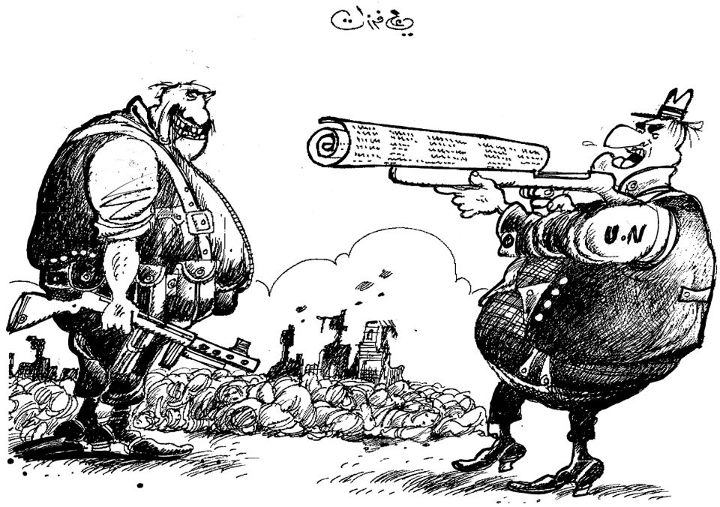
This strategy will allow Mr. Assad to go on killing indefinitely. Mr. Annan, after all, describes his plan as the only alternative to a Syrian civil war, so he is unlikely to abandon it any time soon. The Russians don’t sound at all shamed: “Things are moving in a positive direction,” Moscow’s U.N. ambassador Vitaly Churkin chirped Tuesday. The Syrian opposition, like any beleaguered resistance to a murderous dictatorship, can be counted on not to reach the high bar set by disdainful desk officers at the State Department.More than 1,000 men, women and children have died since Susan Rice, the U.S. ambassador to the United Nations, declared the Annan plan “the best way to end the violence.” But the consequences of U.S. passivity go beyond loss of innocent Syrian life. The prolongation of the conflict poses serious threats to U.S. interests and allies.
That testimony was delivered on March 1.
Kindly share them with all the journalists, TV channels, newspapers and Human rights organizations to support the Syrian people in their demand for freedom.
ترجمة فريق العمل
Syrian4all team
.
Homs, Alqusayr, the UN observers in the company of Hadi Elabdullah and Dr Muhammed Elmuhammed
Mr ِAbu William is adamant to stay in his destroyed house in Homs, shelled by Syrian army 01/05/12
01, May, 2012 Dara’a, surgery to one of the wounded with live bullets from Assad’s thugs
08, May, 2012 Homs Al kusoor heavy shooting and shelling on the neighborhood
+18 Homs – Al- Qusur : Finding unknown burnt body
Homs –Al-Qusur: one-year kid among four bodies
09, May, 2012 Serious injury of a speech- impaired child
09, May, 2012 Homs Al kusoor shooting on the houses
01, May, 2012 Al-Jajzeera Channel: impressive report by Majed Abdulhadi
The activist Omar Al-Tilawi in one of the retreats in Homs .. A real suffering
Homs- Khaldiya: Al-Arabiya channel camera in a makeshift hospital
2nd, May, 2012 Activist Abdel Basit Saroot Injured by a Sniper