Search

band annie's Weblog

I have a parallel blog in French at http://anniebannie.net

Month

April 2012

‘I’ve been duped’ — America’s travel guide Rick Steves says our media black out the brutal occupation

by  on April 7, 2012 94

source

Rick Steves watched Peace, Propaganda, and the Promised Land and had an epiphany, he has seen the light.

If you happen to be one of the 3.5 people in America who have never heard of Rick Steves watch this 60 Minute episode. He’s huge, the only famous American tour guide.

images 1
Rick Steves

He’s got a popular TV show , hosts NPR Travel with Rick Steves, and has a 20-million-dollar-a-year business selling travel books. Can’t get much more mainstream than that. He’s the all-American boy (that’s how he strikes this California girl anyway).

So imagine my surprise when I read his recent article on Huffington Post,  Reflections on Israel and Palestine.

I’ve been duped.

Do you know the frustration you feel when you believed in something strongly and then you realize that the information that made you believe was from a source with an agenda to deceive?

I just watched a powerful and courageous documentary called Peace, Propaganda, and the Promised Land. It certainly has its own agenda and doesn’t present balanced coverage. Still, it showed me how my understanding of the struggles in the Middle East has been skewed by most of our mainstream media. I saw how coverage of the Israeli/Palestinian problem is brilliantly controlled and shaped. I pride myself in understanding how the media works… and I find I’ve been bamboozled….

In my view, many Palestinians live under inhumane conditions, and U.S. taxpayers help to make it happen. Please, watch this and then share your impressions. Criticism of Israel’s policies is not automatically anti-Semitic (see J-Street for an example of a pro-Israel, pro-peace group). In fact, the irony is that for Israel’s hard-liners, their clever PR strategy could be their own worst enemy. While Israel certainly deserves security on its land, the Israeli occupation of Palestinian territory (in Gaza and the West Bank) degrades Israel and drives Palestinians to desperation. The question of whether Israel is conducting a brutal military occupation or a reasonable defense against terrorism gets no real airtime. If we care about the long-term security of Israel, we have a responsibility to understand what our government is funding and supporting.

Peace, Propaganda, and the Promised Land is a fantastic important film and Steves has a huge following.

http://video.google.com/googleplayer.swf?docid=-2165626245072381061&hl=en&fs=true

Here’s Rick Steves at the Temple Mount. Or watch the full episode on Hulu.

I’m looking forward to ‘Rick touring Palestine’ on an upcoming episode.

(Hat tip Marsha Holmquist)
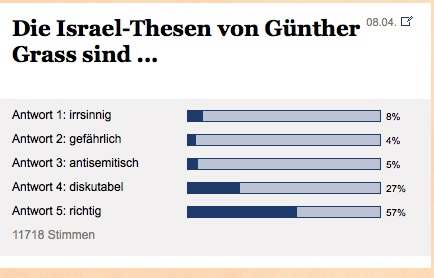
GERMANS ARE BEHIND GÜNTER GRASS

MONDAY, APRIL 9, 2012 AT 9:03AM GILAD ATZMON

 Israel doesn’t approve Grass’s recent poetic intervention. Yet, according to the German Financial Times, Grass views are highly accepted amongst Germans.

http://www.ftd.de/

Günter Grass´ take on Israel is..

1.ludicrous———————8%

2.dangerous—————- 4 %

3.antisemitic—————– 5 %

4.discussable—————-27%

5.correct———————55%

Seemingly the Germans have drawn the necessary lesson from the big war. They oppose war, expansionism and militancy. But what about the Israelis, will they ever learn?

source

Israelis can be angry with Gunter Grass, but they must listen to him

After we denounce the exaggeration, after we shake off the unjustified part of the charge, we must listen to the condemnation of these great people.

By Gideon Levy 

The harsh, and in some parts infuriating, poem by Gunter Grass of course immediately sparked a wave of vilifications against it and mainly against its author. Grass indeed went a few steps too far (and too mendaciously ) – Israel will not destroy the Iranian people – and for that he will be punished, in his own country and in Israel. But in precisely the same way the poem’s nine stanzas lost a sense of proportion in terms of their judgment of Israel, so too the angry responses to it suffer from exaggeration. Tom Segev wrote in Haaretz: “Unless Prime Minister Benjamin Netanyahu or Iranian President Mahmoud Ahmadinejad recently confided in him, his opinion is vacuous.” (“More pathetic than anti-Semitic,” April 5 ). Prime Minister Benjamin Netanyahu mentioned Grass’ Nazi past, and Israeli embassies in Germany went so far as to state, ridiculously, that the poem signified “anti-Semitism in the best European tradition of blood libels before Passover.”

It is doubtful that Grass intended his poem to be published on the eve of Passover. It contains no blood libel. In fact, it is the branding of it as anti-Semitic that is a matter of tradition – all criticism of Israel is immediately thus labeled. Grass’ Nazi past, his joining the Waffen SS as a youth, does not warrant shutting him up some 70 years later, and his opinion is far from vacuous. According to Segev, anyone who is not a nuclear scientist, an Israeli prime minister or an Iranian president must keep silent on the stormiest issue in Israel and the world today. That is a flawed approach.

Grass’ “What Must Be Said” does contain things that must be said. It can and should be said that Israel’s policy is endangering world peace. His position against Israeli nuclear power is also legitimate. He can also oppose supplying submarines to Israel without his past immediately being pulled out as a counterclaim. But Grass exaggerated, unnecessarily and in a way that damaged his own position. Perhaps it is his advanced age and his ambition to attract a last round of attention, and perhaps the words came forth all at once like a cascade, after decades during which it was almost impossible to criticize Israel in Germany.

That’s the way it is when all criticism of Israel is considered illegitimate and improper and is stopped up inside for years. In the end it erupts in an extreme form. Grass’ poem was published only a few weeks after another prominent German, the chairman of the Social Democratic Party, Sigmar Gabriel, wrote that there is an apartheid regime in Hebron. He also aroused angry responses. Therefore it is better to listen to the statements and, especially, finally, to lift the prohibition against criticizing Israel in Germany.

Israel has many friends in Germany, more than in most European countries. Some of them support us blindly, some have justified guilt feelings and some are true, critical friends of Israel. There are, of course, anti-Semites in Germany and the demand that Germany never forget is also justified. But a situation in which any German who dares criticize Israel is instantly accused of anti-Semitism is intolerable.

Some years ago, after a critical article of mine was published in the German daily Die Welt, one of its editors told me: “No journalist of ours could write an article like that.” I was never again invited to write for that paper. For years, any journalist who joined the huge German media outlet Axel Springer had to sign a pledge never to write anything that casts aspersions on Israel’s right to exist. That is an unhealthy situation that ended with an eruption of exaggerated criticism like Grass’.

Grass is not alone. No less of a major figure, the great author Jose de Sousa Saramago opened the floodgates in his later years when, after a visit to the occupied territories, he compared what was going on there to Auschwitz. Like Grass, Saramago went too far, but his remarks about the Israelis should have been heeded: “Living under the shadow of the Holocaust and expecting forgiveness for everything they will do in the name of their suffering seems coarse. They have learned nothing from the suffering of their parents and their grandparents.”

After we denounce the exaggeration, after we shake off the unjustified part of the charge, we must listen to these great people. They are not anti-Semites, they are expressing the opinion of many people. Instead of accusing them we should consider what we did that led them to express it..

source

9/11: A Conspiracy Theory

[youtube http://youtu.be/yuC_4mGTs98?]

Transcript and sources: http://www.corbettreport.com/?p=2594

Everything you ever wanted to know about the 9/11 conspiracy theory in under 5 minutes.

Featured Documentaries: Bahrain: Shouting in the dark

[youtube http://youtu.be/xaTKDMYOBOU?]

See interview on Democracy Now here

With ‘last ink,’ Gunter Grass breaks silence on Israeli nuclear program threatening world peace

by on April 5, 2012 104

Gunter Grass Gunter Grass, by Marcus Brandt in the Guardian

The Gunter Grass poem was published in Germany. Our translation is by Norbert Jost. It is already stirring big controversy. Guardian headline: “Nobel Prize-winning author Günter Grass uses poem to say a nuclear-armed Israel is a threat to world peace.” Tom Segev says Grass is “pathetic” and is guilty about his Nazi past.

Why am i silent, conceal already too long a time, What is apparent and has been simulated in exercises, at the end of which we the survivors may at best be footnotes. It is the alleged entitlement for a first strike, which could extinguish the Iranian people, – subjugated by a big mouth and directed to organized jubilations- because one assumes the making of a nuclear bomb. Alas, why do i restrain myself to name the name of the other country, where since years – although kept secret – a growing nuclear potential (is) available, albeit beyond control, because inaccessible for any examination? The general silence of this fact, which my silence has subordinated itself to, i feel to be a burdensome lie and as coercion, which promises punishment, soon as it is not complied with; the verdict “antisemitism” is ready at hand. However, now, that my country, which is confronted with its very own crimes which are unique without comparison, again and again and made to answer for, is about to deliver, routinely and businesslike, even though with a nimble tongue declared as reparation, is to supply Israel another submarine, the speciality of which is to deliver all-destructive warheads to where the existence of a single nuclear bomb is unproven, only “proven” by the strength of fear, I say, what must be said. But why did i remain silent so far? Because I was of the opinion, that where i am from, which is stained with a never removable stain, forbids me, to dare confronting Israel, the country I am attached to and want to remain so, with this fact as an outright spoken truth. Why do I speak now only, aged and with the last ink: The nuclear power Israel endangers the world’s peace, ever so delicate anyhow ? Because it must be said, what already tomorrow could be too late; also because we – as Germans burdened enough – could become suppliers of a crime, which can be foreseen, and why our complicity could not be made undone by any of the usual evasions. And admitted: i do not remain silent anymore, because i am weary of the hypocrisy of the West; moreover, it is hoped, may many free themselves of the bondage of silence, demand from the originators of the discernible danger the renunciation of all violence and simultaneously insist, that an unhindered and permanent control of Israeli nuclear potential and of Iranian nuclear facilities through an international entity will be permitted by the governments of both countries. Only this way, everybody, Israelis and Palestinians, even more, all human beings, who live as enemies next to each other in this region, occupied by madness, can be helped – ultimately us, too.

About Philip Weiss

Philip Weiss is Founder and Co-Editor of Mondoweiss.net.

Homsenica 05Apr12

The below post is from the Revolutionary Council of Homs dated today and signed by Bayan Seif El Din from the Revolution Council. Below that I’ve posted the original Arabic.

Have we finally reached this point where a direct parallel between Srebrenica and Homs is possible?

========================
Revolutionary Council of Homs
April 4, 2012

Homsenica

What is happening in Syria generally, and particularly in Homs, is ethnic cleansing that is far more atrocious than what happened in the Bosnian town of Srebrenica. The Serbs forced between 50 and 80 thousand Bosnians out of Srebrenica to change the demographics of the population and replace the native Muslim population with Serbs. The Syrian regime is also carrying out an atrocious ethnic cleansing campaign in Homs by forcing more than half a million of Homs natives out of their homes and immediately replacing them with Alawites. All of this is going on while the international, Arab, and Muslim communities remain silent.

For those who do not know the demographic of the city of Homs, here is a little synopsis:
Alawites came to the city of Homs and lived on its edges starting in 1965, and initially, there were only a few families. They spread then in several areas like Nuzha, Zahraa, Akrama, and Wadi al-Thahab, near other residential areas.

What has happened in the last two months – February and March of 2012 – is that nearly half a million people who live in predominantly Sunni neighborhoods near the aforementioned Alawite neighborhoods, were forced to leave their homes. This came after the residents witnessed atrocious crimes including slaughtering women and children; burning and abusing dead bodies; group-raping women and little girls, some of whom under the age of 12; terrorizing the residents with heavy bombing and destroying their homes on top of them; cutting off water, electricity, and communications; and preventing food and medicine from reaching these neighborhoods.

After the residents left their homes, the regime immediately brought loyalist Alawite and Shia families to live in the homes that belong to mostly Sunni families. The regime’s thugs then looted the other homes that remained unoccupied and robbed their contents in an organized manner, and then they set the homes on fire. The regime had formed groups, each of which was responsible for stealing specific things. For example, a group was responsible for stealing dishes and silverware, another was responsible for stealing washer, another group was responsible for stealing propane tanks, and so forth. In this manner, it has become impossible for the displaced residents to come back to their homes.

Here are some estimates that the Revolutionary Council of Homs has obtained regarding the number of displaced residents according to neighborhoods:
Rifai: 5000
Karm al-Zeitoun and Nazeheen: 55000
Bab Sbaa, Adawiyeh, and Mrejeh: 50000
Bab Draib: 20000
Bab Tadmur: 20000
Jib al-Jandali: 25000
Ashira and Sitteen: 15000
Bayada: 40000
Khaldiyeh: 80000
Qusoor: 50000
Karabees: 15000
Baba Amr: 80000

The total estimated number of people forced to migrate exceeds half a million people, and this is the largest displacement operation known in recent history, happening right in front of the entire world and went unnoticed as if nothing had happened. Most of the displaced people have either become migrants in their own country – in nearby villages or in other cities like Damascus, Hama, and Aleppo – or refugees outside Syria.

So will there be a Homsenica or should we just forget this city?

By: Bayan Saif el-Din
Media Bureau
Revolutionary Council of Homs

https://www.facebook.com/H.R.C.HOMS

source

A Word On The Syrian Independence Flag

Maysaloon :

Several times I have heard people who support Assad derisively label the Syrian independence flag as “that French mandate” flag. For some reason these people think that this flag is a product of Syria’s former colonial masters, and that it is fitting that a revolution that they consider to be a foreign plot against the regime would choose such a flag. This is patently untrue and demonstrates a lack of knowledge in the country’s history. If anything the Syrian independence flag represents the best of everything that is Syrian, and its history gives us some startling insight into the present.

In 1933 the French colonial authorities suspended the Syrian constitution of 1930 and tried to impose an independence treaty that would have left them in control of Syria’s coastal mountains. There was an immediate uproar and widespread demonstrations and strikes. There was also immense support throughout the Arab world, with protests in what are today Iraq, Lebanon, Palestine and Jordan. This period of crisis reached its climax with the Franco-Syrian Treaty of Independence, which was the first time that a treaty was made with a recognised representative of the Syrian people, the National Bloc, under Hashem al Atassi. al Atassi, who was the prime minister of the short lived Kingdom of Syria under King Feisal, returned to Syria and was made the first president of the Syrian Republic. This independence flag was made the national flag of all of Syria, including Syria’s coastal mountains and what might have become a separate Alawite Syrian state under the French.

The main goal of the National Bloc was to achieve independence through non-violent and diplomatic means, and they succeeded. Today the Syrian opposition would do well to remember how Syria’s freedom was initially won, and how the Syrian Republic had been born. The general strike that eventually forced the French to the negotiating table paralysed the country, and could not be quashed violently. Ironically it had its roots in an event held by the National Bloc commemorating the death of another national hero of Syria’s fight for independence, and once a prominent National Bloc leader himself, Ibrahim Hanano. Hanano had fought the French and led an armed uprising, with Ataturk’s help, centred around the Idlib and Aleppo regions. It was soon crushed when the Turk’s withdrew military assistance, but it cemented Hananu’s reputation in Syrian history, having already fought for King Feisal’s Arab Army. When the heads of the National Bloc were arrested by the French, mass protests and a strike were called. The series of events culminating in the Independence Treaty of 1936 can be traced from here, and with that, the path to the new Syrian independence flag.

Today that flag has been chosen by many of the Syrian opposition as representative of those who do not wish Assad or his family to rule the country anymore, and in it they find an authentic representation and nostalgia for a better Syria where life was not governed by fear. Cynical attempts by detractors of the Syrian revolution – in both its armed and peaceful components – ignore the enormous personal bravery and conviction required for any Syrian to dare challenge Assad’s rule and stand up against his injustice. They choose to simply see things in a black and white world of power politics and a West versus the Rest perspective. In doing so they deny the Syrian people any agency, and also deny them the right to make their own mistakes and aspire for a better future for themselves and their country.

Everything about this flag, the background of the movement that made it a symbol for Syria, and the figures that fought for it to become so, is steeped in principles rooted in a hope for a better country that is free and good for all its people. Should the Syrian people decide one day to once again make this flag Syria’s official flag, then it is not because the current flag is any less legitimate, but because the independence flag represents that hope. To describe it flippantly as a “colonial” flag is an insult.

Mabrouk, Yussef El Guindi

Last week, Egyptian-British-American playwright Yussef El Guindi took the prestigious 2012 Harold and Mimi Steinberg/American Theater Critics Association (ATCA) New Play Award for his “Pilgrims Musa and Sheri in the New World.

The Steinberg/ATCA recognizes the best American scripts that premiered outside New York City.

The announcement was made Saturday in Louisville, Ky, USA. The award includes a prize of $25,000, and is, El Guindi told the Seattle Times, “like being handed a bottle of water in a marathon run. It just keeps you going.”

“Pilgrims” is, according to ATCA, a “gentle romantic comedy wrapped around a serious examination of issues facing immigrants today.” The play’s wrapping is a budding relationship between an immigrant Middle Eastern cabbie and an American waitress (pictured above). El Guindi has written nine plays to date, many of them about how Arab-American characters relate to the larger US society.

El Guindi was born in Egypt, raised in London, and is now based in Seattle. He got a B.A. from the American University in Cairo and an MFA in playwriting from Carnegie-Mellon University. It would be interesting to have him back here for a collaboration, I’m sure.

Blog at WordPress.com.

Up ↑