Search

band annie's Weblog

I have a parallel blog in French at http://anniebannie.net

Month

December 2011

Naomi Klein’s Inconvenient Climate Conclusions

ANDREW C. REVKIN

Naomi KleinSuzanne DeChillo/The New York Times Naomi Klein

Naomi Klein, the author of a string of provocative and popular books including “The Shock Doctrine,” recently took on global warming policy and campaigns in “Capitalism vs. the Climate,” a much-discussed cover story for The Nation that has been mentioned by readers here more than once in the last few weeks.

The piece begins with Klein’s conclusion, reached after she spent time at a conclave on climate sponsored by the libertarian Heartland Institute, that passionate corporate and conservative foes of curbs on greenhouse gases are right in asserting that a meaningful response to global warming would be a fatal blow to free markets and capitalism.

She challenges the environmental left to embrace this reality instead of implying that modest changes in lifestyle and shopping habits and the like can decarbonize human endeavors on a crowding planet.

Please dive in. The piece is particularly relevant this week given the continued standoffs and disconnect between stated goals and behavior at the climate treaty talks in Durban, South Africa. Whether you embrace or dispute her conclusions, the article is a worthy and substantive provocation. I disagree with her in pretty profound ways, yet some of her points echo my assertion awhile back that greenhouse-driven climate change is “not the story of our time” but a symptom of much deeper issues. I contacted Klein, who kindly spent quite a bit of time engaging in an e-conversation about her argument. Here’s our chat:

Q.

First, I was happy to see you dive into the belly of the many-headed beast challenging the need for greenhouse-gas cuts (as was clear from your piece, you recognize that there’s no single species called “deniers”). There are lots of slings and arrows awaiting anyone exploring this terrain, as was the case with the Heartland meeting in 2008. What prompted you to do an in-depth look at global warming stances and the issues underlying this “crisis”?

continue here

Reflections on the Meaning of Palestine


”… the Palestine question within a European context.”

By Alain Gresh

This essay addresses the Palestine question within a European context. After reflecting on why Palestine has been widely embraced as a “universal cause,” the author explores its relationship to the “Jewish question” in the changed context following World War II: Whereas prior to the war it was the Jews who were perceived as a threat to European civilization, today it is the Muslim immigrants who have the scapegoat role. Also discussed are philosemitism (and its manifestations in the West) and anti-Semitism (as it relates to the Arab world), and how these phenomena have been impacted by the ongoing Palestinian-Israeli conflict. The essay concludes with “utopian musings” on possibilities for a future Palestinian-Israeli peace. 

”IF ONE DEAD ISRAELI is worth several dead Palestinians, how many Congolese corpses are needed for a Gazan shroud?” These words were written by the French journalist Hugues Serraf immediately following Israel’s launch of Operation Cast Lead against Gaza. In his article, Serraf notes that 271 people had been killed at about the same time in the Democratic Republic of Congo by fighters from Uganda on their way to the Central African Republic, without anyone making a fuss about it in the international press. He then goes on to ponder this discrepancy in a way that is entirely valid, whatever one may think of his implied conclusion.

To understand why Israel has become the perfect bad guy, the one everyone loves to hate unreservedly and without risk of contradiction except by a “Zionist”; the one whose excesses systematically evoke comparisons to the Nazis. . . . It is possible that the predictability of reactions concerning Israel springs from a logic that I am frankly unable to grasp. Perhaps it really is possible to say that the Palestine conflict is more serious, more intense, more tragic—in short, more everything than anything else. But you have to demonstrate it. [1]

Let us try to demonstrate it, even if beneath his feigned naiveté Serraf is already convinced of the reason: to his mind, it is anti-Semitism that explains the “fixation” on Palestine, that makes it possible to express without shame or remorse an “eternal hatred” for the Jews. Could Palestine be the new name for anti-Semitism?


ALAIN GRESH , longtime editor-in-chief and current deputy-director of the French monthly Le Monde diplomatique, is the author of numerous books. The present essay is adapted from the last chapter of his latest book, De quoi la Palestine est-elle le nom? (2010).
—-

END NOTE

1 Hugues Serraf, “De Gaza au Congo: des poids, une mesure,” Rue89, 5 January 2009.

Click here to read the post in its entirety at the Journal of Palestine Studies, Vol 41, no. 1 (Autumn 2011), p. 67 Essays

A colourful uprising in Damascus #Syria

Activists in Syria’s capital are using covert methods to show their opposition to Bashar al-Assad’s continuing rule.

New methods of creative civil disobedience are flourishing in Syria’s capital [Calendar of Freedom]These days, it is not extraordinary in Damascus for flyers calling for freedom to be blown on the breeze, or for garbage bins to bear banners calling for the collapse of the ruling administration.

This is the work of youths in the city in the belief that, with creativity, they could cause the government of President Bashar al-Assad to falter – along with its security apparatus. Apparently inspired by MK Gandhi, scholar Gene Sharp and other progenitors of non-violent civil disobedience, they formed a movement named “The Calendar of Freedom” and planned and executed pioneering forms of civil disobedience.

“We do the regime a big favour when we move in a direction they expect, when we protest in a typical way and we show up from a predictable location”

– Mouhannad, Calendar of Freedom Movement

These Damascus dissidents began their work as mass protests broke out in March, but only recently has the movement become more organised, with membership swelling from the tens to the hundreds.

“The media always asks: ‘Where is Damascus in the uprising?’” Mouhannad, a member of the movement, told Al Jazeera. ”This is an unfair question. Just because there are no large-scale street protests in Damascus, that does not mean that the city is dead. Our methods are different from the rest of the cities because this is the capital. It’s tightly controlled by security forces and shabiha [pro-government militia].”

Small protests have taken place in the heart of Damascus, but have failed to take hold – as they have in the suburbs and in other restive cities. Hundreds of plainclothes police roam the capital’s districts, ready to disperse and arrest gathering crowds. Meanwhile, the army has effectively locked down the peripheries to prevent the daily anti-government protests in the suburbs spilling into the centre of town.

Anti-government youth have had to find other ways to express their dissent. To avoid the crackdown, they have attempted to be one step ahead of government’s forces – and to constantly surprise them.

“We do the regime a big favour when we move in a direction they expect, when we protest in a typical way and we show up from a predictable location,” said 26-year-old Mouhannad. “The security forces will be able to catch us easily and still boast [of their] strength, intelligence and brutality. Therefore, the surprise factor is important for us.”

Fountains of ‘blood’

One of the movement’s first schemes was adding red dye to the waters of the city’s seven major fountains, making them flow scarlet, symbolising the blood of the estimated 4,000 people killed by security forces across the country.

One fountain sat directly in front of one of the headquarters of one of the most feared intelligence services.

“Imagine that: With all their perceived might, all their heavy weapons they use to kill protesters, the government forces stood helpless and confused in front of merely coloured water,” said Salma, a 24-year-old activist.

Activists dyed seven fountains red [Calendar of Freedom]“The main aim of this action was to raise the morale of the freedom seekers, to crush the morale of the government forces and distort the prestige of the security apparatus.”

Another time, activists aimed a strong laser light, bought from a party supplies store, at the presidential palace. They posted a video showing what appears to be a laser light beaming from one hill to another, where the palace is located. Activists claimed that armed guards frantically fired into the air, confused about the source or the nature of the laser.

“The message we wanted to deliver here is that neither Bashar nor his forces scare us. We wanted to show him that the Syrian people do not respect him,” Salma said.

The youth of the movement surprised Damascus residents once again when they stuffed cassette players and speakers in black garbage bags and threw them into trash bins in crowded streets and universities. Minutes later, a well-known anti-Assad song would blare from the bin. Its singer, Ibrahim al-Qashoush, was killed and his throat cut – allegedly by security forces – after he chanted the song in a protest in the central city of Hama.

Syrian state television broadcast pictures of the speakers – alongside grenades and ammunition – claiming the materials were seized from “terrorists”.

“This shows you that our simple, peaceful methods are as dangerous for this insecure regime as weapons. This gives us more motivation to carry on,” Mouhannad said.

Small acts of sabotage

Activists have also gone street to street, changing signs by affixing stickers bearing the names of people killed by security forces in the city. They have covered neighbourhoods including Barzeh, Mashrou’ Dummar, al-Midan, Rukn el-Deen, al-Salhiyeh, Daraya, al-Qadam, al-Qaboun and Zamalka.

The sign on a street in Barzeh area, for example, was changed to: “Eid Abdel Kayem Allou Street. Died at the age of 40. Married with four children, the youngest of whom was born 40 days after his death.”

“Creative ideas could only be fought back with ideas, something that this decaying unimaginative regime lack”

– Salma, Calendar of Freedom Movement

The Damascus dissidents’ campaign has extended to other ideas and small acts of sabotage, including glueing the door locks at a government building, releasing “freedom balloons” into the sky, spraying walls with anti-government graffiti, and calling on residents to collectively switch off their lights at a certain hour.

Salma said that the movement’s power lies in its simplicity, encouraging those who are still hesitant to join the ranks of the Syrian uprising.

“Our campaign was particularly effective in universities,” Salma said. “We had called on students to wear black clothing on certain days as a gesture of support for the Syrian revolution against Assad. The response was amazing. Students loved the fact that they could express dissent for this ruthless regime with the least risk of getting arrested.”

The youths also focused on awareness campaigns. Using home printers, they printed and distributed newsletters discussing the uprising. They created educational videos on non-violence and interviewed Erica Chenoweth, a professor and a co-author of a book on non-violent civil disobedience.

To avoid being arrested, the youth group said that they carefully study the security risks of each activity before embarking on it. Many of the members do not even know each other. They communicate and make logistical arrangements anonymously through Facebook.

Salma said the movement was planning more projects that aim at “driving the government crazy”.

“Creative ideas could only be fought back with ideas, something that this decaying unimaginative regime lack,” she concluded. “This is why we know that we will eventually win this battle.”

Follow Basma Atassi on Twitter: @Basma_

Syria Top Goon: Diaries of a Little Dictator

571. Tara said:

Aboud was the first who cones the name Besho.  The name is going regional

http://www.cbsnews.com/8301-503543_162-57341297-503543/top-goon-puppet-show-takes-aim-at-syrias-assad/

Puppet characters from “Top Goon: Diaries of a Little Dictator.” Syrian President Bashar Al-Assad is on the right. (Credit: Masasit Mati) This post originally appeared on Global Post. It was written by Hugh Macleod and Annasofie Flamand.
BEIRUT, Lebanon – The whip cracks against the prisoner’s back as the man with the moustache and the military uniform repeats his accusation: “You want freedom, right? Freedom?”

The whip comes down again and the prisoner punches the wall in pain.

“What kind of freedom is it you want?” demands the torturer. The freedom the puppet protester seeks, he tells his torturer, is “one where you and I wouldn’t be here. You’d be with your kids and I’d be with my family.”

And then a reply that explains why this small scene from a series of dramatic vignettes played out by finger puppets is among the boldest works of art to have grown out of the unprecedented upheaval in Syrian society.

“You bastard!” retorts the man from Assad’s security services. “I am here because of you.” But the protester has understood the paradox: “You are here because you are not free,” he says. “You are imprisoned just like me. I’ll leave prison in a month or two. But you’ll stay here. Because you are afraid to take your freedom.”

Since its launch on YouTube two weeks ago, the series, “Top Goon: Diaries of a Little Dictator,” has received more than 40,000 views and garnered lavish praise and occasional furious outbursts from audiences stunned by its unprecedented and very personal lampooning of Syria’s struggling president, Bashar al-Assad. And, importantly for the country’s increasingly polarized society, by its refusal to indulge in easy answers.

In a Syria divided between regime and opposition, between mainly Sunni Muslim protesters and the Allawite Shiite Muslims who dominate Assad’s security services, between aggressor and victim, the perspective presented in this upcoming episode of Syrian theater group Masasit Mati’s groundbreaking drama is a rejection of black and white views.

The shabih, or pro-Assad thug, is seen not simply as the oppressor — though he most clearly is that — but also as another kind of victim of the regime, while the protester, though enduring a whipping, is by no means simply a victim, but rather a figure of strength, as he says, “a free Syrian who refuses humiliation.”

“The idea for this dialogue came from a real life example,” Jamil, Masasit Mati’s director told GlobalPost, which was shown a preview of the seventh episode of the series, due for release on Sunday.

“But it was actually the other way around: A friend of ours was in prison and heard the interrogator telling a prisoner, ‘Why are you doing this to us? You are forcing us to stay here. You are imprisoning us.’ We wanted to say that even the shabiha are brought up like slaves to serve the regime.”

A collaboration between a group of 10 artists from inside Syria and named after the straw used to drink mati, a herbal tea popular among Syrians who sip it over lengthy conversation, Jamil said the aim of Top Goon’s finger puppets was to bolster audiences in the best tradition of black comedy, even as blood continues to be spilled in the regime’s unrelenting crackdown on pro-democracy protesters.

“Comedy strips things bare and gives you the strength to fight. Of course, with black comedy the laughter gets stuck in your throat. It makes you laugh and cry at same time,” Jamil said. “But we will not allow the regime to turn us into victims that just cry and stay at home all the time.”

The emergence of Masasit Mati’s series comes amid a critical stage in what the International Crisis Group aptly describes as Syria’s “slow motion revolution,” by far the most drawn out of this year’s Arab uprisings.

The United Nations now estimates at least 4,000 Syrians have been killed since the crackdown began in mid-March, but human rights group Avaaz, which has researchers inside Syria, says it has registered more than 6,500 killed, with at least 20,000 arrested or disappeared, including last week a high profile 30-year-old female blogger, Razan Ghazzawi.

In a report released last month, Human Rights Watch said the regime’s crackdown against civilians in the central city of Homs, including systematic torture, constitutes crimes against humanity.

Last week Avaaz reported the kidnap of 14 Sunnis, including six women, in Homs as they traveled by bus near an Allawite neighborhood, with a senior Western diplomat in Damascus warning a sectarian war in the city is already underway.

Finding ways to make its largely Syrian audience laugh amid all the bloodshed and violence is no mean feat, but Masasit Mati has tapped a rich vein of satire in its portrayal of Syria’s president.

Bashar, or Beeshu — a kind of baby name he is known by in the series — swings wildly between the character of a child suffering attention deficit disorder and the spoiled autocrat in his nightcap, comforted to sleep by his most trusted thug, in the episode Bishou’s Nightmares.

“The regime has fallen,” cries Beeshu, waking from his nightmare as his shabih opens fire on unseen opponents. “Shabih you moron!” screams Syria’s dictator. “It was only in my dream!”

Later Beeshu is seen flying into a rage on a game show, Who Wants to Kill a Million?, angered that his assertion of crushing the protesters is not the right final answer. Later his son and daughter challenge him over the killing of Syrian children and he responds by calling on his goon to put down this domestic uprising.

“We only kill our own people, but on the Golan Heights [Syrian territory occupied by Israel] we are a peaceful army,” Beeshu assures his audience during the episode, Talk Show, modelled on a famous talk show on Al Jazeera.

The direct and confrontational story lines, seeking to expose the lies by which the Assad regime has depicted its 41-year dictatorship as the choice of the Syrian people and a sacrifice in the name of Palestinian freedom from Israeli occupation, has won Masasit Mati rave reviews.

“It’s so good it’s driving me crazy,” posted one fan on the group’s Facebook wall. “I want to see a Masasit Mati TV station.” “It’s very good work and we watch it with our kids,” posted another, adding irreverently: “All we want to know is which finger you put Bashar on.”

Not everybody has greeted the series with such acclaim, however. Among the outpourings of praise, a few viewers have taken deep offense and posted threats that are unpublishable but tend to center on sexual violence against the mothers and sisters of Masasit Mati’s members.

“It’s kind of obvious it comes from the security apparatus,” said Jamil, who uses a pseudonym and did not wish to reveal his whereabouts.

The threat to the safety of those who would ridicule Syria’s president in words or pictures is all too serious. In July, a man identified as Ibrahim Kashoush was found with his throat slit in Hama after leading carnival-like street songs ridiculing the president.

A month later masked gunmen attacked Syria’s best known political cartoonist days after he published a cartoon showing Assad hitching a lift out of town with Libyan dictator Muammar Gaddafi. The attackers fractured Farzat’s arm, left him with a black eye and symbolically broke two of his fingers.

In the Top Goon series, the voice of Bishou mimics the president’s lisping pronunciation of the letter S and shows the president giggling inappropriately and telling bad jokes while delivering rambling speeches on reforms, such as the Law of Gravity that he says will put an end to the so-called ‘flying protests’ — spontaneous and short demonstrations by the opposition.

The series got an unexpected boost last week with the broadcast of an interview with Assad on US network ABC in which the president denied all responsibility for the killing of protesters, telling ABC’s Barbara Walters that Syria’s security forces “are not my forces,” despite, as president, he is constitutionally sitting as commander of all Syria’s armed forces.

“We don’t kill our people,” Assad said. “No government in the world kills its people, unless it’s led by a crazy person. Most of the people that have been killed are supporters of the government.”

“We used to worry that people outside Syria might think the things we show in Top Goon are exaggerated,” Jamil said. “But after we saw Assad’s interview we decided to run it on its own as episode five and a half because the interview was more comic than we could have imagined. We didn’t even have to make something up.”

Liberté “Liberty” – Syrian story simply put in a creative way – Free Syria

[youtube http://youtu.be/upAYUCyy8KA?]

IDF kills Palestinian protester and tweets ‘#Fail’

by Phan Nguyen on December 10, 2011 49

Warning: graphic image below 

Usually when the Israeli military kills a high profile civilian, the response from its spokespeople is limited to words along the lines of: “It’s under investigation, but we’re innocent anyway.”

However, with the shooting and eventual killing of Mustafa Tamimi, the IDF feels free to speak its mind via Twitter. Here’s what its spokespeople have to say:

IDF Spokesperson Lt. Col. Avital Leibovich:

1 Leibovich

IDF Spokesperson Capt. Barak Raz:

2 Raz

In other words, the smoking gun is the slingshot, not the tear gas launcher that was fired at close range from an armored Israeli miltary jeep that was invading a Palestinian village situated outside of Israel.

Personally, I couldn’t care less if Tamimi had a boulder and a catapult in his back pocket. But there’s something depressing about laying out a single slingshot for display as if it were a major arms or drugs cache at a press conference.

And is it me, or is it rather tasteless to boast that you are treating someone in your fine, fine hospital right after you shot that person in the face?

IDF Spokesperson Maj. Peter Lerner:

Lerner600

That’s right. If Tamimi really had nothing to hide, he would have been wearing olive green fatigues, combat boots and a helmet, while firing from the back of an armored military jeep.

However, the award for the most sickening response to the shooting of Mustafa Tamimi is this additional tweet from Lerner, which was retweeted by Leibovich:

4 Lerner

Take a look at the image below and imagine Lerner’s “#Fail” hashtag superimposed on it. Then excuse yourself and vomit.

5 Tamimi
(Photo: Lazar Simeonov)

About Phan Nguyen

Phan Nguyen is a Palestine solidarity activist based in New York.

{ 49 comments… read them here}

  1. What more can one say than Israel is a nation of bloody sadists?

    • MRW says:

      Nothing more, Jeffrey. At least, they should drop the ‘moral’ ‘democracy’ monikers. They’ve got an army of barnyard animals.
      ___________________________

      The triptych (L–>R) should be Mustafa’s face, the slingshot, the armored military jeep.
      The caption beneath should read ‘The IDF did this because Mustafa used this against this’.

Netanyahu lies through his teeth with a straight face

[youtube http://youtu.be/O7C1Y5H8AN0?]

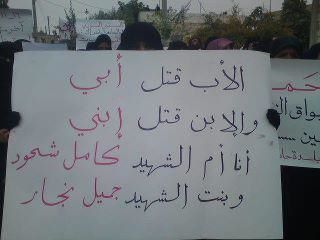
A family of martyrs

“The FATHER killed my father.
The SON killed my son.
I am the mother of martyr Kamel Shahoud,
and the daughter of martyr Jameel Najjar”

Mustafa Khalifa. Al-Qawqa’a [The Shell]

Syrian Studies Association Newsletter 14.2 (2009) Spring Issue Book Review: A Memoir-Novel of Tadmur Military Prison
Mustafa Khalifa. Al-Qawqa’a [The Shell]. Beirut: Dar al-Adab (http://adabmag.com/books) ,
2008.

[This review is based on the Arabic original. The book is also available in French:
Moustafa Khalifé. La Coquille: Prisonnier politique en Syrie. Traduction Stéphanie
Dujols. Arles: Actes Sud, 2007.]
By Shareah Taleghani
In 2001, following the release of several hundred political prisoners, the Syrian
government ordered the closure of its most notorious detention center—Tadmur Military
Prison.

Located in the desert near the ancient site of Palmyra and originally built by the
French Mandate authorities, Tadmur has been described as a “kingdom of death and
madness” by Syrian poet Faraj Bayraqdar and the “absolute prison” by dissident Yassin
al-Haj Salih.

The abject conditions of torture, daily degradation, and arbitrary execution
which prisoners experienced there were the subject of intense scrutiny by both
international and local human rights organizations throughout the 1980s and up until its
doors were finally closed almost eight years ago. The site of a massacre of suspected
members of the Muslim Brotherhood in 1980, Tadmur, according to a 2001 report by
Amnesty International, was and is “synonymous with suffering”.
In the recent proliferation of contemporary Syrian prison literature, most narrative
accounts of prisoners’ experiences of surviving the conditions of Tadmur have been
circulated in the form of testimonials and memoirs.

Aside from a website dedicated to testimonies of former Tadmur prisoners, Muhammad Salim Hammad’s prison memoir
Tadmur: Shahid wa-Mashhud [Witness and Witnessed] recounts in linear and
chronological fashion his experience of detention and torture at the prison as a suspected
member of the Muslim Brotherhood.

Faraj Bayraqdar’s own poetic prison memoir
Khiyanat al-Lugha wa al-Samt [The Betrayals of Language and Silence] (2005) dedicates
an entire chapter to what he calls “Tadmuriat”—brief, disjointed fragments of
descriptions of terrifying events and moments he witnessed while detained at the
infamous prison—moments that appear to escape the possibility of representation
because they are “beyond surrealism”.
Mustafa Khalifa’s recently published work al-Qawqa’a [The Shell] (2008) is one of the
first novels dedicated to the story of a detainee’s imprisonment in Tadmur. Detained
himself from 1982 to 1994, the author presents the story of a seemingly apolitical
protagonist who returns to his homeland after studying film in Paris and is arbitrarily
detained.

Musa is arrested upon arriving at the airport, brutally tortured at an
interrogation center of the military security service, mistakenly placed with detainees
who are members of or suspected members of the Muslim Brotherhood, and then sent to
the “desert prison”.

He will not learn what precise crime he had been accused of until
close to the time of his release. Like many prisoners, Musa discovers and masters the
skill of oral composition and memorization. He has no paper and no pen. But throughout
his detention, in his mind, he composes his diaries, memorizes them word by word and
sentence by sentence, and retains each entry in his memory until he is eventually able to
record them on paper after his release. Except for the very beginning, the novel is
composed of these dated entries—some just a day or two apart and some separated by
several months. Each entry contains parenthetical observations—editorial comments or
additions that the narrator makes to his own memorized composition, seemingly at a later
point in time.
Musa is never sentenced by a court, and he is never placed on trial, but he will spend
twelve years in the desert prison. He is however, sentenced to silence by his fellow
detainees, when he is overheard telling his torturers that first, he is a Christian and then
declaring himself an atheist and therefore in no way affiliated with the Muslim
Brotherhood.

Ostracized completely by the rest of the inmates in his mahja’ (dormitory
or communal cell), he describes himself as withdrawing into his shell. The subtitle of the
novel is “diary of a secret observer” (yawmiat mutalassis).

Musa is constantly “peering”
or “creeping out of” his shell; he listens attentively, meticulously observes, and diligently
records all of the horrors he witnesses in the prison. From the beginning of his enforced
sojourn in detention, his life is threatened not only by the brutality of daily forms of
torture and degradation, but by the Islamist extremists in his cell who believe that he
should be executed as an unbeliever.

Rescued and then protected by the moderate
pacifist Shaykh Darwish and a physician who treated the wounds afflicted by his torture,
Dr. Zahi, he nonetheless remains isolated for ten years. No one will speak to him
because he is impure—this silencing imposed not just by his jailors but by his fellow
inmates mimics the muting of thousands of political prisoners who passed through
Tadmur and other sites in Syria’s infamous carceral archipelago who have never been
able to tell their stories.
Nonetheless, Musa speaks through his diary, and in doing so, he introduces his reader to a
gruesome lexicon of torture and detention. He tells of the “reception” the prisoners
receive upon their arrival to the prison: each is forced to drink the putrid filthy water
from a sewage drain. Those who resist are beaten to death. Those who drink are treated
to more torture or “hospitality” as the guards call it.

Day after day, the torture continues.
Daily activities can bring arbitrary death. He describes the “breather” or break where
prisoners are routinely whipped, lashed, and beaten. He recounts how prisoners were not
allowed to raise their eyes towards their jailors. He recollects the warden coming into the
cell and randomly executing fourteen of his cellmates because of a threat he received in
the outside world.

He witnesses the weekly execution and trials of inmates in the
courtyard through a tiny hole he discovers in the wall of his communal cell. He also
methodically describes daily aspects of prison life—surviving the baths, illicit prayers,
the confining, airless dimensions of the mahja’, the brutal shaving of prisoners heads and
faces, the secret forms of communication between prison cells, the innovative modes
prisoners use to treat the sick and wounded when deprived of medical care, and the
myriad forms of resistance that detainees develop despite the ever looming threat of
death.
Musa will remain in complete isolation from his cellmates for ten years. After nearly a
decade, he is once again confronted by an extremist calling for Musa’s trial, judgment,
and execution by the other prisoners; finally, he breaks his silence and vocally confronts
his would-be executioner.

From that moment, he becomes intimate friends with Nasim—
an inmate who was detained as a hostage due to his brother’s affiliation with the Muslim
Brotherhood.

Like others, Nasim will eventually suffer a breakdown; his dissent into
madness occurs when three brothers are executed after their father was promised that the
youngest would be spared. Abruptly, in twelfth year of detention, Musa is transferred
from the prison back to the military interrogation center.

He learns that his influential
uncle has been attempting to obtain his release. But before he is actually freed, he will be
interrogated in three different branches of the security services because he refuses to
confess to belonging to any political organization, to write a thank you letter to the Syrian
president for his release, or to renounce involvement in politics.
After his release, Musa returns to his family home that he inherited from his father and
lives with his niece and her family. Despite family pressure to marry and to work, he
does neither. He isolates himself from the world around him. Eventually, he learns that
Nasim as well as others he was imprisoned with have been released. Nasim, however,
has never recovered from his breakdown, and takes his own life in front of Musa after a
brief reunion of former cellmates.

At the end of the novel, there is no sense of
celebratory liberation for Musa. Instead, noting that he has never truly been released
from prison, he describes himself as having lost the ability to communicate, as perceiving
an insurmountable abyss between himself and all others, and as carrying a grave within
himself. Rather than creep out of his “shell” to watch and record what is happening
around him, he remarks: “I do not want to look outside. I close its holes in order to turn
my gaze entirely to the inside, to me, to my self”.
Narrated in stark, simple language, the basic plot of The Shell, along with the framing
device of a prison journal, will be familiar to readers of prison literature. Khalifa’s direct,
documentary style lacks elements of formal experimentation seen in other recent works
of Syrian prison literature such as the fragmented, stream of consciousness narration in
Hasiba ‘Abdalrahman’s prison novel Al-Sharnaqa [The Cocoon] (1999) or Malik
Daghastani’s Duwar al-Hurriya [The Vertigo of Freedom] (2002).

However, the
absence of experiment with form in the text does not detract from impact of the narrative
on the reader. The history of Tadmur Military Prison, the stories of the human lives
detained and lost inside its walls, are still in the process of being written, and Mustafa
Khalifa’s The Shell marks a significant contribution to the beginning of that process.
Shareah Taleghani is a PhD candidate in modern Arabic literature in the Dept. of Middle
Eastern and Islamic Studies at New York University. She is completing her dissertation
on the relationships between contemporary Syrian and Arabic prison literature, human
rights discourse, and literary experimentalism.

Source : http://www.scpss.org/libs/spaw/uploads/files/English%20Content/Books/TheShell.pdf

Blog at WordPress.com.

Up ↑