Search

band annie's Weblog

I have a parallel blog in French at http://anniebannie.net

Month

November 2011

Bashar’s last chapter

The endgame has started for the Syrian regime, writes Dina Ezzat


The regime of Syria’s President Bashar Al-Assad may be in denial but the writing is on the wall. The end is coming, later rather than sooner, but inevitable nonetheless. Such is the assessment of Arab, Western and other diplomats that spoke to Al-Ahram Weekly.

In the words of one: “There is no uncertainty left. Bashar has to go. What concerns us most at the moment is who will replace him, and how to ensure that regime change in Syria does not open the doors to chaos in Iraq, Lebanon and elsewhere in the region.”

“Everybody is aware that it has become impossible for the Syrian president to stay in office. The Egyptian authorities, like many others, are asking questions about post-Bashar Syria.”

Both Washington and Paris, say diplomats, have given the nod to diplomatic and political processes that will conclude with the removal from power of Bashar and the Al-Assad clan. They may step down and seek asylum in some other country, or stay put and face the wrath of their people.

It is hoped that accelerated communications with Syrian opposition factions, and between the factions themselves, will lead to a formula for transition that can accommodate the concerns of all parties. Egypt and Israel will want an alternative that does not shake the current strategic set-up, which precludes military action to liberate the Israeli occupied Golan Heights; Lebanon and Iraq are seeking guarantees there will be no intervention in their internal affairs. Western capitals and Israel will want a replacement that ends Syrian support of Iran, of Hamas in the occupied Palestinian territories and Hizbullah in Lebanon.

A leading opposition figure, speaking on condition of anonymity, says several factions within the still fragmented opposition are willing to offer the guarantees required by Syria’s neighbours and other concerned states.

“We are examining our options. I think we are almost ready to form a coalition of most opposition groups, in Syria and in exile,” he said.

Representatives of key in-exile opposition groups are due to meet at the Cairo headquarters of the Arab League next week to discuss post-Bashar Syria scenarios.

“He might not have to come to terms with it yet but his days are numbered. We are already working with the secretariat of the Arab League, and with concerned capitals, on the nature of transition in Syria,” said another opposition figure.

Saturday’s Arab League foreign ministers meeting not only adopted a resolution suspending the participation of Syrian delegations in meetings of the foreign ministers council but also signalled its intention to host a meeting with the Syrian opposition.

The agenda was being contemplated on Wednesday by Arab foreign ministers, Turkey’s foreign minister and the Arab League secretary-general on the fringe of an Arab Turkish cooperation meeting in Rabat. According to diplomats close to the discussion the key item on the agenda will be to determine ways to ensure Syria is never again controlled by a single faction as it has been by the Alawites, under Hafez Al-Assad from 1970 to 2000, and his son Bashar from 2000 till now.

Fearing ties with Iran Sunni ruled Gulf states, led by Saudi Arabia, are also demanding guarantees that Syria’s Shia are held in check. Turkey, faced with Kurdish separatist demands, will want to prevent the consolidation of Kurdish influence in any future set-up.

Diplomats following the Syrian file say it is going to take months before an alternative to the Al-Assad regime is ready but a balanced combination is already emerging. Increasing defections from the Syrian army, they argue, auger well for the political set-up that is being assembled.

“We have no illusions. We know that the transition in Syria will not be easy and that even as we formulate the alternative we are going to face serious challenges with getting this alternative formula to work on the ground. Whatever the case, Bashar’s end is round the corner,” said a Western diplomat.

It is this Western certainty that helped prompt the change in the language and positions of the Arab countries that met on Friday evening and Saturday afternoon in Cairo and adopted a resolution that effectively issued the Syrian president with an ultimatum.

Syrian diplomats who took part in the meeting at the Arab League blamed Qatar for their growing isolation. They accused the Gulf state of “acting as a facilitator for the US in the region”.

Only Yemen, whose regime is also faced with upheaval, and Lebanon, whose government is closely associated with Syrian regime, rejected the Arab League resolution demanding protection for Syrian civilians and the recall of Arab ambassadors to Damascus. Iraq expressed reservations on the resolution, abstaining for what one Iraqi diplomat said were obvious reasons, “fear of antagonising the Syrian regime that could start unrest in Iraq”.

The six Arab Gulf states declined a call made Sunday by Syrian Foreign Minister Walid Al-Muallim for an Arab summit to discuss developments in Syria. No other Arab country has expressed interest in a summit being convened.

Jordan’s King Abdullah, a close US ally, said on Monday that were he in the shoes of the Syrian president he would have already stepped down.

Turkey is openly threatening more sanctions against Syria following the suspension of cooperation in petroleum projects and a partial halt in electricity exports. Ankara has said on more than one occasion that the Syrian regime will pay a heavy price for its continued violent repression of demonstrators.

What that price is, says one Turkish diplomat, is obvious: an end to the regime of Bashar Al-Assad and the rule of the Alawites. (see pp.8-9)

Interview of Syria’s Commander of the Free Syrian Army

225. Revlon (on Syria Comment) said:

العقيد : رياض الأسعد – تقديم : عمر خشرم تاريخ البث 2011/11/19
لقاء اليوم – العقيد : رياض الأسعد
http://aljazeera.iyobo.com/fe8CNaA4wXV

This interview was aired yesterday on AlJazeera
It served to introduce Colonel Riad AlAsaad,
Commander of the FSA
President of the Transitional Military Council

He appeared in civilian suit.
He spoke with clear language and clarity of purpose.
He projected civility, assertiveness and good nature.
He spoke about the revolution and revolutionists with affection and pride.

The following is an English summary of the Q/A

On the identity of the members of the FSA.
– All are professionals of the armed forces.

On the types and sources of arms of FSA?
– Light and intermediate.
– Source is strictly within Syria: brought along with defectors, acquired from ambushing Asad units, or bought from black market; interestingly, such sources have included Alawis arms businessmen and smugglers, who are currently part of the regime!
– None of FSA arms come from any non-Syrian sources.

On the strategy of FSA: the protection of civilians
– Ambushing convoys of Shabbeeha and security forces on their way to crackdown.
– Attacking security checkpoints.
– Engaging armoured units enforcing blockade on cities.

On the number of the FSA and rate of defection from Asad army;
– Number of FSA members is >15,000
– Defection is taking place daily.
– Rate and size of defection are on the rise.
– The more and bolder FSA operations the more defections.
– Asad army officers and soldiers wait for the right time to defect, such as attacks on their units by FSA who provide them with fire cover for their protection.
– Defections have been seriously hampered by Asad air force which serves to track and capture many defectors, like happened in Rastan and Baba Amr.

On the Militarization of the Revolution
– WFSA rejects such concept.
– FSA members are professional army members who have the right to defend Syrians as per Oath.
– Our number and armament do not enable us to fight army to an army.
– However, we are able, through our targeted operations cum defections to dismantle the Syrian army from within.
– Our experience from ground operations and from own reconnaissance from Asad security forces have shown us that Asad army is crumbling and their members are utterly demoralised. One clear example is the use of Air force, Artillery and tanks to merely subdue a small unit of the FSA. To us, Baba Amr operation spells the beginning of the end of the Regime.

On the future of FSA operations in the wake of the failure of the AL initiative
– We spontaneously suspended all our operations against Asad forces once the AL initiative was signed, although we knew the regime will not honour the agreement.
– Asad forces instead attacked and shelled Homs city with tanks and shells.
– Asad released 550 prisoners, only to arrest 4000 just in the Reef Dimashq area (Countryside of Damascus).
– Asad forces have managed to repaint Army armoured vehicles in blue to claim that it belonged to police.
– There is a plan for Asad armed forces and security agents armed with light concealable machine guns, to dress in civilian cloths and infiltrate demonstrators and fire at the crowd to create a scene of chaos and perpetuate their claim of armed gangs.

On future plans for acquiring heavy arms.
– None!
– We incite terror in Asad forces with the light weapons we have.
– We draw strength from the bravery of our revolution and from our faith.
– We salute the Syrian people who give us the greatest of inspirations to defeat this regime.

On the way FSA is regarded by Revolutionists
– Their saviour and the future army of Free Syria.
– We are a national, non-ideological army

On the presence of Officers from minorities in FSA
– None so far.
– I have made an overture to Alawi officer friends and I hope they join us. We hope the honourables of the officers from Kurdish, Alawis, Christian and Druze communities join us in the future.

On FSA ties with Turkey
– We thank Turkey and its PM for hosting Syrian refugees.
– Turkey’s contribution to us has been limited to humanitarian aid.
– Unlike in Lebanon refugees feel safe and do not fear getting arrested.
– Turkey has not provided us with a single bullet.
– None of our arms came from Turkey, Lebanon or Jordan; we buy much of it from local market in Syria, including regime merchants in Aalwis Mountains.

On relationship with SNC
– We support the SNC as long as they stick to serving the goals of the revolution.
– We do not need foreign military forces to fight for us
– We call the international community to provide us with political cover, a no fly zone, and arms in order to expediate our operation in ousting Asad and his regime.
– I have met with a delegation from SNC and the meeting was fruitful.
– We have decided to form a coordination assembly mandated with drawing the strategy for future Syria.

End of interview

Ali Abunimah on the one state solution

[youtube http://www.youtube.com/watch?v=bkYffFq7kR0?]

At a colloquium held in Brussels on November 19.

Political Programme for the Syrian National Council

After sustained efforts by the Syrian opposition, the Syrian National Council (SNC) was founded in response to the urgent need for a political framework that represents revolutionary work being done on the ground since March 15, 2011 to overthrow the regime and its operatives. Seven months after the beginning of the revolution, a consensus was reached on establishing the Council, which was officially announced in Istanbul on October 2, 2011.

The SNC is a political institution that represents most political opposition forces, blocs, and groups, as well as revolutionary movement committees. The SNC works as a national, general, and temporary umbrella organization that reflects the will of the people for revolution and change. The goal of the SNC is to build a democratic, pluralistic, and civil state by the following means:

  • Breaking down the existing regime, including all of its operatives and symbols.
  • Preserving, protecting, and enhancing the peaceful nature of the popular revolution.
  • Uniting the efforts by the revolutionary movement and the political opposition.
  • Garnering Arab and international support at the individual, public opinion, and official levels.
  • Focusing efforts to support the peaceful revolution; continuing and increasing acts of civil disobedience.
  • Mobilizing both the Arab and international societies to increase pressure on the regime by all possible means.
  • Diversifying the means and methods of the revolutionary movement to include demonstrations, general strikes, and civil disobedience.
  • Working to secure international protection for civilians and supporting joint Arab and international means to secure its implementation within international agencies in the shortest amount of time possible.
  • Communicating with committees and action groups participating in the revolution to further mobilize the population and extend the reach of the SNC.
  • Enhancing communication and encouraging initiatives and activities among professional groups, business community, intellectuals, and others.
  • Maintaining a positive and flexible outlook towards all political opposition forces that are not part of the SNC, and working with them towards joining the SNC – if they approve the founding declaration documents – or, at minimum, coordinating efforts and establishing protocols for collaboration.
  • Giving the diversity of Syrian society the appropriate focus by providing clear programs, thoughtful analysis, and political activism, while intensifying efforts to communicate among committees, groups, and members and emphasizing the concept that their participation is the best guarantee for their concerns to be addressed.
  • Pursuing the official recognition of the SNC by Arab and foreign states.

Transitional Period

  • The SNC will take responsibility, with the military apparatus, to manage the transitional period and guarantee the security and unity of the country once the regime falls.
  • The SNC will form a transitional government to manage the affairs of the state.
  • The SNC will call for a national and all-inclusive convention with the theme of “democratic change” to implement a program and outline for the transitional period with representatives from all segments of Syrian society whose hands have not been stained with blood or theft of national wealth from among the regime’s officials.
  • The transitional government is responsible for creating the appropriate conditions for organizing political life in the country as well as providing conditions to promote the flourishing of civil society through various institutions, including trade unions.
  • Within one year at most, the interim government will organize free elections with Arab and international observers to elect a Constitutional Assembly tasked with drafting a new constitution for the country that is then voted on by the people in a referendum.
  • Free parliamentary elections shall be held within six months, in accordance with the new constitution.
  • The SNC will continue to implement its founding declaration concerning the preservation of state institutions, especially the military institution, throughout the transitional period. These institutions belonged to the people long before the authoritarian regime encroached upon them and stole them from the people. This does not contradict the need to end all expressions and symbols of totalitarianism.
  • Releasing detainees and prisoners; investigating the fate of those who are missing; ensuring the safe return of refugees and those in exile; and compensating the families of fallen heroes, the injured, and all those who were victimized.
  • The formation of an independent judicial commission whose task is to receive citizens’ grievances and investigate crimes committed against the people, and punishing those found guilty.
  • The formation of a national reconciliation commission in collaboration with civil society organizations, human rights groups, and volunteers to cleanse all residue from the era of corruption and tyranny.
  • Criminalizing all forms of oppression, exclusionary policies, and discrimination on the basis of ethnic or religious background, or gender.

The New Syria – General Principles

  • The new Syria is a democratic, pluralistic, and civil state; a parliamentary republic with sovereignty of the people based on the principles of equal citizenship with separation of powers, smooth transfer of power, the rule of law, and the protection and guarantee of the rights of minorities.
  • The new Syria guarantees for all its citizens what is declared by international laws in terms of human rights and basic freedom of belief, opinion, expression, assembly, the press, and other rights. In addition, all of its inhabitants will enjoy equal rights and duties without any discrimination on the basis of ethnicity, religion, or gender.
  • The government is committed to ambitious plans for economic and human development.
  • The new Syria is committed to combating poverty and focusing on developing disadvantaged areas. It regards achieving justice and equal opportunity among all citizens to be a national duty.
  • To achieve equity in the distribution of national wealth, since national resources belong to all Syrians in the context of good governance, and directing benefits from development to raising the capabilities and standard of living of all sectors of society and all regions, particularly the most disadvantaged.
  • The new Syria is committed to eradicating illiteracy and providing factual information to the general population.
  • The new Syria, with its civil and democratic system and constitution, provides the best assurance to all Syrians from all ethnic, religious, and sectarian backgrounds.
  • The constitution guarantees national rights for the Kurdish people and a resolution to the Kurdish question in a democratic and fair manner within the framework of the unity of Syrian territory and people, as well as the exercise of rights and responsibilities of equal citizenship among all citizens.
  • The constitution guarantees national rights for the Assyrian people and a resolution to the Assyrian Syriac question in a democratic and fair manner within the framework of the unity of Syrian territory and people, as well as the exercise of rights and responsibilities of equal citizenship among all citizens.
  • The new Syria guarantees full rights of women, including ensuring their effective participation in political life and all other sectors.
  • The new Syrian state will have a positive role and impact on the stability of the Arab and regional system as well as on the international level.
  • The new Syria will work to restore its sovereignty in the occupied Golan Heights on the basis of relevant and legitimate international laws and resolutions.
  • The new Syria will support the full and legitimate rights of the Palestinian people.
  • The new Syria will promote Arab and regional solidarity and cooperation, and will build relations with other states on the basis of mutual respect and national interests.

******************************
For more information or commentary, please contact Ausama Monajed, member of the Syrian National Council. Email: amonajed@gmail.com

OFF THE WALL | November 20, 2011 at 11:38 am | Categories: Syria | URL: http://wp.me/p1ANo5-a0

At Homs Syria

World news | Syria
Amid deserted shops and military patrols, one of the few journalists to gain access to Syria’s troubled central city encountered a world of guarded conversations and shadowy rumours amid the funereal silence of a military lockdown
A world of guarded conversations and shadowy rumours amid the funereal silence of a military lockdown

James Harkin in Homs · 19/11/2011 · guardian.co.uk

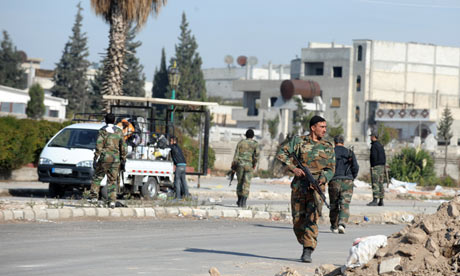
Syrian soldiers guarding the streets of Homs earlier this month. Photograph: Yin Bogu/Xinhua Press/CorbisSyrian soldiers guarding the streets of Homs earlier this month. Photograph: Yin Bogu/Xinhua Press/Corbis

On Thursday morning, I woke up in Homs, the city labelled by the international media as the “capital of the Syrian revolution”.

Homs has been in more or less open revolt since at least April, but in recent weeks what is going on here has acquired ominous new significance. Facing the full force of a crackdown on their demonstrations by the Syrian army and police, at least some of the city’s residents have taken up arms, either to defend themselves and their communities or to go on the attack.

Outside Syria and in the international media, the siege has become a cause célèbre. But events here show not only the courage and the forbearance of its citizens, but also the traps that lie in wait for an unhappy people suppressed by a brutal military crackdown.

I was lucky to get here. It’s not quite true that all foreign journalists are banned from Syria, but it was extremely difficult to get in, even before the uprising, and those who succeed are carefully shepherded around. It took me two journeys back and forth from Beirut even to get across the border into Damascus.

After a few days there, I went to the bus station and bought a ticket to Homs. A policeman was on hand to check foreign passports, but fortunately he didn’t bother to check mine carefully – it clearly indicates, by means of a Syrian government stamp, that I am a journalist.

My second stroke of luck was to have been befriended by an 18-year-old boy as we boarded the bus. An engineering student on his way back home to Homs, he was concerned that here was an idiotic tourist about to get himself into trouble. “There are no tourists in Homs,” he told me, looking serious. “My mother and father are afraid to go out. Yesterday my sister saw a body in the street, and she’s been crying ever since.”

On arrival, he ushered me past any prying eyes and directly into a taxi, going out of his way to take me straight to a hotel in the city centre. The city centre is the only safe place, he said.

Homs is a city of more than half a million people in the heart of the country. It’s where Syrians go to escape the hustle of Damascus, to let their hair down in its cafes and restaurants, or watch football: Homs boasts two football teams, as well as a museum where tourists can read about the famous battles that were fought here.

Nowadays it’s fighting another battle: the city is under total military lockdown. The hotel I’ve been taken to overlooks the main square and its now infamous clock tower, where the Syrian army apparently ran amok and gunned down peaceful demonstrators in April.

Since then, the violence has moved into the residential areas, and into the shadows. In the weeks before my arrival the death rate rose, making it the most violent place in the country.

On the road into the city, we passed at least 50 military vehicles that were going in the same general direction: a convoy of long green buses, lorries carrying munitions, and trucks with weary-looking soldiers sitting in the back, smoking and sleeping.

There were no tanks, but on one lorry was mounted what looked like a huge gun. Near Homs I saw one tank sitting by the side of the road, guarding a broad, freshly dug ditch about 100 yards long by the side of the highway. It might have been a trench.

Here in the city centre, however, all is quiet. Funereal. The battles between the Syrian army, the demonstrators and unknown armed groups take place just a mile or two away from here in densely packed residential areas like Baba Amr; another flashpoint, the hotel manager tells me, is Bab al-Sebaa, just a few hundred yards up the road.

He looks at me quizzically, but doesn’t ask questions – he’s happy to have a customer, whoever I am. The hotel covers four spacious floors, but tonight I’ll be the only guest. Before the disturbances there were 75 staff here, but now there are only three during the day and one in the evening.

In my luxury business suite a huge cockroach is circling through the air in the bathroom; when I turn on the TV, it sizzles at the socket and then goes quiet. I was promised a room without a street window, just in case. But there’s no hot water, so I ask to be moved to another suite. This, too, has no hot water; it will be working very soon, he assures me.

I say I’m going to get some food, but the manager is gently solicitous. I shouldn’t really go out, he says – I can eat at the hotel. When I tell him I need to stretch my legs, he points out the window at a single shopping street. Walk down there, he says, but don’t go too far and don’t be too long. Trouble is only a few hundred yards away: a short walk in the other direction, and you enter Bab al-Sebaa.

As I walk through the retail district, people are emerging from government offices and there are signs of normality returning to the city; at a functioning street market, some business is being done. Across the road from the main square, a skinny man in a long leather jacket is staring around and barks instructions to another man.

People hurry along the street and don’t idle, going about their business under the gaze of authority. And even here, everyone shuts up shop in the afternoon and scurries home.

In an electronics showroom, beneath a huge poster of President Bashar al-Assad and his father, I get chatting to a young man of about 20; he seems prosperous, starting off the conversation by talking about his expensive car. He’s also a little guarded, suspicious of my interest. “Why did you come here? By accident? How did you get in? There are checkpoints. Didn’t you know that the army are here, that there’s fighting?”

Who are they fighting, I ask him – terrorists? “No. The people.” Whose side you are you on, I ask. Can you say? There are two other people in the shop; he grins and looks at the floor. “No,” he says, making a show of not answering. “I don’t want to say.”

There have been rumours of kidnaps, he says – paramilitaries from the president’s own Shia Alawite sect who tell drivers to go down a certain road and then kidnap or kill you. You can avoid getting hurt if you stay at home all evening, but it’s no life. “If this keeps up I’m going to emigrate,” he says. “Maybe to Australia, until things get better.”

A friend of his was arrested yesterday after a demonstration at nearby Kalamoon University, between here and Damascus – one of the jewels of Assad’s fitful programme of economic modernisation. “The police were using electrical prods,” he says.

Maybe I could take a taxi to look around the city, I ask. Don’t do that, he says – if the driver is a friend of the government he will take you to their offices, and you’ll be arrested for being a journalist. I hadn’t told him that I was a journalist. I don’t want to be arrested, I say: I have a plane to catch. He turns a little testy. “It’s OK for you,” he says. “All that will happen to you is that you’ll be deported.”

Have you seen the tanks, he asks. Not in the town centre, I say. There are some parked just a few streets away, he says; I’d take you, but the soldiers might see you if you get too close. After the Arab League decision to suspend Syria three days ago, they painted them blue. “It was their way of saying the tanks aren’t really tanks any more.” He laughs at the innocence of it.

Amazingly there are still sporadic demonstrations throughout the city during the day. In one cafe I walk into, two workers are leaning out the window as though listening for something – for a moment they thought they could hear slogans and chanting, one of them says, but it might have been something else.

On the same street I find a fancy patisserie where a well-dressed manager in his 30s is doing very little. When the other customer in the shop shuffles off, he becomes much more talkative, smiling at me, but also deadly serious.

“There are 5,000 killed here in the last six months,” he says, a figure much higher than official estimates. “There is no water, gas or electricity for most people here.” Now I know why my hotel has no hot water.

“Unesco send things here, but this is no good. We can’t go on like this.” He pats an imaginary child. “They are killing little children.”

Why did I come here, he wants to know. Aleppo is safe, he says: there are lots of safe places. Should the president go? “How can he stay,” he says, rolling his eyes, “after all this killing?” He knows this much: “I want my freedom.”

Does he support the Arab League’s suspension of Syria? He nods. Does he say these things to people?” “No,” he says, as if the answer should be obvious, and runs his index finger across his throat.

His boss, a small businessman who lives outside Homs, arrives and pulls down the shop’s shutters. Nobody is buying anything, and it’s getting dark. For the next few hours, over leaf tea and cake, we talk.

The businessman’s mobile phone keeps interrupting us, with friends chiding him for even going to Homs. When he’s here he doesn’t leave the shop, he says – just comes and goes.

On the television we switch between Syrian state TV and al-Jazeera. The former is showing a demonstration of 300,000 people in Damascus in support of the president. The shop manager is quieter now, but both my companions agree that the president can still muster a measure of support for his ability to hold the country together, even if not in Homs.

Al-Jazeera is showing grainy images on mobile phones of detainees being brutalised by soldiers, while Syrian state television is showing the bound, bloodied bodies of men it says were assassinated by terrorists in Homs. All of this must be happening just a mile or two away, but no one really knows who is doing what to whom.

“Eleven killed today in Homs,” chuckles the businessman blackly, reading the statistic from a TV channel. “Homs is now the big problem.”

It doesn’t help that Syria is a police state. In the vacuum, rumours multiply. As we eat our cake, the businessman treats us to some of them. There is a story, he says, that al-Jazeera is paying people $20,000 for photos taken on their mobile phone. The self-styled Free Syrian Army, an outfit that seems to be on the rise, and which is posting a lot of video on the internet, might be out there fighting, and if so the best of luck to them – on balance, however, he thinks that they’re an illusion puffed up by Turkey. It’s said that both the government and the opposition are paying people to attend their demonstrations in Damascus. And he’s heard it on good authority that the police are pretending that drug dealers and criminals are demonstrators; after all, he says, that way they’re “outside the law” and can simply be killed.

“All the conspiracies are true,” says the businessman. “Turkey and Qatar and the Saudis have their own axes to grind, and reasons to weaken Syria; they’re playing with us.

“Arabs,” he continues, “what have they done for us? They’re oh so concerned about us, but less keen when it comes to giving us visas to their countries.”

The shop manager agrees, but maintains he’s still proud to be Arab. Both can agree that they’re Syrian above all else. Nato gets no more than a snort; no Syrian, says the businessman, wants another Iraq. He doesn’t even want another Libya.

Syria is very far from being another Iraq – at least for the moment. From what little I saw, travelling back and forth between Damascus and Homs, the talk of “civil war” is premature and a little overheated. Most of Damascus is carrying on very much as normal, even if its residents are a little more hushed and fearful than usual. It’s in the capital’s suburbs – places such as Douma and Harasta, where huge swaths of the country’s neglected, humiliated poor live – that the demonstrations after Friday prayers occur.

But what’s embarrassing for the authorities about Homs, says the businessman, is that here the violence is taking place within the confines of the city itself; that’s why they’re cracking down so hard.

Taking pictures on your mobile phone can be enough to invite trouble. After people were gunned down in the huge demonstration at the clock tower in April, he says, Sana, the Syrian news agency, brought crowds and people armed with cameraphones to the main square to show that life was getting back to normal. But, according to the businessman, a police sniper saw the cameraphone snappers and opened fire. A few people were hurt. “Mistakes have been made,” he says, with another gallows chuckle.

He thinks that the president is a smart and decent man, undermined by shadowy forces within his own security establishment. “He didn’t sleep for three days after some of the killings, a friend of mine who knows told me.” But should the president stay in power and try to reform the system? “Too little, too late,” he says, with a flick of the wrist. “Go.”

The businessman is sleeping above the shop tonight, and the shop manager will walk the short distance home as usual. But he’s not happy about it: he’s had friends who have been hit by stray bullets.

Why not get a taxi, I ask. It’s becoming difficult, he says. Both my companions are Sunni, and both speak of discrimination against Sunnis in the country at large, but the shop manager says that taxi drivers are beginning only to pick up passengers from their own religious affiliation; the city itself, he says, is beginning to fragment along doctrinal lines. The businessman is not sure he agrees.

I walk back the 100 yards to the hotel with the shop manager and bid him goodnight. The hotel rooms are all unlocked and empty, so I walk around the place and spy on the streets down below. In the middle of a city of hundreds of thousands of people, there’s not a sound. Occasionally a few white army pickup trucks zoom up, and the soldiers jump out and investigate a building.

I sit a while with the hotel manager in the bar area. We look out, and see what at first looks like a man carrying a gun ambling down the street. Then we realise it’s an old woman carrying a bag. “She must be mad,” he says.

We retire to bed. During the night there’s the odd crackle of gunfire, and a small explosion, but nothing else.

In the morning I go out walking again and pay another visit to the electronics showroom. I hand over some money for internet access, but it doesn’t work. “Oh, that happens a lot,” the man says. “They shut it down, usually for only a couple of hours at a stretch. And especially on Thursday – the day before prayers.”

I walk a bit further, and meet the shop manager again; we’re walking in the same direction, towards the clock tower, where all that remains of the April demonstration is a single graffito in Arabic.

“There were 70,000 people here,” he says, “and the police were doing this”: he mimics the act of shooting from a machine gun. I bid him goodbye, afraid that he might draw attention; a few hundred yards away, two soldiers with Kalashnikovs are guarding a government building.

After another cursory attempt to walk up and down the few roads open to me, pretending to be a shopper, I give up. As a foreigner, I stick out like a sore thumb; not wanting to be arrested and have my notes taken, I return to my hotel room and pace up and down until it’s time to leave. In a way, it’s what the residents of Homs have been doing for the last seven months, only in much more gruelling conditions.

I want to get out of this hothouse, as quickly and as efficiently as possible. The businessman is going to Damascus, and offers to take me with him. As we go, we pass through the central square, the scene of many attacks. Hardly anyone is around, not even many soldiers; both sides are preparing for what might happen tomorrow, after prayers.

Turrets made out of sandbags are built up on one side of the road, where soldiers have dug themselves in. As we drive, the businessman confides that he, too, plans to emigrate – only for a few years, until things have got better.

Most people here, however, can’t afford to leave, even if they wanted to. Before we got into the car I went back into the pâtisserie shop one last time to buy some cake. The manager had a glint in his eye, and he said goodbye with a welcome. “Welcome to Syria,” he said, smiling his enigmatic smile. “Welcome to Homs.”
Meeting with Bashar Alassad

Translation by Sheila on Walls

This is what Bashar Alassad said during his meeting with us:
by Houssam Arian on Friday, November 18, 2011 at 3:03pm (from FB)

First, I would like to point out that I refused to publish the disastrous aspect of our debate earlier. What I said, was published by Alsafir Newspaper in one sentence that boils down to this: We went to propose solutions, not to ask for personal favors, despite that, some of the people present did have personal favors to ask. I would also like to say that I resent the question: “what are your demands?” that we heard over and over from every regime representative that we met and earlier over the broadcast of “the students’ voice”. It felt like we were there on a begging mission.

On May 5, 2011 and through a phone call that I received from the Student union of Syrian students, I was informed that my name came up along with a group of other Syrian youth from all over Syria, to attend a meeting with the president Alassad to discuss the current situation. I was also told that the meeting will take place in two days, i.e. on May 7, 2011. I accepted and traveled to Damascus to attend the meeting at the presidential palace. We all went in. A group of 14 young men and women. After they welcomed us and we introduced ourselves, the meeting started. I chose to be the last to ask any questions about problems and solutions, hoping not to steal anybody else’s ideas without realizing it. Here is what amazed me in terms of the answers that we received:

We have to activate the role of the Baath party, because in the last few decades, the Syrian citizens did not feel the importance of the ruling party in the government.

This was the president’s answer to a young woman who came from Homs, when she asked about the proposed idea to cancel article 8 of the constitution with the utmost speed, so that we avoid arguments and allow the opposition free speech and permit the establishment of parties opposed to the Baath party.

Military service, in its current condition is in fact national service. Even if you thought of a doctor manning a check point and fighting. In doing so, he is in fact serving his nation.

This was the answer that one of the participants from Qamishli received, when he suggested that we should transform the concept of military service into national service. This will allow us to use the young conscripts in their fields of expertise, like sending engineers to participate in government projects or sending teachers to teach in underserved areas. This will achieve two objectives: first, is covering all the schools in Syria and second, is saving a good amount of money that can be used to improve the schools infrastructure in some areas.

It was the turn of a guy from Hasakeh, who had a simple request: can we stop the beatings and killings by the intelligence services. If they are trying to arrest someone, why don’t they do it with a little respect?

The answer was that we are working on training police forces specializing in dealing with demonstrations. They will start their work within the next few months.

I believe that these were the most important questions asked before it was my turn and I asked three questions:

The first was that since the government account of what is happening in Syria is the truth and not lies and fabrications, why don’t we allow the press to come to Syria and see what is going on to prove once and for all that the Syrian government is telling the truth.

The answer was that we do not need the outside press for two reasons: first, because press agencies have reporters all over the world except in Syria, this is why they need to get their news from our Syrian press and we will give them the truth about what is happening on our soil, second, our press throughout these past years never had the chance to shine on the world stage. Today it is taking advantage of this opportunity to increase its expertise in this field.

My second question was: Arabs in general tend to lean to the emotional side. This characteristic is a good one, but can prove detrimental if it is not dealt with properly. This is why I suggest that the intelligence services avoid random arrests and treat detainees in a humane and civilized manner.

The answer was that yes, we are emotional, and to overcome what you talked about, we should first and foremost, follow the truthful press on this earth. this will help guide us on where to go with our emotions. I have also answered your friend that we are working on training the police to deal with the demonstrators with respect.

My third question was: since you have the leadership, the wisdom and the judicial system, why haven’t we seen till this day any trial for those who are complicit and guilty of killing Syrians like Atef Najeeb?

The answer was with a lowered head: yes, Atef Najeeb is complicit, but no one filed a law suit against him. In addition, he is my first cousin and I have not seen him in 22 years.

Here I could not control myself and dared to interrupt him to point out that only yesterday a few of my friends were arrested during a demonstration that they were not even participating in. When we went to try to get them out through the judicial system, we were told: who are you going to sew? Here he asked me to give him the names of my detained friends, but I had one more question: what is the fate of the other detainees? He continued addressing the group saying:

yesterday there were 19 people arrested in Seif Aldowleh, all of whom are hobos.

I interrupted him again to say: of the 19 that you just mentioned, 5 are doctors. In addition, the arrests that night exceeded 200. Then I continued: and how about the new demonstration law?

His answer was: we do not care who is demonstrating, rather who is documenting the event and sending it to the foreign press.

After a few seconds, his personal guard came in to tell us that our time was up. Before we left, the president asked if one of us would volunteer to appear on Aldunya news channel live, to talk about our meeting with him. He received no answer from anyone of us. Everyone was quiet for a little while, when he interjected: has it reached that level? The answer came from me and the person next to me simultaneously: and a lot more.

Dissident: A tiny push will end al-Assad regime

Friday, November 18, 2011

Barçın Yinanç
ISTANBUL – Hürriyet Daily News
People in the Baath party are waiting for another vessel to come along to jump from the regime ship, says a member of the opposition. There will come a time when the regime will fall with a tiny push, according to Khaled Khoja, who is a member of Syrian National Council, which is seeking for international recognition.
The second meeting with Foreign Minister Ahmet Davutoğlu was tantamount to moral recognition of the Syrian National Council, says its member Khaled Khoja (R), speaking in his personal office in Istanbul.  DAILY NEWS photos, Hasan ALTINIŞIK
The second meeting with Foreign Minister Ahmet Davutoğlu was tantamount to moral recognition of the Syrian National Council, says its member Khaled Khoja (R), speaking in his personal office in Istanbul. DAILY NEWS photos, Hasan ALTINIŞIK

Q: What makes you say the Syrian National Council (SNC) represents nearly 80 percent of the Syrians, which is a very ambitious claim? 

A: The gist of the SNC was actually a gathering of diaspora opposition who were seeking ways to support the demonstrators on the streets and had no claim to representation. But when the regime attempted to establish an alternative opposition group, the street forced the outside groups to assume responsibility. So we take our legitimacy from the street.

Q: What is the street? How can you judge their support from here?

A: There have been three consecutive Friday events when banners saying “SNC is our representative” were carried. There are three groups in Syria representing the streets and all three of them support us and have their representatives in the SNC, whose names are not disclosed obviously. The Muslim Brotherhood, Kurds and Christians also are represented in the SNC.

Q: The opposition meetings took place in Turkey. What was Turkey’s role during the whole process?

A: Actually Turkey did not really have a warm approach to the first congress in Istanbul.

Q: But even the fact that it let the congress happen is important.

A: But we did not ask for permission. Actually it was not really like a meeting of the opposition. It happened rather like a brain-storming by intellectuals. It was organized by Turkish NGOs. But opposition figures got to know each other in that meeting. When the regime sent a group to sabotage our meeting in Antalya, Turkish authorities said to them, go hold your own meeting in another hotel. They said this is a democratic country, people can hold meetings. It is then that we realized a change in attitude, and we said if we hold a congress the government won’t object.

Q: So Turkey was not behind this process.

A: No it was not at all. Its position was, “We neither say come here nor do we say go away.” But we also insisted for the meetings to take place in Turkey. Most of the participants have Syrian passports; there are no visa requirements for Syrians. We had visa problems with France, we tried but couldn’t organize it there. It is easy to come to Turkey from abroad. It is a secure country. At one stage there were discussions to go to Cairo. But some of our friends were attacked by Assad supporters in Cairo. We have easy access to media. Our friends from Paris were surprised as there were 20 cameras at our meeting. We need to be heard by the international media, which is present in Turkey. So there was not a better alternative.

Q: What now are your relations with Turkish government?

After the establishment of SNC we started to communicate at the level of Prime Ministry’s advisors and Turkey started to monitor the SNC. We then had our first meeting with Foreign Minister Ahmet Davutoğlu. The second meeting was like a moral recognition. Turkey has been looking for a solution through persuasion with minimum loss of life. Turkey was never focused on military intervention. We know from the Libyan experience, Turkey never wants Muslims to kill other Muslims, it will never give weapons. We were also told so by the Libyans when we went there. They said: “Turkey helped us a lot, but it gave only financial help. It did not give one single bullet.” But Prime Minister Recep Tayyip Erdoğan said Turkey would not stand silent if there are mass atrocities. The Arab League’s call for the protection of civilians is very important. So I believe Turkey will work for the implementation of sanctions. But if the regime continues to escalate violence, then I believe the next step will be a process leading to the establishment of a no-fly-zone and/or safe zones on the Turkish and Syrian border.

Q: So you believe Turkey will look to that positively?

A: The conditions of the Arab League are very clear. With the decision it took, the whole region has entered a very historic process. What is important from now on is to secure a consistent process.

Q: But how will this take place?

A: We are against military intervention, the type we have seen in Libya. What is very important are the streets in Syria. It is very important that they maintain their unity despite provocation from the regime. The NSC did not close its doors to anybody. We keep giving satisfactory messages to even the supporters of the regime. The regime stands on three pillars: the army, the Baath party and the regime’s financial supporters. Defections have started in the army. The people from the Baath party are waiting for another ship to come along to jump out from the ship they are on. Businessmen started to transfer their money from Syria. The regime is weakening from the inside and there will come a time it will just fall down with even a tiny push. It may take between six months and a year.

Q: But there are also important communities like minorities who continue to support the regime because they fear reprisals. There are fears of civil war.

A: But there have not been ethnic clashes since the beginning of the events. If there had been, for instance Sunnis attacking Nusayri villages, believe me the regime would have made them public. We also have Nusayri supporters. There have never been clashes between Muslims and Christians or between Nusayris and Sunnis.

Q: How about the massacres in Hama and Homs.

A: But they were not seen as sectarian clashes. They were seen as the regime’s effort to make the Nusayri part of these clashes so that the regime would share the same fate.

Q: How then will the transition process be if the regime falls?

A: Our red line is that we are against the revolution taking up arms. We are against ethnic civil war. When the regime falls, this will mean that the current regime of fear, based on the intelligence agency and the Assad family that controls it, will fall, while all other state officials will remain in their position. The SNC will abolish itself once the regime falls.

Q: Some fear radical Islamists and extreme Arab nationalists will replace the current regime.

A: This is being said for all Islamic countries. It was said of the Justice and Development Party (AKP). It was said after the revolution in Tunisia. Islamists movements became more pragmatic and less ideological. We saw this in the Turkish model. Islamic movements focused on providing services, not on ideology. It is their biggest success and other Islamic movements need to get adopted to the global culture and to the thoughts of younger generations.

Q: What is your evaluation of the Syrian Free Army?

A: These are soldiers who flee the army saying their mission is to protect civilians, not to kill them. But the clashes are mostly directed at those fleeing and them shooting back. But they cannot do much when their ammunition runs out. They stand more of a chance if there is a no-fly zone or safe zones. This will also increase the fleeing. But we do not advise the Syrian Free Army to launch attacks right now because it will complicate the situation and lead to internal conflicts.

Khaled Khoja was born in Damascus to a family with Turkish roots. He was interred in Syrian prisons in 1979 when his father provided financial support to the Muslim Brotherhood when uprisings started in Aleppo. He fled Syria in 1982 for Turkey, where he built a career as a doctor. Facing capital punishment, he has not returned to Syria since.

Following the sart of unrest in Syria in March, he became the head of the Turkey committee of the Damascus Declaration. The Damascus Declaration in 2005 was a historic statement of unity by opposition figures criticizing the regime as being authoritarian and calling for reform. Since then he has been participating in the meetings of the opposition groups, becoming a member of Syrian National Council.

Friday, November 18, 2011

نشيد البقاء-حمص قناة العربية – تقرير عن الثورة في حمص ج1 HOMS

[youtube http://youtu.be/Wh9ahIvrQY0?]

Part 2

[youtube http://youtu.be/RDAhEbbOzOQ?]

Honored as a Freedom Rider

Nov 16, 2011

I was honored to be a freedom rider and it was team effort at its best (those who rode and the many who worked behind the scenes).  Two other Palestinians were also arrested with us who were there as a reporters/observers not participants. All eight of us were released eventually pending potential trials. Fajr kindly gave us a ride to the edge of Beit Sahour from Ramallah (we were released at Qalandia checkpoint) where my wife met us there with my car and then she and I gave a ride to Nadim and Badi’ to Hebron.  I thus arrived home at 1:30 AM and the phones started ringing again at 7 AM.  I am extremely tired and with a headache but wanted to send you a brief report and links to stories about this amazing and inspiring experience. While released, we are still charged with “illegal entry to Jerusalem” and with “obstructing police business” pending potential trial.
This was one of the most heavily covered media events I ever participated in.  It was also streamed live on the internet and nearly 100,000 people signed a petition of support for us freedom riders (https://secure.avaaz.org/en/palestine_freedom_riders/?aerQkcb). Thus, I do not need to write to you in detail about how three buses refused to let us board and then one driver (who later told journalists he did not know what was going on otherwise would have also refused) allowed us on the bus and what happened on and off the bus.  Below are some links to stories published that give you a taste of this. Note especially the signs that we carried and showed before we rode the bus and from the windows of the bus (I am the one with the “DIGNITY” sign).  Perhaps I will write more personally when my mind is clearer and I have had some sleep. But there are two anecdotes that happened that are kind of unusual and funny and in some way worth telling while they are fresh in my mind:
-They took me to the Shabak (“Israeli intelligence”) guy before they took me to the investigator for the bus issue.  The Shabak guy did not ask me about the bus at all.  He introduced himself as head of the Shabak area of Ramallah (and previously of Nablus and Jenin).  He asked me if I was abroad recently.  I said yes.  He said what happened when you came back.  I said I was interrogated at the bridge.  He said “come-on interrogating is a big word”. I said I do not know what else to call an 8 hour delay including 2 hours of actual questioning.  He said what else they told you.  I said that the interrogation would continue and that there is a captain “Suhail” or “Suhaib” or something like that who will call me later.  He said that that it is him and his name is “Shihab”!  I said “well then maybe we will save another visit”! He told me that is not likely as I seem to continue to “cause problems and violate laws”. I said there is something called international laws and the Universal Declaration of Human Rights.  Denial of freedom of movement and entry to Jerusalem while allowing colonial settlers to live on our land and have freedom to travel in and out of Jerusalem on segregated buses is a violation of the International Convention Against the Crime of Apartheid. We also engaged in a political discussion and I explained about why Israel now has no incentive for peace (the three main sources of income for it would all dry up if there is peace) and my views of a democratic, pluralistic country for its entire people.
-One young Ashkenazi soldier was very arrogant and even called me “Professor Teez” (Teez is arabic for “ass”).  We all (freedom riders) laughed it off and I told him that I did not insult him and that when someone insults me they demean themselves first.   When he repeated it after my interrogation by the Shabak, I stood up and confronted him and the Druz officer intervened and the soldier moved away. There were other incidents with other people similar showing that our collective attitude was strong, defiant, and resilient.  We all had Palestinian Kuffiyyas and kept wearing them.  Fadi even wrapped himself in the Palestinian flag the whole time except when they did the full body search.  We have some video from inside the compound which I will share later.
I came out to find the news that the Zionist mayor of New York Mike Bloomberg ordered the clearing out of the “Occupy Wall Street” protesters for now; a very important protest *.  But my reading of history and trends tell me that the global intifada will only accelerate as a result of repression by the powers to be.
Freedom Riders odyssey:
http://www.jpost.com/DiplomacyAndPolitics/Article.aspx?id=245717 (there is a picture here of me being taken off of the bus)
*Arundhati Roy: Occupy Wall Street is “So Important Because It is in the Heart of Empire”
Posted by Qumsiyeh at 11/16/2011

Blog at WordPress.com.

Up ↑