Search

band annie's Weblog

I have a parallel blog in French at http://anniebannie.net

Month

October 2011

For Syrian activists abroad ‘there’s no turning back’

October 04, 2011 01:00 PM By Brooke Anderson

The Daily Star
Demonstrators, during a solidarity protest for Syria, in Geneva, Switzerland, Saturday, May 28, 2011. (AP Photo/Keystone/Sandro Campardo)

BEIRUT: When Malek Jandali’s parents were brutally attacked at their house in Homs in July following a performance by the renowned Syrian pianist of his song, “Watani Ana” (I am my homeland), he canceled the rest of his tour for fear of further reprisals.

Then, two weeks ago, he posted graphic photos of the aftermath of the attacks on his parents on Facebook, in an album he called “Mom & Dad after Brutal Assault by Syrian Government Thugs.”

Like Jandali, an increasing number of expatriates are speaking out against their government, despite knowing the potential consequences of their activism.

For many the benefit of expressing their opinions outweighs the cost of continuing to live in fear for their loved ones, a sentiment that would have been hard to come by before the uprising began six months ago, since when more than 3,000 people have been killed, mainly civilian protesters, and more than 10,000 detained in the government crackdown.


“I’m not worried about it anymore. For me and others close to me who’ve spoken out, there’s no turning back,” says Omar Dahi, an assistant professor of economics at Hampshire College in Massachusetts.

The Syrian expatriate, who had never before publicly criticized his government, says he thought long and hard before writing a detailed account of a trip he’d taken to several cities in Syria over the summer. In “A Syrian Drama,” published Aug. 13 on the blog Syrian Comment (considered sympathetic to the government), Dahi leads by writing “The Syrian regime is in big trouble” and that “the regime is effectively done.”

Instead of fearing for his family’s safety, Dahi says he now feels an obligation to speak out.

“People inside are taking so many risks, and we need to share the burden,” he says.

“It’s imperative to speak out. If you retreat now, then they’ll go after everyone. It’s the best way to support people on the inside. The protesters want us to speak out and follow their lead.”

Although nothing has happened to his family in Damascus so far, Dahi says he still doesn’t speak with them about sensitive topics over the phone.

“I still don’t discuss politics over the phone. It’s changing. People are starting to discuss things online. People are careful, but much less so than a few months ago. And there are more debates taking place within the protest movement,” he says.

Indeed, as Syria’s protest movement matures, there is increasingly vocal discussion within the expatriate opposition about how to move forward.

Amr al-Azm, a member of the National Council, which formally launched this weekend, who lives in Ohio where he is a professor at a Shawnee State University, says taking part in the opposition at such a prominent level leaves him particularly vulnerable.

“When they want someone and they can’t get them, then they go after their family. I expect no less from them,” he says. “I’m very concerned because they’re my family and they [the government] are doing everything they can to prevent the opposition from doing any activity.”

Some of Azm’s colleagues have been attacked both inside Syria and abroad for their activities, but he believes that the increased threats make it imperative for Syrian activists to continue to speak up.

“The regime can only sustain the pressure and the climate of fear for so long. Both the regime and the protesters have passed the point of no return.”

Another prominent activist in exile, who spoke on condition of anonymity for fear of reprisals, says his wife’s family in Damascus has been threatened by the authorities there. He admits that if the threats against his in-laws get worse, he may halt his activities.

It’s unclear how the Syrian authorities have been able to link Syrian activists abroad, particularly the less-prominent ones, to their families back home. But some people have accused the Syrian foreign missions of supplying information on dissidents abroad.

In an email message to The Daily Star, the Syrian Embassy in Washington stated that “there have been concerted efforts recently by individuals and the media to spread lies and distortions regarding the Embassy of Syria. These preposterous allegations claim that the Embassy is involved in targeting or intimidating Syrian expatriates in the U.S., which is absolutely untrue.”

The statement claims that such allegations are “an outrageous travesty of truth, promoted and proclaimed by vicious circles, [and] come within the framework of an extensive campaign to instigate hatred and incite animosity.”

Syrian-American activist Ammar Kahf acknowledges that it is “difficult to prove a connection between someone taking a picture of activists here in Los Angeles, and an arrest occurring in Damascus.”

Other activists blame Facebook for giving authorities an easy reach to activists abroad.

[youtube http://youtu.be/fjqR7H6YumE?]

As most foreign journalists have been banned from reporting from the country, much of the reporting inside the country has come from citizen journalism, using cellphone cameras, YouTube and Facebook.

And while the social networking site has served as a powerful tool for organizing anti-government protests, it has also been used by the authorities to track dissent.

After being blocked for three years, Syria reversed its ban on Facebook and YouTube in February this year, a few days after small protests began to emerge, leading some to speculate that the policy was aimed more at increasing government monitoring than loosening its grip.

A young student from Latakia who became an activist when the uprisings began posted videos on Facebook of the Syrian protests from Germany. He then got an anonymous message saying, “We can’t get you, but we can get your family.”

Another Syrian activist abroad, who wished only to use his first name, Mohamad, says he had to “defriend” some former college classmates from back home who were writing abusive messages on his Facebook wall after he posted critical comments about his government.

He says he chose to speak out because he could no longer stand idly by as the violence against peaceful protesters mounted. Still, he doesn’t discuss the situation with his parents over the phone.

“Lately, my elderly parents have been so scared to talk to me. Every time we talk they want to assure me they are doing very well and hang up. I’m not sure why they do that,” Mohammad says.

The situation in his home country is also affecting his family financially.

“My brother is a professional who lost his job and cannot find a new job,” he says. “I had left some money back in Syria last time I was there, and now I told my family to use it, this was to be a payout to the Syrian government in lieu of me serving in the army. Of course, we are not going to pay them now.”

A Syrian-American activist, who requested anonymity because his family in Damascus had recently been threatened, says that it is precisely because of this fear that people must speak up.

“Syrian expats know too well that the regime will not hesitate in harming relatives in Syria to silence all voices abroad supporting freedom and democracy,” he says. “It is more reason for me to speak out against such a regime that has no value for human life and dignity.”

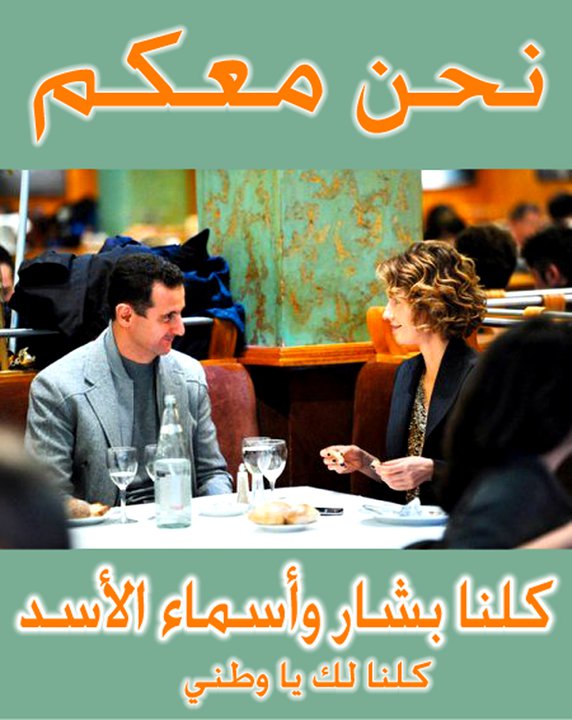
Propaganda and Lies: A Collector’s Guide

For the full collection click HERE


This one aims at showing the family man. It says “We are with you. We are all Bashar
and Asma al Assad. We are all for you oh nation.” These pictures are from the famous
visit that Syria’s royal family had to Paris a few years back. The designer clothes, the expensive restaurants. Perfect photo-opportunities. Lovely.

Is Syrian Civil War a Self-Fulfilling Prophecy?

A revolution that began peacefully is turning to weapons in self-defense. Can all-out bloodshed be stopped?

BY ROBIN YASSIN-KASSAB | SEPTEMBER 29, 2011

From the start of the Syrian revolution, the Assad regime’s media have portrayed the overwhelmingly peaceful grassroots protest movement as a foreign-backed military assault. Its preferred catchall term to describe the tens of thousands of patriots it has kidnapped and tortured, as well as the thousands it has murdered, is “armed gangs.” Despite a series of televised “confessions,” the regime has not provided any serious proof of the supposed American-French-Qaeda-Israeli-Saudi-Qatari plot against the homeland. Nor has it explained the evident contradictions between its narrative and the thousands of YouTube videos and eyewitness accounts of security forces shooting rifles and artillery straight into unarmed crowds.

Of course it hasn’t. Yet its propaganda is taken seriously by Russian and Chinese state media, certain infantile leftists, and a vaguely prominent American academic.

Those Sunni Syrians who are (understandably) enraged by the minorities’ siding with the dictatorship should remember first that many Alawis and Christians, as well as many more Druze and Ismailis, have joined the revolution and that many have paid the price. Second, Sunnis should remember that Alawis and Christians have good reason to fear change, if not to believe the propaganda.

Alawis have a complex, esoteric religion that throughout history has been savagely denounced, and its adherents savagely oppressed. Ultimately it’s a matter of political interpretation whether or not Alawis are to be considered Muslims. The Ottoman Empire didn’t even consider them “People of the Book,” which meant that unlike Christians, Jews, and mainstream Shiites, Alawis didn’t enjoy any legal rights. The ravings of the influential medieval scholar Ibn Taymiyya (who thought Alawis were “greater disbelievers than the Jews, Christians, and Indian idol-worshipping Brahmans”) contributed to their oppression and justified the theft of their lands around Aleppo and their forced retreat into the mountains. Until the 1920s, the Alawis were stuck in those mountains. Antakya (Antioch) was the only city where Alawis lived with Sunnis, and Antakya was gifted by France to Turkey before the independence of the modern Syrian state.

Most Alawis today are not particularly religious. Far from pushing Alawi tenets on the general populace, the Assads discouraged the study of the faith and repressed the traditional Alawi clerics. As a result, if individual Alawis do turn to religion, most tend to practice Sunni or mainstream Shiite rituals.

Of course, as far as the business of state is concerned, it should be entirely irrelevant whether or not Alawis are Muslims or even People of the Book. As Syrian citizens they should be guaranteed the same rights and the same access to political office as anyone else. It would help a great deal if revolutionary leaders and Sunni clerics were to state this as clearly and as often as possible. The blatant anti-Alawi sectarianism of Sheikh Adnan al-Arour (given prominence by Saudi Arabia) and Sheikh Yusuf al-Qaradawi (given prominence by Al Jazeera), both supposed friends of the revolution, does not help at all. Speaking to “those [Alawis] who stood against us,” Arour recently promised, “I swear by God we will mince them in grinders and feed their flesh to the dogs.”

The one thing the regime has done intelligently in the last six months is to play on minorities’ fears. I know that prominent Alawis have been receiving threatening phone calls from unknown numbers, ostensibly from “Sunnis” but almost certainly from the mukhabarat. (How would street-level Sunnis get hold of the phone numbers, and why would they want to make such threats when the committees coordinating the protests are stressing the importance of avoiding sectarianism?)

source

Glenn Greenwald: With al-Awlaki, US Launches New Era of Killing US Citizens Without Charge

[youtube http://youtu.be/vh9ZrJEHXEQ?]

See also http://essential-intelligence-network.blogspot.com/2011/10/awlaki-assassination-marks-phase-shift.html

Son of Israeli general speaks for Palestine

Wednesday, September 28, 2011
Miko Peled.

Israeli activist and author Miko Peled, currently touring Australia, is convinced that the Israel-Palestine conflict can be solved.

But, he told public meetings in Sydney and Newcastle, he doesn’t believe that it will happen while the government of Israel remains committed to Zionism (the maintenance of Israel as an exclusively “Jewish” state) and continues its ethnic cleansing operation by moving Palestinians off their land.

“It is not some inexorable process of nature,” Peled said. “It is a conflict between people, and it is therefore something over which people can have control.”

Peled was raised in a prominent Zionist family in Jerusalem. His grandfather, Dr Avraham Katsnelson, was a Zionist leader and signatory to the May 14, 1948 Israeli Declaration of Independence.

Katsnelson was also a member of Hashomer Hatzair Workers Party of Palestine that, in 1946, was the sole Zionist political organisation in Palestine at the time that recognised the national rights of the Palestinian Arabs.

Peled’s father, Matti Peled, was a young officer in the war of 1948 that led to Israel’s establishment. He was a general in the war of 1967 when Israel conquered the West Bank, Gaza, Golan Heights and the Sinai from Egypt, Jordan and Syria.

When he retired, Matti Peled became part of a group of retired army officers who met secretly with the Palestine Liberation Organisation to work on finding a two-state solution.

Peled recounted several life changing episodes — including the death of his niece from a suicide bombing attack in 1997 and the deaths of children of several Palestinian friends — that pushed him to discover and understand the true nature of Israel’s ongoing war on Palestinians that was having such a devastating impact on his family and friends.

He is now a fearless campaigner for one secular state for Palestinians and Israelis in which all live in equality.

He also supports the non-violent boycott, divestment and sanctions (BDS) movement against Israel. He said the boycott of Max Brenner cafes was not anti-Semitic, explaining how the Stauss Group openly support the Israeli government’s apartheid politics and an Israeli army unit responsible for war crimes.

He added: “All businesses based in Israeli are a legitimate target, since all of Israel is based on Palestinian land.”

Peled was asked to brief the ALP’s foreign affairs committee in Canberra. He said he was asked some strange questions in response to his argument for one democratic secular state. Someone asked, “But wouldn’t the Arabs outnumber Jews if there was a single state?” Peled answered, “Yes. And?”

Responding to foreign minister Kevin Rudd’s accusations that BDS was “anti-Semitic”, Peled said there is no comparison. “Then, the Jews were victims. Today, it is the Israeli Defence Force [IDF] that is a terrorist organisation. Mr Rudd should be proud that Australians are standing up for the cause of justice and supporting the BDS.”

It takes enormous courage to stand up against the Zionist mind-set Israelis are raised with. Peled recounted a moving story about his first journey to the West Bank. It was a pivotal moment.

Driving past the Israeli checkpoints into the West Bank, in an Israeli-plated car, he suddenly felt very unsafe. His unfounded fears worsened when became lost and felt he couldn’t ask for directions as he only spoke Hebrew.

He finally managed to arrive at his destination in Bil’in — unscathed.

Peled now laughs while narrating this story. But he expresses concern that Israelis are taught from a young age to be racist by the racism embedded in their text books. For example, school maps of Israel do not include any Palestinian towns.

Children grow into adults only knowing that Israel is surrounded by it Arab neighbours and have little or no idea of the reality of the Occupied Territories.

Peled references tragic personal events alongside Israel’s 2008-09 attack on Gaza as examples of terrorism. He describes the 2008-2009 Israeli attack on Gaza — Operation Cast Lead — a deliberate act of terrorism committed against children.

“Gaza is a children’s land: there are 800,000 children there. The aerial bombing was timed to start precisely when the first shift of Palestinian school children were leaving school to go home. The second shift were leaving home to go to school.

“The Israel pilots who carried out the bombing went home every night to their wives and families, and go up the next morning to do it again and again.”

His conclusion is that Israel is a terrorist state, that Israel’s conquest of Palestine has been made “irreversible” and that a Palestinian state based on the territories Israel occupied in 1967 (the West Bank and Gaza) “can never emerge”.

Referring to the Palestinian Authority’s current push for a Palestinian state in the United Nations, he reminded people that the UN had already voted that way — in 1947. When Israel was created, in 1947, an overwhelming majority of countries voted in favour of the Partition Plan: 33 in favor, 13 against with 10 abstentions.

“However Israel immediately set out to conquer some 80% of the remaining Palestinian territory, destroying hundreds of homes and forcing some 800,000 people to flee. Its aim was to make sure the conquest of Palestine was irreversible, to prevent any possibility of a Palestinian state emerging.”

Peled exposed the myth that Israel launched the Six-day war in 1967 because it faced an external threat from neighbouring Arab states. Rather, his father, General Peled, urged the Israel cabinet to attack its neighbours arguing that an opportunistic attack would succeed as the Arab states were “unprepared”.

Peled said that documents from cabinet meetings prior to the war confirm that there was never any mention of any existential threats.

Immediately after the war, his father argued for a Palestinian state to be set up in the West Bank and Gaza Strip “to avoid Israel becoming an occupying power”. This was advice the Israeli Cabinet did not take.

“The two-state solution may have been possible 50 years ago”, Peled argued, “but not now.”

“Both sides have much the same population but Israel takes 80% of the resources. Palestinians are given about 1/20th the amount of water allocated to the Israeli settlers, for instance, and Israel refuses to negotiate this.”

But Peled believes that there is hope. “There is growing discussion that Israel has to change from being an occupier to a democracy”, Peled said. Citing the uprisings across the Arab world, Peled commented that mid way through last year it was inconceivable to imagine Egypt without Mubarak. “Change doesn’t happen from a single cause or reason. Apartheid in South Africa fell because of pressure from the outside, as well as within.

“Zionism is incompatible with peace because it offers no compromise. The only solution is to dismantle the Zionist framework and apply the rule of law equally to both people. It is not impossible, because the people of Egypt remind us that nothing is impossible.”

[Miko Peled’s book, The General’s Son will be available in February 2012. To find out more click here.]

Al Jazeera’s Jane Arraf reports on the Syria latest

[youtube http://www.youtube.com/watch?v=kTAXEcJ16P8&feature=colike?]

Blog at WordPress.com.

Up ↑