by Jen Marlowe
Just months after the Israeli assault that killed 1,390 Palestinians, I visited Gaza. Among dozens of painful stories I heard, one family stood out. I spent several days with Kamal and Wafaa Awajah, playing with their children, sleeping in the tent they were living in, and filming their story.
Wafaa described the execution of their son, Ibrahim. As she spoke, her children played on the rubble of their destroyed home. Kamal talked about struggling to help his kids heal from trauma.
What compelled me to tell the Awajah family’s story? I was moved not only by their tragedy but by the love for their children in Wafaa and Kamal’s every word.
Palestinians in Gaza are depicted either as violent terrorists or as helpless victims. The Awajah family challenges both portrayals. Through one family’s story, the larger tragedy of Gaza is exposed, and the courage and resilience of its people shines through.
For more information or to purchase a DVD or organize a screening, please contact donkeysaddle@gmail.com
Monday, January 3, 2011 at 9:37PM  Gilad Atzmon
Gilad Atzmon Given the severity and uncertainty of the economic crisis we are all experiencing, I suggest we look once more at the work of Milton Friedman, the leading economist and a staunch advocate of hard capitalism.
During the 1960s -80s Friedman was regarded by many academics, politicians and world leaders as the most important post- World War Two economist. Friedman was chief economic advisor to Ronald Reagan, Margaret Thatcher and Menachem Begin. He also went on record advising the Chilean military dictator Augusto Pinochet.
It is far from surprising to note that more and more commentators have realised in recent years that it was Friedman’s ideology and advocacy of free enterprise, zero governmental intervention and privatisation that has led to the current financial turmoil. It was Milton Friedman’s philosophy that also contributed to the transformation of the West into a service economy.
But Friedman wasn’t just an economist: he was also a devout Zionist and a very proud Jew. Friedman was interested in the role of the Jews in world finance and politics. He also attempted to analyse and understand the attitude of Jews towards wealth. In 1972 Friedman spoke to The Mont Pelerin Society about “Capitalism and the Jews”. In 1978 he repeated the same talk, addressing Jewish students at the Chicago University’s Hillel institute.
I’d suggest that Friedman deserves our immediate attention, since he contributed to the rise of an ideology and school of thought that bears some responsibility for the rearrangement (some might say dismantling ) of the West’s economy.
The Jewish Paradox
Friedman was, no doubt, a sharp intellect, and could offer sharp and succinct criticism. Yet, Friedman was not entirely ‘a cosmopolitan’ in every sense of that word, since he was deeply involved in Jewish concerns and Zionist affairs, and he was deliberately open and transparent about being so.
In the talks he gave in 1972 and 1978, Friedman examined a unique Jewish paradox : “Here are two propositions,” he said. “Each of them are validated by evidence yet they are both incompatible one with the other.”
The first proposition is that “there are few peoples if any in the world who owe so great a debt to free enterprise and competitive capitalism as the Jews.“
The second proposition is that “there are few peoples or any in the world who have done so much to undermine the intellectual foundation of capitalism as the Jews.”
How do we reconcile these two contradictory propositions?
As one may gather by now, Friedman, the free enterprise advocate, was clearly convinced that monopoly and government intervention were bad news in general; but, more crucially for him, they were also very bad for the Jews.
“Wherever there is a monopoly, whether it be private or governmental, there is room for the application of arbitrary criteria in the selection of the beneficiaries of the monopoly—whether these criteria be color of skin, religion, national origin or what not. Where there is free competition, only performance counts.”
Friedman, clearly prefers competition. According to him “the market is color blind. No one who goes to the market to buy bread knows or cares whether the wheat was grown by a Jew, Catholic, Protestant, Muslim, or atheist; by whites or blacks.”
Friedman’s elaborates further: “Any miller who wishes to express his personal prejudices by buying only from preferred groups is at a competitive disadvantage, since he is keeping himself from buying from the cheapest source. He can express his prejudice, but he will have to do so at his own expense, accepting a lower monetary income than he could otherwise earn.”
“Jews” Friedman continues, “have flourished most in those countries in which competitive capitalism had the greatest scope: Holland in the sixteenth and seventeenth centuries, and Britain and the U.S. in the nineteenth and twentieth centuries, Germany in the late nineteenth and early twentieth century.”
According to Friedman, it is also no accident that Jews suffered the most in Nazi Germany and Soviet Russia, for these countries clearly defied free market ideology.
One may suggest at this point, that though it is undoubtedly true that Jews suffered in Soviet Russia and in Nazi Germany, and though it is also true that these countries defied free market ideology — Friedman fails to establish a causal or even rational relationship between the opposition to the free market, and anti Jewish policies.
However, the message Friedman conveys is clear — Jews do benefit from hard capitalism and competitive markets.
Yet, Friedman is also genuinely intrigued by Jewish intellectuals’ affinity with anti-Capitalism : “Jews have been a stronghold of anti-capitalist sentiment. From Karl Marx through Leon Trotsky to Herbert Marcuse, a sizable fraction of the revolutionary anti-capitalist literature has been authored by Jews.”
http://www.youtube.com/v/ulqBb4JePuQ?fs=1&hl=en_US
How could that be, Friedman wonders? Why is it that, despite the historical record of the benefits of competitive capitalism to the Jews; despite the intellectual explanation of this phenomenon that is implicit or explicit in much liberal literature from at least Adam Smith onwards, the Jews have been disproportionately anti-capitalist?
Friedman considers some answers —
Rather often we hear from Jews on the left that their affinity to humanitarian issues is driven by their ‘Jewish humanist heritage’. More than once I myself have commented that this is an utter lie. There is no such a Jewish heritage. Driven by tribal precepts, both Judaism and ‘Jewish ideology’ are devoid of universal ethics. If there are some remote patches of humanism in Jewish culture, these are certainly far from being universal.
Friedman, however, offered a further take on the subject: In direct reference to Lawrence Fuchs who argues that the anti-capitalism of the Jews is a “direct reflection of values derived from the Jewish religion and culture,” Friedman wonders — if Jewish culture is, indeed, inherently anti capitalist (as Fuchs suggests) how is it then, that Jews failed to successfully combat Capitalism and free markets throughout their history? Friedman analyses that whilst “Jewish religion and culture date back over two millennia; the Jewish opposition to capitalism and attachment to socialism, is at the most, less than two centuries.”
Being a sharp intellect then, Friedman managed to dismantle Fuchs’s argument. He managed to counter the argument that Jewish culture is inherently socialist or humanist. If Judaism is, indeed, inherently and innately bound to such ethics, how is it that this humanism failed to become dominant throughout Jewish history?
Friedman also reflects in a surprisingly respectful manner, on the writing of alleged anti Semite Werner Sombart’s The Jews and Modern Capitalism. Sombart identifies Jewish ideology at the heart of capitalism. “Throughout the centuries, the Jews championed the cause of individual liberty in economic activity against the dominating view of the time. The individual was not to be hampered by regulations of any sort. I think that the Jewish religion has the same leading ideas as capitalism . . . “(1)
Though Jewish intellectuals at the time were largely unhappy with Sombart’s book, Milton Friedman is brave enough to admit that there is nothing in Sombart’s book itself to justify any charge of anti-Semitism (though, he argues, there certainly is in Sombart’s later work). Friedman, a proud capitalist, tends actually to interpret Sombart’s book as “philo-Semitic”.
“If, like me”, says Friedman, “you regard competitive capitalism as the economic system that is most favorable to individual freedom, to creative accomplishments in technology and the arts, and to the widest possible opportunities for the ordinary man, then you will regard Sombart’s assignment to the Jews of a key role in the development of capitalism as high praise. You will, as I do, regard his book as philo-Semitic. “
Milton Friedman may even agree with early Marx, that Capitalism is Jewish ‘by nature’. Yet, while Marx believed that in order for the world to liberate itself from Capitalism it had better emancipate itself from the Jews (3), for Friedman capitalism is of profound value and to be respected, and Jews should be praised for their inherent bond with this philosophy and its diverse ramifications. As far as Friedman is concerned, for Capitalism to prevail, Jews should continue to do what they are good at: and that is to trade freely in an open and competitive market.
Friedman seems to dismiss the presumed ‘intellectual honesty’ behind Jewish affiliation with the left and anti capitalism: He tends to argue that the Jewish intellectual inclination towards the left is a direct outcome of some political and historical circumstances, rather than ethical or ideological choice. He explains that, in his view, Jewish affiliation with the left is the product of a particular occurrence in Europe in the nineteenth century.
“Beginning with the era of the French revolution, the European political spectrum became divided into a “Left” and a “Right” along an axis that involved the issue of secularism. The Right (conservative, Monarchical, “clerical”) maintained that there must be a place for the church in the public order; the left (democratic, liberal, radical) held that there can be no Church at all . . . .”
It was only natural, then, for the Jews to join the left — in fact Jews could only join the left.
“The axis separating left from right also formed a natural boundary for the pale of Jewish political participation. It was the left, with its new secular concept of citizenship, that had accomplished the Emancipation, and it was only the left that could see a place for the Jews in public life.”
Such a reasoning, then, views Jewish affiliation with the left as a politically opportunistic move instead of a form of ‘moral awakening’.
Such a reading of the ‘Jewish left’ reaffirms my own critical assessment. It also explains why some Jews join the left — they support cosmopolitanism, solidarity, an international working class; and yet, they themselves often seem to prefer to operate within ‘Jews only’ racially orientated cells such as the Bund, Jewish Socialists or even Jews For Boycott of Israeli Goods. Friedman’s reasoning might also explain why so many Jews who had their roots in the so- called ‘left’, ended up preaching moral interventionism and Neo Conservatism.(4)
Friedman argues also, that Jewish affiliation with the left might be better understood as an attempt to disown some anti Semitic stereotypes of the Jew as being “a merchant or moneylender who put commercial interests ahead of human values.”
According to Friedman, the Jewish anti capitalist is there to prove that, far from being money-grabbing, selfish and heartless, Jews are really public spirited, generous, and concerned with ideals rather than material goods. “How better to do so than to attack the market with its reliance on monetary values and impersonal transactions and to glorify the political process, to take as an ideal a state run by well-meaning people for the benefit of their fellow men?”
And yet, in Friedman’s logic then, it is not a ‘moral awakening’ that moves the Jew to the left; it is neither humanism, nor solidarity and nor is it kindness, but, instead, it seems to be a desperate attempt to replace or amend the Jewish image.
Surprisingly enough, I find myself in total agreement with Friedman, though I would phrase it differently. I do differentiate between ‘the leftist who happen to be Jewish’- an innocent category inspired by humanism, and ‘the Jewish leftist- which seems to me to be a contradiction in terms, for the left aims to universally transcends itself beyond ethnicity, religion or race. Clearly ‘Jewish left’ is there to maintain a Jewish tribal ethno-centric identity at the heart of working class philosophy. ‘Jewish left’ is there to primarily serve Jewish interests
I noticed that Richard Kuper, the European Jewish activist behind the recent Jewish Boat to Gaza, was quoted as saying that their goal was to show that “not all Jews support Israeli policies toward Palestinians.”
It seems to me that the message Kuper conveyed was pretty clear: Rather than being driven entirely by a genuine care for the Palestinians in Gaza, the Jewish boat was also engaged in a symbolic exchange. It was also there to save the image of the Jews rather than solely providing humanitarian support. This fact alone may explain why the Jewish boat hardly carried any humanitarian aid for the Gazans. Rather than a ‘humanitarian aid mission for the Palestinians,’ it was probably also an ‘image rescue for the Jews’.
Seemingly then, Friedman managed to resolve the paradox between his two initial propositions (Jews being the benefactors capitalism vs. Jews being profoundly anti-capitalist) by offering an historical and political explanation: Jews or Jewish intellectuals are not really against capitalism; it was just the “special circumstances of nineteenth-century that drove Jews to the left, and the subconscious attempts by Jews to demonstrate to themselves and the world the fallacy of the anti-Semitic stereotype.” It was neither ideology nor ethics.
This interpretation explains why left Zionism was doomed to disappear. During his talks, Friedman reviewed the right/left political division in Israel. He noticed that two opposing traditions were at work in the Jewish State: “an ancient one–going back nearly two thousand years– of finding ways around governmental restrictions (and) a modern one– going back a century– of belief in “democratic socialism” and “central planning.” Friedman was clever enough to gather already in 1972 that it is the “Jewish tradition”, rather than ‘socialism’, that would prevail. Friedman noticed already in the 1970’s that Israel was capitalist to the bone. He predicted that the short phase of Zionist ‘pseudo socialism’ was foreign to Jewish culture.
Yet. It isn’t just Israeli left that was doomed to die. Friedman’s reading of Jewish culture also explains why the Bund (5) died; it didn’t really spread to the West; it also explains why the legendary Mazpen and other Jewish tribal anti Zionist revolutionary groups have never attracted the Jewish masses.
Self-Fulfilling Prophecy
Friedman is not free of fault. In spite of his succinct reading of the Jewish left/right divide there are a few crucial points that have to be made about Friedman’s reading of Jewish culture, and his reading of capitalism.
Friedman argues that the free market and competition is good for the Jews. Yet he is also adamant that Government intervention is a disaster that leads to anti Semitism and other forms of institutional bigotry. If Friedman’s model is valid, then Jews in the West had better brace themselves, for Western Governments are currently intervening in the markets in a desperate attempt to slowdown the inevitable collapse of what is left of our economy and relative wealth.
If Friedman’s model is correct, and intervention is indeed bad for the Jews, then anti Jewish bigotry could be immanent, especially considering the gigantic bailout intervention schemes put up by states in an attempt to save what remains of the Western economy.
But it goes further — it is also plainly clear that the bailout schemes are there to amend a colossal disaster caused by the endorsement of Friedman’s own ideology. We are all paying a very heavy price for free enterprise, hard capitalism, or, in general, the ideologies Friedman was so enthusiastic about.
There is something Friedman didn’t tell his listeners in the 1970s — He himself probably did not realise the full meaning of his economic model. He himself did not realise that the adoption of his philosophy by Ronald Reagan and Margaret Thatcher would eventually bring the West to its knees. He himself did not realise that it was his own advocacy of hard capitalism that would lead Western continents to poverty and deprivation. He perhaps did not realise back in the 1970s that it was his model that would eventually eliminate productivity, and every positive aspect of the welfare state. Milton Friedman did not realise at the time that service economy that suited some ethnic minorities for two millennia wouldn’t necessarily be a successful model once adopted into a macro model. As Friedman had gathered, throughout their history Jews and other ethnic minorities were very effective operating as service economy within competitive and productive markets. However, Jews and other ethnic or religious minorities did well because others were there to work around them. The transforming of the West into a service economy driven by relentless greed, a process that followed Friedman’s economic precepts, is now proving to be a disaster. It means poverty and global depression. It is translated into alienation from labour and productivity.
Friedman may have been correct when he predicted that governmental intervention may lead to anti Semitism — yet, he probably failed to realise that it was largely his own intellectual heritage that would be responsible for the current financial disaster. It is in fact his own economic model and prophecy that could also introduce Jews to far more suffering.
(1)(http://classiques.uqac.ca/classiques/sombart_werner/Jews_and_modern_capitalism/sombart_jews_capitalism.pdf (pg’109-110)
(2)ibid 174
(3)“What is the secular basis of Judaism? Practical need, self-interest. What is the worldly religion of the Jew? Huckstering. What is his worldly God? Money. Very well then! Emancipation from huckstering and money, consequently from practical, real Judaism, would be the self-emancipation of our time.” Karl Marx On The Jewish Question, 1844
(4)David Miliband, David Aaronovitch and Nick Cohen are all good examples of the above.
(5) East European Jewish Socialist Party was formed in 1897 as the tthe General Jewish Labour Bund of Lithuania, Poland and Russia.
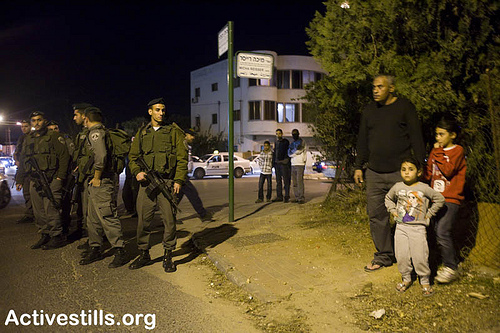
…In Ras al-Amoud [in occupied East Jerusalem], 13 Palestinians were left homeless after being forced to demolish their own home on 21 December, following a demolition order posted on their door by Israeli police.
The International Solidarity Movement (ISM) reported that the families were faced with the decision either to demolish their own home and pay a fine of 60,000 shekels (approximately $17,000 US) “or refuse, and watch as soldiers demolish their house and punish them with a fine of 120,000 shekels ($34,000),” ISM stated. “Soldiers showed up outside with a bulldozer. Finally, on 21 December, they [the Palestinians] tore down their own houses”.
Pretty much like digging your own grave.
“While children around the world are enjoying the holiday season in their homes, these children have suffered the trauma and indignity of watching their homes destroyed in the presence of their parents,” Barbara Shenstone – an UNRWA official said as she watched Palestinian homes being demolished in East Jerusalem….
The perpetrators of this crime will have their day in a real court.
|
Written by: Palestine Chronicle
By Richard Lightbown
On 26 December thousands turned out in Istanbul to welcome the Mavi Marmara back to the port. A large banner on the starboard side featured photos of the nine martyrs from the Israeli raid. The ship had spent more than four months in Iskenderun where forensic experts had checked out the bullet holes that Israeli operatives had filled and painted over. Blood stained clothing and heaps of ransacked baggage have been cleared away. No doubt the railings cut by activists for the makeshift defence of the ship have now been replaced, and perhaps the six kitchens have been restocked with knives and utensils to replace those taken to display to the world’s media as proof of a premeditated ‘lynch’ of Israel’s well-equipped and highly-trained elite special forces.
Already it has been announced that the ship is to leave on the first anniversary of the raid on 31 May 2011 in a renewed attempt to break the blockade. The need in Gaza remains acute. The Palestinian Centre for Human Rights reported on 18 October that Israel maintains a total ban on raw materials and construction materials necessary for reconstruction. (It is still unclear whether the 3,500 tons of cement from the flotilla was ever allowed to reach Gaza.) On 9 July the same NGO had stated that 86,000 homes and 900,000 tons of concrete were needed to make good the damage from Operation Molten Lead and provide for population growth.
Gisha reported on 21 December that bureaucratic delays to permits for construction materials had thwarted international projects to build schools, hospitals and infrastructure, while projects administered by the Hamas government were using materials entering through the tunnels from the Egyptian border. In the five months between July and December 744 truckloads of cement, gravel and steel had entered the Strip via the Israeli crossings, compared with 900 tons (equivalent to 36 truckloads) which pass each day through the 30-40 tunnels intended for construction materials.
Despite Israel’s well publicised easing of the blockade the number of trucks allowed into Gaza in October was on average only 34% of pre-June 2007 levels. The Palestinian Trade Centre reported on 14 October that fuel imports were markedly below the estimated needs. Cooking gas was particularly affected since it cannot be piped through the tunnels from Egypt. Exports allowed out of Gaza between January and September this year amounted to a mere 80 truckloads, stifling any meaningful recovery of the economy.
The Turkish government has made no objection so far to the announcement from the humanitarian organization IHH to make a renewed challenge of the illegal Israeli blockade. And why should it? As Huwaida Arraf explained at the Free Gaza press conference in Rome on 13 December:
“The International Committee of the Red Cross has said that Israel’s closure of Gaza is a violation of international law. States have an obligation to end this violation of international law. Therefore states have an obligation not to stop us, to let us go to Gaza.”
‘Us’ in this case refers to organizations from the USA, Canada, Norway, Holland, UK, Italy, France, Spain, Ireland, Malaysia and Turkey. This is a far cry from two tiny vessels and 42 activists that began this snowball in 2008. Nothing it would seem is going to stop this movement from sailing for Gaza. But what will Israel do this time?
There will no doubt be diplomatic pressure. The Republic of Cyprus can be expected to again refuse access to the flotilla, and no doubt the U.S. administration will find some spurious reason to disapprove of the operation. Maybe the shambles that is the stalled peace process will be wheeled out once more as an excuse for disapproving of solidarity with the Palestinian’s claim for justice and human rights. We can expect at least three Nobel peace laureates to disgrace themselves and to side with injustice again.
The organizers will know to watch their vessels closely for sabotage. Both of the cabin cruisers suffered steering faults on the way to the rendezvous for the last flotilla and only managed to reach harbour with difficulty. One of them, the Challenger II, also had a problem with the bilge pump, and did not manage to set sail for Gaza. Sabotage to the Rachel Corrie’s propeller and exhaust also resulted in delays and repairs costing £37,000.
Mossad can also be expected to get at least one spy onto the flotilla this time. Advance information of the emergency channel on the Mavi Marmara would have been a major help to the IDF in its attempt to control media sources during the last raid. The Israeli government was seriously embarrassed by news headlines reporting 16 dead at 06:00 GMT on 31 May and the Ministry of Foreign Affairs will be keen to avoid a repeat of this negative PR. Both sides will have learnt lessons from their experiences last time and there will be a keen battle of wits to control information sources this time around. This time too major media outlets may even decide to come to the party since the story is becoming too big to bury. (For the sake of journalistic integrity it is to be hoped that the BBC will not chose to send Jane Corbin. However the presence of at least one BBC journalist on board may render it impossible for the corporation to fabricate another propaganda piece to match Panorama’s Death on the Med.)
The Free Gaza Movement is again declaring its intention to carry out non-violent resistance against any illegal assault. The IHH president, BülentYildirim, appears unrepentant for his previous statements, so a forceful defence of the Mavi Marmara will again be a possibility in the event of an Israeli attack. Israel will know this and will be evaluating the choices. These appear to be more limited this time. The diplomatic fallout with Turkey has still not cleared and the Turkish government remains steadfast in its demand for an apology from Israel. Legal actions are also underway in various European courts and in the International Court of Justice for compensation and criminal prosecution. The threat of legal action has already prevented Defence Minister Ehud Barak and deputy Prime Minister Dan Meridor from travelling to Europe since the raid. The subject of ‘de-legitimisation’ was mentioned several times by witnesses to the Turkel Commission, to the extent that maybe even Benjamin Netanyahu will be starting to see a connection between Israel’s criminal behaviour and the way its citizens are welcomed overseas: (maybe!).
Mr Netanyahu’s first choice is to let the flotilla pass, and by doing so open up a seaway to Gaza for importing desperately needed construction materials, open up the export market which will stimulate the economy, allow Gazans their human right to travel, and allow the free passage of world citizenry into the enclave to see first-hand Israeli snipers attacking Gazan farmers and gunboats attacking fishermen. In effect this will begin the de-occupation of Gaza. (And why does Israel insist on occupying Gaza?)
His second option is to attack, risk a major military stand-off with Turkey (to the great embarrassment of NATO) and prove to the world that the first attack was not an error of judgment. This will do wonders for the BDS movement and might even kick-start it in North America.
Alternatively can the commandos attack it this time without wholesale bloodletting? Clambering up the stern from Zodiacs seems an impossible task when faced with defenders wearing gas masks (from the ship’s fire-fighting equipment) and using fire hoses. This proven defence will be difficult to overcome without the use of extreme violence. Or will the navy chief be willing to authorise live fire from helicopters before boarding on a second occasion, knowing that this has already been declared an unlawful act contrary to the Fourth Geneva Convention by the UN Human Rights Council Fact-Finding Mission (and knowing that he can personally be held criminally responsible)? If not, what other options does he have available to seize the top deck against persons determined to exercise their legal right of defence (and who know what strategy was employed on the previous occasion)?
The compromise might be to try to disable the ships. This is widely seen as a high risk strategy. Chief of the General Staff Gabi Ashkenazy told Turkel that there were no safe options to boarding, and commentators have questioned the safety of disabling a ship on the high seas that is carrying more than 600 civilians. If a bungled attempt causes the ship to sink or founder with serious loss of life Israel could become a pariah state overnight and the UN might be forced to oversee the sea route into Gaza.
An unstoppable force seems to have been unleashed here. As on the Indian subcontinent, in southern Africa and in the American south, this movement for civil rights is not going to be frightened off. It is not going to go away. It is not going to wither and die. That the vast majority of Israeli citizens were misguided enough to have supported the terrorism against the last flotilla only underlines the corrupting influence on Israeli society of the illegal occupation of Palestinian lands. For Israel to escape its internal decay and destruction it has to give up its role of occupying power and a defining moment in its history now approaches. If not with this flotilla, then with the next or the one after…At some stage soon, the unstoppable force will engulf the blockade. The sooner that happens the better it will be for Israel, the better for the opportunities for peace in the Middle East and the better for the tragic victims in Gaza for whom freedom and justice have been denied for far too long.
– Richard Lightbown has researched a review of media sources on the flotilla raid and a critique of BBC Panorama’s programme ‘Death in the Med’. He contributed this article to PalestineChronicle.com.
About the author:Palestine Chronicle
The Palestine Chronicle publishes news and commentary related to the Middle East Peace
We were devastated to hear the news of the first martyr in 2011 being none
other than Jawaher, the sister of the martyr Bassem Abu Rahma from Bil’in.
Jawaher fainted in yesterday’s demonstration but died apparently of this
toxic tear gas (a much stronger version with unknown chemicals than used in
the West). Here is a video of the demonstration where Jawaher was injured
(she was martyred in hospital the next day)
To keep up to date on developments in Bil’in, visit
http://www.bilin-ffj.org/
 band annie's Weblog