
Report, The Electronic Intifada, 19 August 2010
Grassroots Palestinian boycott campaigns across the occupied West Bank to take Israeli settlement products off the shelves of local stores have made an impact on the Israeli settlement economy, to the unease of the Israeli government, noted the Israeli daily Haaretz this week (“Palestinians ‘adamant about continuing boycott on settlement goods’,” 8 August 2010).
From the tightly-packed communities in refugee camps, to the sprawling urban areas in major cities, to the rural countryside, Palestinians have galvanized around campaigns to promote locally-made products and locally-harvested food instead of a myriad of items made in illegal settlement colonies on occupied Palestinian land in the West Bank.
The Palestinian Authority (PA), for its part, has produced pamphlets listing Israeli settlement-made products and delivered them to thousands of homes across the West Bank, urging Palestinians to buy Palestinian products and warning that trading of settlement products risks legal prosecution. But grassroots, local community initiatives have been working independent of the PA for years as activists have organized to educate and support business owners in making responsible choices in purchasing and selling merchandise.
Haaretz reports that the Israeli Ministry of Industry, Trade and Labor has asked the PA to cancel the boycott, citing supposed violations of international trade rules and feigning concern for Palestinian laborers who work in the settlements.
International trade laws do not apply to consumer boycotts, however, and the Israeli settlements themselves are entirely illegal under international law, including Articles 46 and 55 of the Hague Convention; Article 49 of the Fourth Geneva Convention and UN Security Council Resolution 465. The illegality of Israel’s settlements was reaffirmed in the 2004 ruling of the International Court of Justice at the Hague (“Israeli settlements fact sheet,” Palestine Monitor, 15 March 2010).
Irish artists pledge to boycott Israel
In international boycott news, more than 150 Irish artists helped to launch a broad-based boycott of Israel, pledging on 13 August to refuse to perform or exhibit their work in Israel, and to refuse to accept funding or grants from institutions connected to the Israeli government. Through this campaign, Ireland has become the first country to enact a nation-wide cultural boycott movement against Israeli apartheid.
In a joint action with the Irish Palestine Solidarity Campaign (IPSC), artists drafted a statement, published on the IPSC website, that “commits signatories to boycotting the Israeli state until it respects international law” and notes that the artists are responding to a call from Palestinian civil society for a cultural boycott of Israel (“Dublin concert sees launch of ‘Irish Cultural Boycott of Israel’ pledge,” 13 August 2010).
Musician Eoin Dillon was amongst the Irish artists who signed the pledge. IPSC states that his brother was on the Gaza Freedom Flotilla in May of this year, and was kidnapped and arrested when Israeli commandos attacked the ships, killing nine and wounding dozens.
Dillon told IPSC, “I encourage all Irish artists to take this pledge and thereby honor not only their own dignity but more importantly, the dignity of the Palestinian people.”
The pledge was recognized by the Palestinian Campaign for the Academic and Cultural Boycott of Israel (PACBI), which remarked in a statement on 11 August — anticipating the artists’ boycott action — that this represents a “groundbreaking strategy in supporting the Palestinian struggle for freedom and justice” (“Irish artists make BDS history …”).
“In the last few years, many international cultural figures have come out in support of the cultural boycott of Israel,” PACBI added. “A statement authored by John Berger in support of the boycott gathered dozens of signatures, including some celebrities. Montreal, Canada, witnessed a most impressive initiative in this respect, where 500 artists issued a statement this last February committing themselves to ‘fighting against [Israeli] apartheid’ and calling upon ‘all artists and cultural producers across the country and around the world to adopt a similar position in this global struggle’ for Palestinian rights. Yet, the Irish artists have raised the bar of solidarity by pioneering the first nation-wide cultural stance in support of the boycott of Israel.”
This cultural boycott initiative comes on the heels of last month’s consumer boycott, divestment and sanctions campaign by the IPSC to deliver more than 6,000 signatures to a national supermarket chain, as customers demanded that the Dunnes markets stop selling Israeli-made products. Trade union officials, Sinn Fein activists and members of the Palestinian and South African communities in Ireland presented the petitions to the Dunnes stores in multiple locations across the country.
IPSC says that this campaign only took two weeks to gather signatures, and “comes a quarter-century after Dunnes was at the center of a bitter two-year campaign of boycott and pickets, when it sacked a group of workers who refused to handle South African goods” (“Petition: Thousands demand that Dunnes stop stocking Israeli goods,” 29 July 2010).
Canadian union supports boat to Gaza
Meanwhile, the Canadian Union of Postal Workers (CUPW) officially called on Canadians to support the Canada Boat to Gaza project. The Canadian boat is to be included in a flotilla led by activists with international human rights organizations planning to deliver humanitarian aid to the beleaguered Gaza Strip in the coming months (“Postal Workers’ Union: Get Mail to Gaza on the Boat,” 12 August 2010).
The union has a long history of solidarity actions in support of justice for Palestinians, including drafting resolutions calling for an immediate end to the illegal occupation of the West Bank and Gaza Strip.
“Following an announcement by Canada Post that Israel Post has suspended mail delivery to Gaza, the union is encouraging people who wish to send mail to Gaza to get their mail onto the Canadian boat bound for the blockaded Palestinian territory,” CUPW stated.
The CUPW says that its support of the Canada Boat to Gaza was elevated when Israel Post recently informed Canada Post that Canadian mail would not be delivered to the Gaza Strip due to circumstances “beyond their control,” according to the Canadian daily Vancouver Sun (“Canadian postal workers put stamp of approval on bid to break Gaza blockade,” 12 August 2010).
Receiving mail in Gaza has been irregular for years, as Israel’s illegal blockade against the strip continues. But according to Gaza’s Director General of the Communications Ministry, Jalal Ismail, the mail delivery system has been delayed and government mail has remained undelivered for at least four months. Speaking to news agency The Media Line, Ismail said that mail disruptions “are not new” in Gaza. The Gaza-based Palestinian postal employee responsible for mail transfer in Gaza was arrested by Israeli forces, and Israel continues to stall in their “vetting” of a new postal liaison.
Israel has also blocked mail between Gaza and the West Bank, according to Maan News Agency (“Israel blocks mail between Gaza, West Bank,” 20 May 2010).
Denis Lemelin, the CUPW’s national president, explained the union’s move to back the Gaza-bound boat actions: “As postal workers, we know very well that cutting off mail creates suffering and hardship for people, who are isolated from their loved ones. How many more abuses will the people of Gaza have to endure?”
“We are heartened by the growing international response to Israel’s cruel treatment of the Palestinian people,” continued Lemelin. “We stand in solidarity with all efforts to break the blockade and end the indignities imposed on the Palestinian people by the state of Israel.”
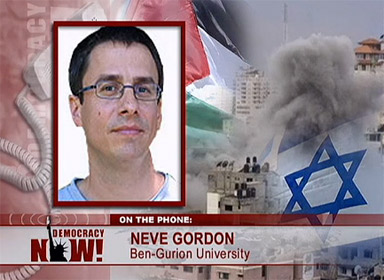
By Neve Gordon
20 August 2010
Neve Gordon argues that the demand of a loyalty oath in Israel has ominous similarities to the demands made by Mussolini’s Italy, and that the Israeli state must “be loyal to all of its citizens, regardless of race, colour, gender, language, religion, political opinions, national or social origin, property or birth status”.
“Several weeks ago, hundreds of students demonstrated in front of Ben-Gurion University’s administration building. About a third of the protestors were expressing their opposition to the government’s decision to attack the Gaza relief flotilla, while the remaining two thirds came to support the government. At one point the pro-government protesters began chanting: ‘No citizenship without loyalty!’
While loyalty is no doubt an important form of relationship both in the private and public spheres, unpacking its precise meaning in the Israeli context reveals a disturbing process whereby the democratic understanding of politics is being inverted.
As Israeli citizens, Prime Minister Binyamin Netanyahu and Foreign Minister Avigdor Lieberman want us to prove our loyalty to the flag by supporting a policy of oppression and humiliation. We must champion the separation barrier in Bi’lin and in other places throughout the West Bank. We have to defend the brutal destruction of unrecognized Bedouin villages, and the ongoing land grab both inside Israel and in the occupied Palestinian territories. We must support the checkpoints and the silent transfer in East Jerusalem.
We are also expected to bow our heads and remain silent every time government ministers, Knesset members and public officials make racist statements against Arab citizens. We must support the neo-liberal policies that continuously oppress Israel’s poor, and we are obliged to give our blessing to the imprisonment of the Gaza Strip’s 1.5 million residents.
Hearing the chants at the recent demonstration, I understood that I will never be able to accept this disastrously myopic form of loyalty. I refuse to be loyal to a policy of humiliation, racism and discrimination.
And, yet, loyalty is an important issue that urgently needs to be discussed because ultimately there is a firm link between the state and loyalty. The pressing questions that need to be addressed are: what is the meaning of loyalty? And who is supposed to be loyal to whom?
Surprisingly, the answer to these questions is not particularly complex. According to the republican tradition, the state is first and foremost obliged to be loyal to its citizenry and is held accountable for inequities and injustices. Yet we are currently witnessing a complete reversal of the republican relationship between state and loyalty and the adoption, instead, of a proto-fascist approach.
Perhaps the most disturbing feature of this trend is that it is taking place on all levels of Israeli society. From the ongoing attacks against Israeli human rights organizations spearheaded by NGO Monitor and Im Tirzu, through the police response to the peaceful protests in Sheikh Jarrah, and all the way to the McCarthyist atmosphere in the Knesset Education Committee, one witnesses how elements within civil society, the executive branch and the legislative branch are all working according to a logic similar to the one that informed Mussolini’s Italy. All of these elements expect citizens to swear loyalty to the state regardless of the government’s policies.
However, because loyalty is a vital component of politics, we need to strive to ensure that the call for loyalty meet the requirements of a democratic rather than a fascist logic. We must demand that the state be loyal to all of its citizens, regardless of race, colour, gender, language, religion, political opinions, national or social origin, property or birth status.
A state that is loyal to its citizens does not discriminate between Jews and Arabs, does not expropriate land from Muslims and Christians, does not humiliate and trample on the lower classes and does not brutally oppress the Palestinians in the occupied territories. A state of this sort protects the rights of each and every citizen and, thus, will not need to demand loyalty because it will receive loyalty on a silver platter.
Yes, I too understand the importance of loyalty. But the appropriate chant is not “No citizenship without loyalty!” but rather “Loyalty to every citizen!”.
Neve Gordon is the author of Israel’s Occupation (University of California 2008) and can be reached through his website www.israelsoccupation.info.

By Jonathan Cook in Nazareth
20 August 2010
Jonathan Cook reports that secrets of serious war crimes, such as the ethnic cleansing of the Syrian Golan Heights following the 1967 war, lay behind the Israeli government’s decision to extend from 50 to70 years the period during which sensitive state documents must remain classified.
History may be written by the victors, as Winston Churchill is said to have observed, but the opening up of archives can threaten a nation every bit as much as the unearthing of mass graves.
That danger explains a decision quietly taken last month by Binyamin Netanyahu, the Israeli prime minister, to extend by an additional 20 years the country’s 50-year rule for the release of sensitive documents.
“The state’s chief archivist says many of the documents ‘are not fit for public viewing’ and raise doubts about Israel’s ‘adherence to international law’, while the government warns that greater transparency will ‘damage foreign relations’.”
The new 70-year disclosure rule is the government’s response to Israeli journalists who have been seeking through Israel’s courts to gain access to documents that should already be declassified, especially those concerning the 1948 war, which established Israel, and the 1956 Suez crisis.
The state’s chief archivist says many of the documents “are not fit for public viewing” and raise doubts about Israel’s “adherence to international law”, while the government warns that greater transparency will “damage foreign relations”.
Quite what such phrases mean was illustrated by the findings of a recent investigation by an Israeli newspaper. Ha’aretz revisited the Six Day War of 1967, in which Israel seized not only the Palestinian territories of the West Bank and Gaza, but also a significant corner of Syria known as the Golan Heights, which Israel still refuses to relinquish.
The consensus in Israel is that the country’s right to hold on to the Golan is even stronger than its right to the West Bank. According to polls, an overwhelming majority of Israelis refuse to concede their little bit of annexed Syria, even if doing so would secure peace with Damascus.
This intransigence is not surprising. For decades, Israelis have been taught a grand narrative in which, having repelled an attack by Syrian forces, Israel then magnanimously allowed the civilian population of the Golan to live under its rule. That, say Israelis, is why the inhabitants of four Druze villages are still present there. The rest chose to leave on the instructions of Damascus.
One influential journalist writing at the time even insinuated anti-Semitism on the part of the civilians who departed: “Everyone fled, to the last man, before the IDF [Israel Defence Forces] arrived, out of fear of the ‘savage conqueror’… Fools, why did they have to flee?”
“…all but 6,000 of the Golan’s 130,000 civilians were either terrorized or physically forced out, some of them long after the fighting finished.”
However, a very different picture emerges from Ha’aretz’s interviews with the participants. These insiders say that all but 6,000 of the Golan’s 130,000 civilians were either terrorized or physically forced out, some of them long after the fighting finished. An army document reveals a plan to clear the area of the Syrian population, with only the exception of the Golan Druze, so as not to upset relations with the loyal Druze community inside Israel.
The army’s post-war tasks included flushing out thousands of farmers hiding in caves and woods to send them over the new border. Homes were looted before the army set about destroying all traces of 200 villages so that there would be nowhere left for the former inhabitants to return to. The first Jewish settlers sent to till the fields recalled seeing the dispossessed owners watching from afar.
The Ha’aretz investigation offers an account of methodical and wholesale ethnic cleansing that sits uncomfortably not only with the traditional Israeli story of 1967 but with the Israeli public’s idea that their army is the “most moral in the world”. That may explain why several prominent, though unnamed, Israeli historians admitted to Ha’aretz that they had learnt of this “alternative narrative” but did nothing to investigate or publicise it.
What is so intriguing about the newspaper’s version of the Golan’s capture is the degree to which it echoes the revised accounts of the 1948 war that have been written by later generations of Israeli historians. Three decades ago – in a more complacent era – Israel made available less sensitive documents from that period.
The new material was explosive enough. It undermined Israel’s traditional narrative of 1948, in which the Palestinians were said to have left voluntarily on the orders of the Arab leaders and in the expectation that the combined Arab armies would snuff out the fledging Jewish state in a bloodbath.
“Ethnic cleansing is the common theme of both these Israeli conquests [1948 and 1967]. A deeper probe of the archives will almost certainly reveal in greater detail how and why these ‘cleansing’ campaigns were carried out – which is precisely why Mr Netanyahu and others want the archives to remain locked. ”
Instead, the documents suggested that heavily armed Jewish forces had expelled and dispossessed hundreds of thousands of Palestinians before the Jewish state had even been declared and a single Arab soldier had entered Palestine.
One document in particular, Plan Dalet, demonstrated the army’s intention to expel the Palestinians from their homeland. Its existence explains the ethnic cleansing of more than 80 per cent of Palestinians in the war, followed by a military campaign to destroy hundreds of villages to ensure the refugees never returned.
Ethnic cleansing is the common theme of both these Israeli conquests. A deeper probe of the archives will almost certainly reveal in greater detail how and why these “cleansing” campaigns were carried out – which is precisely why Mr Netanyahu and others want the archives to remain locked.
But full disclosure of these myth-shattering documents may be the precondition for peace. Certainly, more of these revelations offer the best hope of shocking Israeli public opinion out of its self-righteous opposition to meaningful concessions, either to Syria or the Palestinians.
It is also a necessary first step in challenging Israel’s continuing attempts to ethnically cleanse Palestinians, as has occurred in the last few weeks against the Bedouin in both the Jordan Valley and the Negev, where villages are being razed and families forced to leave again.
Genuine peacemakers should be demanding that the doors to the archives be thrown open immediately. The motives of those who wish to keep them locked should be clear to all.
Jonathan Cook is a writer and journalist based in Nazareth, Israel. His latest books are “Israel and the Clash of Civilisations: Iraq, Iran and the Plan to Remake the Middle East” (Pluto Press) and “Disappearing Palestine: Israel’s Experiments in Human Despair” (Zed Books). His website is www.jkcook.net.
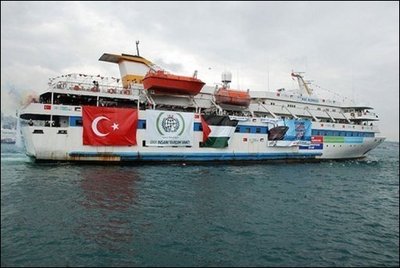
Says Rifat : I called the BBC today and registered an official complaint and had them open a case # for it. I was on the phone with them for quite some time and let them know many points and that I was on the ship when we were attacked as well. I then followed this up with a written complaint on the forms on their website, and also submitted it to the blog page. FYI, my follow-up written comments are below
—
“I was on the Mavi Marmara ship when we were brutally and illegally attacked by the Israeli military in international waters. The episode of Panorama: “Death on the Med” was nothing more than a disgusting piece of Israeli propaganda to put it very mildly. At 2:20 into the show, Jane Corbin states quite bluntly “We got hold of new Israeli military video of the operation”. Yes, that’s exactly it; ISRAELI MILITARY VIDEO. So the only question is, was Jane Corbin in particular and the BBC in general a willing puppet and mouthpiece of the Israeli military or were they just duped into it?? And which of these two possibilities is worse, I’m not even sure.
This Israeli military video and narrative dominated the entire episode. Panorama did not see it fit to refer to the illegality of this piratical attack, involving killing, injuring, hijacking, kidnapping and theft, in international waters. Nor did it challenge any Israeli spokespeople with the illegality of this or question them on it. Further, the program and its so-called reporter did not question the illegality of the Israeli siege on Gaza either, which has resulted in the deaths of hundreds of innocent civilians.
The program referred to “thousands of rockets” being fired from Gaza into Israel but of course fails to mention the bombardment of Gaza with banned white phosphorous and other weapons that killed over 1400 civilians.
The program and its producers which can undoubtedly only have an agenda, did not question the Israeli spokespeople on why they confiscated all of our footage and tapes if they have nothing to hide. On the contrary, Panorama went ahead and appallingly used doctored tapes given to them by the Israeli military, and presented these as fact.
Why didn’t Panorama mention any of the other ships in the flotilla, or mention that citizens from over 40 countries and various religions (including Jews, Christians and even atheists) and ethnicities participated in it and that many organizations collaborated with IHH on this flotilla? Instead, Panorama was despicably trying to play on people’s fears due to their ignorance of Islam and portray this flotilla as being driven by extreme “Islamists”. There were many British citizens aboard the ship as well, but for some strange reason, Panorama opted not to show a single one of them.
Why didn’t Panorama mention the autopsy reports or challenge the Israeli spokespersons on the fact that the dead victims were shot many times and at close range, thus negating the claim of ‘self-defense’ by the Israeli commandos? More importantly, why didn’t Corbin challenge the simple fact that when you attack and board a civilian ship in the dead of the night with fully armed commandos, helicopters, live rounds, warships and Zodiac boats, the self-defense argument is automatically negated because YOU ARE BEING THE AGGRESSOR.
Why wasn’t the footage shown of the Israeli assaults on the activists? We were able to continue broadcasting for a short period of time even as the Israeli military tried to execute a blackout on their crimes after they started attacking, and some of us were able to smuggle footage out that was uploaded on the internet. This footage shows the Israeli commandos killing the activists, but this was probably incompatible with the agenda that BBC has in mind. Why wasn’t this footage shown and why weren’t the Israelis questioned on this, in the same manner Corbin was showing the Israeli footage to Bulent Yildrim and questioning him on it?? Or do the Israelis get a free pass?
The true evil, Nazi-like, fascist, racist nature of the Israelis came through loud and clear when approximately 26-27 minutes into the show, the Israeli spokesperson incredibly stated “I don’t think the force was excessive”. Within an hour, they had committed a massacre killing 9 people and wounding dozens. How many more before the Israelis think the force is excessive?! And in the same clip, we see there is no response by Panorama’s reporter to this outrageous statement, and no pressing further as to why the deaths of 9 innocent civilians is so cheap to him. Merely meek, repugnant, submissive complacency by Panorama.
As someone who’s been involved with the media for many years now and who helped established a media watchdog group in the USA that was quite influential, I can honestly say that this is one of the shoddiest pieces of “journalism” I have ever seen.”
reminder : A Voyage of Life and Death
Ynet learns military police suspect officer, soldier sold laptop computers stolen from aid ships while they docked in Ashdod, after controversial IDF raid. Officials say investigation likely to prove ‘highly shameful’ for Israel
Hanan Greenberg
Published: 08.18.10, 22:20 / Israel News
An officer and a soldier are suspected of selling goods they took from the highly controversial aid flotilla to Gaza, which was raided by the IDF on May 31, Ynet learned from the military police on Wednesday.
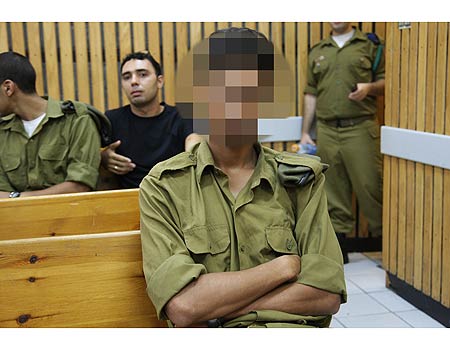
Investigators say they are currently trying to ascertain whether laptop computers were sold by a soldier to three other soldiers, and whether they were initially taken from the flotilla vessels by an officer.
A high-ranking officer familiar with the case said the suspicions are highly likely to prove true. “The investigation has just begun, but as it appears now it will prove embarrassing and shameful,” another official said. “These are soldiers who don’t understand what their uniform represents.”
The investigation could prove extremely harmful to Israel as the state strives to fend off global criticism for the raid, which resulted in the deaths of nine Turkish citizens. Recently the Turkel committee, which is investigating the raid on behalf of the state, has called various leaders to testify before it, and a UN committee is not far behind.
The soldier suspected of selling the computers was arrested late Monday night, along with three soldiers suspected of buying them. In the process police say they discovered additional stolen goods in the soldier’s possession, including more laptop computers and cellular phones.
Later an officer was arrested on suspicion he sold the goods to the soldier. The officer, a second-lieutenant in rank, is a commander of an army unit who had access to the ships while they docked at Ashdod port, awaiting their return to Turkey.
Police say the officer stole 4-6 laptops from the ship and then sold them to the soldier, who in turn sold them to three other soldiers two months ago. The three have already admitted to making the purchases during questioning, and the computers were confiscated by police. They were found to be brand new, and not meant for sale in Israel.
They also told interrogators that the soldier who sold them the goods told them they had been stolen from the flotilla ships, yet they did not pass the information on to their commanders.
Activists complained of theft
The soldier and officer have yet to appear before the court for a hearing on the remand of their arrests. Police say other soldiers are yet to be arrested, but refuse to give further details.
Meanwhile investigators are intent on discovering where exactly the goods came from, and whether they were stolen from flotilla passengers. One investigator said that if indeed the goods were found to belong to activists on board, they would be recompensed.
The IDF Spokesperson’s Office confirmed reports of an investigation Wednesday, but said that it was “not at all certain the equipment was taken from the flotilla”.
Complaints by flotilla passengers about stolen equipment surfaced not long after the raid. Activists told the British Guardian in June that credit cards confiscated by the IDF had been used.
The Guardian reported that soldiers had used the cards to purchase various items, including iPod accessories. Claims regarding calls made from confiscated cell phones followed.
The IDF responded to the claims by stating that all of the personal effects brought by the activists to Israel had been placed aboard planes that transported them from the country, but that audio and video cassettes had been confiscated for security reasons.
Source : Ynetnews
 band annie's Weblog