Search

band annie's Weblog

I have a parallel blog in French at http://anniebannie.net

Month

July 2010

The Spot-and-Shoot Game

By JONATHAN COOK

Nazareth.

It is called Spot and Shoot. Operators sit in front of a TV monitor from which they can control the action with a PlayStation-style joystick.

The aim: to kill terrorists.

Played by: young women serving in the Israeli army.

Spot and Shoot, as it is called by the Israeli military, may look like a video game but the figures on the screen are real people — Palestinians in Gaza — who can be killed with the press of a button on the joystick.

The female soldiers, located far away in an operations room, are responsible for aiming and firing remote-controlled machine-guns mounted on watch-towers every few hundred metres along an electronic fence that surrounds Gaza.

The system is one of the latest “remote killing” devices developed by Israel’s Rafael armaments company, the former weapons research division of the Israeli army and now a separate governmental firm.

According to Giora Katz, Rafael’s vice-president, remote-controlled military hardware such as Spot and Shoot is the face of the future. He expects that within a decade at least a third of the machines used by the Israeli army to control land, air and sea will be unmanned.

The demand for such devices, the Israeli army admits, has been partly fuelled by a combination of declining recruitment levels and a population less ready to risk death in combat.

Oren Berebbi, head of its technology branch, recently told an American newspaper: “We’re trying to get to unmanned vehicles everywhere on the battlefield … We can do more and more missions without putting a soldier at risk.”

Rapid progress with the technology has raised alarm at the United Nations. Philip Alston, its special rapporteur on extrajudicial executions, warned last month of the danger that a “PlayStation mentality to killing” could quickly emerge.

According to analysts, however, Israel is unlikely to turn its back on hardware that it has been at the forefront of developing – using the occupied Palestinian territories, and especially Gaza, as testing laboratories.

Remotely controlled weapons systems are in high demand from repressive regimes and the burgeoning homeland security industries around the globe.

“These systems are still in the early stages of development but there is a large and growing market for them,” said Shlomo Brom, a retired general and defence analyst at the Institute of National Security Studies at Tel Aviv University.

The Spot and Shoot system — officially known as Sentry Tech — has mostly attracted attention in Israel because it is operated by 19- and 20-year-old female soldiers, making it the Israeli army’s only weapons system operated exclusively by women.

Female soldiers are preferred to operate remote killing devices because of a shortage of male recruits to Israel’s combat units. Young women can carry out missions without breaking the social taboo of risking their lives, said Mr Brom.

The women are supposed to identify anyone suspicious approaching the fence around Gaza and, if authorised by an officer, execute them using their joysticks.

The Israeli army, which plans to introduce the technology along Israel’s other confrontation lines, refuses to say how many Palestinians have been killed by the remotely controlled machine-guns in Gaza. According to the Israeli media, however, it is believed to be several dozen.

The system was phased-in two years ago for surveillance, but operators were only able to open fire with it more recently. The army admitted using Sentry Tech in December to kill at least two Palestinians several hundred metres inside the fence.

The Haaretz newspaper, which was given rare access to a Sentry Tech control room, quoted one soldier, Bar Keren, 20, saying: “It’s very alluring to be the one to do this. But not everyone wants this job. It’s no simple matter to take up a joystick like that of a Sony PlayStation and kill, but ultimately it’s for defence.”

Audio sensors on the towers mean that the women hear the shot as it kills the target. No woman, Haaretz reported, had failed the task of shooting what the army calls an “incriminated” Palestinian.

The Israeli military, which enforces a so-called “buffer zone” — an unmarked no-man’s land — inside the fence that reaches as deep as 300 metres into the tiny enclave, has been widely criticised for opening fire on civilians entering the closed zone.

In separate incidents in April, a 21-year-old Palestinian demonstrator was shot dead and a Maltese solidarity activist wounded when they took part in protests to plant a Palestinian flag in the buffer zone. The Maltese woman, Bianca Zammit, was videoing as she was hit.

It is unclear whether Spot and Shoot has been used against such demonstrations.

The Israeli army claims Sentry Tech is “revolutionary”. And that will make its marketing potential all the greater as other armies seek out innovations in “remote killing” technology.

Rafael is reported to be developing a version of Sentry Tech that will fire long-range guided missiles.

Another piece of hardware recently developed for the Israeli army is the Guardium, an armoured robot-car that can patrol territory at up to 80km per hour, navigate through cities, launch “ambushes” and shoot at targets. It now patrols the Israeli borders with Gaza and Lebanon.

Its Israeli developers, G-Nius, have called it the world’s first “robot soldier”. It looks like a first-generation version of the imaginary “robot-armour” worn by soldiers in the popular recent sci-fi movie Avatar.

Rafael has produced the first unmanned naval patrol boat, the “Protector”, which has been sold to Singapore’s navy and is being heavily marketing in the US. A Rafael official, Patrick Bar-Avi, told the Israeli business daily Globes: “Navies worldwide are only now beginning to examine the possible uses of such vehicles, and the possibilities are endless.”

But Israel is most known for its role in developing “unmanned aerial vehicles” – or drones, as they have come to be known. Originally intended for spying, and first used by Israel over south Lebanon in the early 1980s, today they are increasingly being used for extrajudicial executions from thousands of feet in the sky.

In February Israel officially unveiled the 14 metre-long Heron TP drone, the largest ever. Capable of flying from Israel to Iran and carrying more than a ton of weapons, the Heron was tested by Israel in Gaza during Operation Cast Lead in winter 2008, when some 1,400 Palestinians were killed.

More than 40 countries now operate drones, many of them made in Israel, although so far only the Israeli and US armies have deployed them as remote-controlled killing machines. Israeli drones are being widely used in Afghanistan.

Smaller drones have been sold to the German, Australian, Spanish, French, Russian, Indian and Canadian armies. Brazil is expected to use the drone to provide security for the 2014 World Cup championship, and the Panamanian and Salvadoran governments want them too, ostensibly to run counter-drug operations.

Despite its diplomatic crisis with Ankara, Israel was reported last month to have completed a deal selling a fleet of 10 Herons to the Turkish army for $185 million.

Jonathan Cook is a writer and journalist based in Nazareth, Israel. His latest books are “Israel and the Clash of Civilisations: Iraq, Iran and the Plan to Remake the Middle East” (Pluto Press) and “Disappearing Palestine: Israel’s Experiments in Human Despair” (Zed Books). His website is http://www.jkcook.net.

A version of this article originally appeared in The National (www.thenational.ae), published in Abu Dhabi.
Each village is a reminder

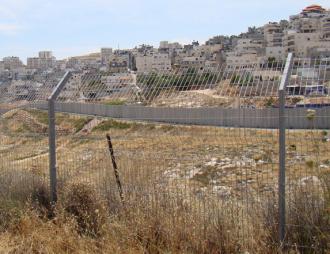
The Palestinian refugee community of Shu'afat sits behind Israel's separation wall, cut off from other Palestinian neighborhoods in Jerusalem (Jeremy Price)

DateTuesday, July 13, 2010 at 3:25PM Gilad Atzmon interviewed by by Brian Lenzo

YOU GREW up in Israel, right when the Palestinian National movement had come on to the scene. Were you aware of it? What was it like growing up in Israel at that time?

THIS IS a very interesting question. When you read what Jews have written about their suffering, the philosophers and historians, they always talk about the magmatic effect of irrational hatred. About the Germans: “It was madness.” Now the Turkish: ‘They are mad!” And the Palestinians. We asked, “Why do they want to come here? There are so many Arab places to go?”

As kids, we thought, “Everybody is mad!” The mentality was–and still is–us versus them. The Jewish world is divided into a binary opposition of us and them. This was my vision of the Palestinians.

We were shocked to wake up in the morning and find out there was a ‘terror’ attack, then another terror attack. It took me years to understand that these were people who were fighting for their land–land that belongs to them and them alone.

It took me some time before I realized that the Qassam rockets are a love letter from the Palestinian’s stolen land. The Palestinian movement is a poetic movement. And it’s through the poets that they will be able not just to liberate their land, but to liberate all of us.

I TRAVELED to Gaza last year in July with the Viva Palestina convoy, and I spoke with people from the Jabaliya refugee camp. They talked about their expulsion first in 1948 and then again in 1967. It became clear to me that if you only allow return to the 1967 territories, but leave alone the issue of 1948, you would be potentially splitting up families…The mother could return to the West Bank, but the grandmother could not go back to Haifa.

Was there any recognition that this tangled web had been woven by the time you were born in Israel? Was that something you realized later or was that something in the background that you look back on and say, “I should have recognized it back then?”

I DEFINITELY look back on it. I wasn’t aware. We were not aware. Probably our teachers were not aware and probably my father, who lived through it.

I asked my father once, when I started to learn about the expulsion, “Listen, man, you were nine years old in 1948. This land changed in front of your eyes. Convoys of refugees.” My father told me, “I didn’t see anything. I don’t remember.”

I told him, “The way to Haifa was all Palestinian villages. Here.” I had the map. “Here they are, and they’re gone.” My father just waved his hand as if to say, “Go away.”

We really have to start to understand the notion of phantasmic past. These people invented their past, as Shlomo Sand argues, and he is right. The Zionists invented their past with the hope that their future would shape accordingly. And their history doesn’t have to be consistent, because they can invent it whenever they want. They cherry-picked the events that would support their narrative. It’s very typical.

Every time I think about my past, I find more and more things I should have recognized. I read and reviewed Ramzy Baroud’s amazing book My Father Was a Freedom Fighter, and he talks about his father’s experience and where he was born. It’s amazing. I gave it to my mom, who read it and, like myself, was shocked. She said, “Where was this village?” We looked at the maps, and we couldn’t figure it out.

You have to understand. It’s hard to believe, but try to imagine you traveled from Rochester, N.Y., to New York City and on your way back, all the villages and towns along the way were wiped out. Even the signposts…gone.

The Israelis have managed to wipe out Palestinian civilization. But it didn’t work. Why? Because the Palestinians didn’t disappear. The claim is there. It is sound. The prickly pear is there, in each village, to point out that this was a village of authentic people and will be there until they come back. Again, it’s poetic.

I ASK about your childhood because growing up in this part of New York, you have the experience of learning about the history of Native Americans in the United States, and then part of your school education is to tour some of the sites, because this area is where the Iroquois Nation lived and still lives.

Our school books will at least admit that the Native Americans were driven off their land, but at the same time, they won’t talk about what that might mean for the current generation of Native Americans. Do you see any similarities to this situation in Israel?

IN MY opinion, the Palestinians are not anything close to that situation. The Palestinians are still nonexistent to the Zionists. The Israelis don’t understand that the people in Gaza, in the West Bank and in Lebanon are largely people waiting to come back. They are there, still waiting, but they will come back.

I understand it now. I know that many Palestinians lost hope throughout the years, but I think that there is room for hope again.

IF YOU google the name Gilad Atzmon, you find this dual persona. There is the musician, and then there is the writer/activist. In your presentation, you talked about how these aspects of your life intersect. Can you explain this some more?

IT’S AN open question. It’s a dynamic thing. You see, I’m basically dyslexic. And dyslexic people are used to regarding themselves, at least in their early life, as morons. I used to think, “You’re stupid, man.” Everybody has to write, you know, we all write, but when there was a dictation, I ended up with more mistakes than letters!

So I never thought that anything good would come of me…I’ve never spoken about my dyslexia before, by the way.

When I was 17, I listened to Charlie Parker, and said, “Oh my god!” And the saxophone–wow! I had a saxophone, and I started to play. Through music, I really became a confident human being.

I never had any dream of becoming a philosopher or thinker. Now I start to understand that I am. It took me many years to understand that I see things differently, and a lot of people are interested in my thoughts.

One thing that is very clear to me: I am a loner. I don’t take orders from anyone. I never want to be part of any party or any group or any ideological setting. I want always to be free and to try to think things through for myself.

As a musician and as a producer, I listen. I close my eyes. I want to be overwhelmed. And that’s the way I operate now with my writing. I am writing for myself. When I’m doing a written interview, I want every answer to be an exciting moment. I think this makes my writing very popular at the moment, and I’m still developing.

I’m searching for the truth, the philosophical truth. I am searching for something that will explain it all. Because there are a lot of things I don’t understand yet.

For instance, I don’t understand what it is that all those AIPAC Zionists want. What do they want? It’s like the most stupid question. Do they want safety? No. Do they want security? No. What do they really want? It’s a very big question, a very simple question but I don’t have an answer.

YOU HAVE a certain confidence to talk about an issue that is rather hush-hush in the United States. It’s not polite to talk openly about the Palestinians, let alone question the nature of Jewish identity.

TO START with, based on stats from my Web site, hits coming from America are surprisingly high. My popularity in this country is shocking. If somebody told me years ago that I would be getting 30,000 hits a day or something like that from America, I would have laughed out loud. So, it’s true, a lot of people here are reading it.

Earlier today, someone asked me, “Given all you said, what should we do?” I don’t like to talk about state solutions–one-state solution, two-state solution. The most important thing, the only thing that we can do, is to speak our heart. For some, it may be for the first time after so many years of being silenced.

Speak your heart. Say, “We don’t like it. We don’t like what you’re doing. We don’t like to send our soldiers to fight Zionist wars in Iraq. We don’t like it.” To identify, to name and shame the people that are behind it. They will call you an anti-Semite. To me, if telling the truth means I have to be labeled an anti-Semite, then I’ll be an anti-Semite. What do you want me to do?

A LOT of musicians aim to become the best at a particular genre. From my perspective, you have managed that much with your saxophone playing, but beyond just being talented at your craft, you explore other musical genres outside the Western musical tradition. Can you talk some about that?

AS I said, growing up, I listened to Charlie Parker, I listened to Coltrane, I listened to Michael Brecker. I said to myself, “Oh man! How can you play like that?” I’m still overwhelmed by it. And when I was in America in 1986-87, I thought to myself, “Shit, I really want to be a professional musician.”

America is a country in search of professionalization in everything. You have to be really good to make it in America, and I admire that. But with music education in jazz, at the Berklee School of Music in Boston and other music schools, music has lost its spirit. Rather than the spirit of resistance–and this is what jazz was and what made it so great–it has become just another form of knowledge.

So the professors say, “And today we are going to learn the Lydian scale. Everyone together–one, two, three, four!” I went to Berklee–I was there for two hours, man. If this is what it means to be a musician, I thought I better become a builder.

YOU SEEM to gravitate towards musical styles that have these radical roots, like jazz and punk rock. Is that intentional?

I LIKE music that moves walls. Coltrane could break a wall. I was lucky to work with Ian Dury. This man, this band, The Blockheads, can cut through anything.

I had a great chance to work with Robert Wyatt. Robert’s taste was extremely vulnerable. It’s delicious. It’s this crispy deliciousness that can make a window crack. Yes, I want to be moved by music.

My engineer, who I’ve worked with for 10 years now, told me a few months back–and realize that he’s 60 years old and he’s been doing this for 40 years–“Gilad, you are the most exhausting human being I’ve ever come across.”

I started to cry. I thought, “What did I do now?” He said, “Listen, you just won’t let something go.” You know, I could walk into a session with a band, and I’ll stay there until a tune is tearing you apart. My engineer is right, I won’t let it go. And I hope that I’m not yet at my peak. Yesterday, I listened to Zero Hour by Astor Piazzolla on the airplane. Oh man, he can go through a tank! I’m not there yet, but I am still working on it.

IT’S THAT combination of anger, defiance and also hope. That came through in your talk and in your playing, too.

I THINK that hope is the fuel of life. And I don’t think that the current political setting is providing us with such a thing. What is the greatest asset of Barack Obama? It was the hope. And I don’t want him to waste this hope on idiotic political games. We need hope because we don’t have money. We have kids, but what kind of world are these kids going to have?

It’s very possible that our politicians cannot provide this hope. I said the other day, and I’ll say it again: Try to buy an F-15 fighter jet. They’re expensive, man. Try to buy a tank. Try to buy armor. How much is it? Hundreds of thousands, maybe millions of dollars?

It’s much cheaper to buy a politician. You take him on two trips to Israel with his wife and put them in the Hilton in Tel Aviv…She can do the shopping, blah blah blah. They have a good time, they fly them back, give them some money so they can have a new swimming pool. That’s it! It’s much cheaper to buy American or British or French or German or Dutch politicians than buying a tank!

So they buy a few American politicians, and then you fight their wars. You go, you kill Saddam, you say you’re going to liberate the Iraqi people. It’s almost pathetic. How can these politicians…how can this system provide us with hope?

The first step towards hope is to be genuine. Say, “We don’t like what we see.” And for Palestine, I think that the shift of consciousness is far bigger than the politicians. The politicians will follow us. We are ahead of them.

source

REPORT OF FLOTILLA FREE MEDIA TEAM FROM THEIR MEETING IN ISTANBUL.

Today is Tuesday, July 13th, 2010. It has been 43 days since the bloody raid carried out by the Israeli army in international waters. During this raid on the Mavi Marmara nine people, including one journalist, were killed. We are here today as survivors of that attack, and as journalists who were not silenced by Israeli bullets. There were about sixty press members from Turkey and all over the world on those ships, which departed to carry humanitarian aid to the civlians of Gaza, who are imprisoned under an illegal Israeli blockade.

The raid at dawn targeted both journalists and regular civilians. The press members were confronted with death like everyone else on the ship.

The soldiers who illegally boarded the ship and opened fire, by order from the Israeli Ministry of Defence, also prevented us from doing our job. In fact, they ultimately punished us for doing our job. This is in clear violation of international law.

According to the “International Instrument for Citizenship and Civil Rights” which has been accepted by the United Nations since 1966, and the “First Principles Declaration Regarding the Mass Circulation of Media” which has been prepared by UNESCO. This enshrines “the freedom to give information, by journalists” and forbids “preventing them from collecting information”. Rights which Israel has clearly violated.

Dear Friends,

We were faced with an inhumane intervention that was against international law and in violation of the most basic of human rights. One of our fellow journalists, Cevdet Kılıçlar, was ruthlessly executed with a bullet to his forehead while fulfilling his duties as a journalist.
After the bloody raid was complete, our human dignity was completely disregarded as we were forced on our knees under the burning sun with our hands tied behind our backs. It was a harsh violation of our human rights. Our freedom to collect and keep information was completely ignored. Live broadcasts and all other forms of communication with the outside world were disrupted and prevented by the jamming of our satellite connection.

Our computers, cameras, memory cards- in short all the equipment necessary to do our job- were illegally confiscated, they were all stolen. The vast majority of these items were not returned. The few items that were returned had been destroyed deeming them utterly useless.

In addition to this, all of our personal belongings- books, clothes, shoes, and even toothbrushes were also stolen. Some of our money and passports were forcefully seized and never returned.

We were arrested at gun-point. They put handcuffs on us. We were illegally questioned over and over again, as if we were criminals. We had to endure humiliating body searched, full body searches, in order to prevent any images from reaching the outside world. Neither our press credentials, nor our membership to national and international press associations were acknowledged or respected.

We were told several times, and in the harshest and rudest possible way, that being a member of the press meant nothing. We were kidnapped and illegally detained in prison for two days. During this time we were not allowed to communicate with our press associations, employers or even our families. We were not given lawyers; in fact many of us never even got councilor assistance from our government. We could neither receive information from the outside world, nor send information out.

Dear Friends,

Press rights and freedoms that are guaranteed by international agreements have been disregarded, disrespected and treated with utter contempt by Israel. The rule of law- one of the shared values of all humanity- was ignored. We cannot and must not remain silent. Not as humans, nor as members of the press. We must protect the rights that have been fought for by so many who sacrificed so much so that we can benefit from them today.

Because of this we have established a platform called Flotilla Free Press (FFP). We will share developments and news about the what happened to us as journalists on that bloody night, and the steps we are taking to secure our rights on our website which shares the name.
We have researched our rights within the framework of international law. We have initiated action with our journalist friends from all over the world and are lodging law suites both in our own countries and in Israel.

We, as journalists, will follow this process to the end by suing for psychological and material damages under national and international law so that the guilty parties in this heinous crime against humanity, this blotch on the human history, will be punished and brought to justice.
In accordance with the information that we have received from our lawyers about the legal status of this action, we consider it beneficial to share with you our demands from both the United Nations and the government of Israel:
1- There is a prohibition against intercepting boats on the open seas according to international agreements. Firstly, the event occurred in international waters that are in the open seas. According to 1958 Geneva and 1983 the United Nations Admiralty Law Contract open seas means international waters which are not under the dominion of any state. There is the principle of the freedom of open seas. The Israeli government committed a crime in intercepting and boarding our ship in complete violation of international contracts, treaties and customs. Those who issued the order to attack, and those who carried out this raid must be held accountable by independent, international courts. The decisions resulting from this inquiry and prosecution are expected to be in accordance with human conscience and first the principles of law.

2- Israel violated international laws by seizing our technical equipment. The Israeli state must immediately return this equipment to journalists intact.

3- The attack on the Freedom Flotilla was an attack against press freedom. The event must be investigated by an objective, international commission under the supervision of the United Nations. The Israeli government must pay compensation to those who have suffered in this event, including their relatives.

4- The Israeli state has used disproportionate force and also ignored UN laws which prevent the deliberate use of force on journalists and civilians.
There were no weapons at all on the ship. On the contrary there was medicine, food, children’s playground equipment and other similar humanitarian aid. Most importantly, Israel knew this. The United Nations must take various actions, including economic sanctions, against Israel. Both the United Nations and the Security Council must deal with this situation seriously. This incident must be condemned in the harshest of terms by the Security Council.

5- Equally, international press associations must draft censure resolutions aimed at the Israeli government, which has prevented journalists from doing their job.

We will persist in our demands of the International community.

We will continue in our struggle to ensure that free media is not attacked.

We will continue reporting the truth.
We will not be silenced.

With regards,
Flotilla Free Press (FFP) Member Journalists

source

U.S. conservatives form new pro-Israel lobby group

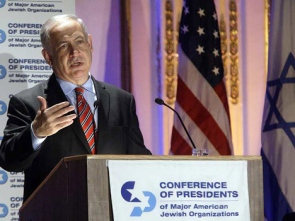
Benjamin Netanyahu speaks to members of the Conference of Presidents of Major American Jewish Organizations in New York, on July 7, 2010.

A group of leading American conservatives has set up a new group to attack President Obama over his “anti-Israel” stance, U.S. website Politico reports.
By Haaretz Service

Washington observers may feel there is no obvious shortage of pro-Israel lobbyists in the city – but a group of leading American conservatives thinks otherwise and has set up a new campaign group to attack President Obama over his “anti-Israel” stance, U.S. website Politico reports.

The Emergency Committee for Israel presents a potent combination of Republican Party neoconservatives and Evangelical Christians. The new group’s board includes Weekly Standard Editor William Kristol and Gary Bauer, a former Republican presidential candidate who leads the group American Values, as well as Rachel Abrams, a conservative writer and activist.
Netanyahu U.S.

Benjamin Netanyahu speaks to members of the Conference of Presidents of Major American Jewish Organizations in New York, on July 7, 2010.
Photo by: AP

“We’re the pro-Israel wing of the pro-Israel community,” Politico quoted Kristol as saying. Bauer described the Obama presidency as “the most anti-Israel administration in the history of the United States.”

Under U.S. law the group does not have to disclose the sources of its funding but has already raised enough to finance its first television advertisement, which launched a savage attack on Rep. Joe Sestak, the Democratic Senate candidate in Pennsylvania.

The ad slammed Sestak for signing a letter criticizing Israel’s blockade of Gaza while declining to add his name to a defense of Israel circulated by powerful pro-Israel lobby AIPAC (the American Israel Public Affairs Committee).

The group also attacked Sestak for appearing at a fundraiser for the Council on American Islamic Relations, which it said was an “anti-Israel organization the FBI called a ‘front group for Hamas.”

“Does Congressman Joe Sestak understand Israel is America’s ally?” the ad’s narrator asked.

This is just the opening shot in what the Emergency Committee for Israel intends to be a series of ads to sway congressional races across the U.S.

“We want to be hard-hitting; we want to get into the debate and shake things up and make some points in a firm way,” said Noah Pollak, the group’s executive director.

Kristol said this group was inspired in part by another new group, the liberal J Street, which he said had shown the power of small organizations to influence the debate.

“There are some who say they’re pro-Israel but aren’t really,” he said, referring to J Street. “Then there’s AIPAC, which is a wonderful organization, but one that’s very committed to working with the administration, so they pull some punches publicly.”

MPs say Israel navy surrounds Libya aid ship


Published today (updated) 13/07/2010 20:40

Ma’an – A PLC member in Gaza and an Israeli MK reported Tuesday afternoon that warships had surrounded a Libyan aid ship 100 kilometers off the Gaza coast.

A military spokesman said he could not confirm the reports, made to Ma’an from Jamal Al-Khudari in Gaza and MK Ahmad Tibi in Jerusalem.

Tibi and Al-Khudari, who are both reportedly in touch with the ship’s organizers, said the crews were determined to continue to their destination, the Gaza City Port.

Al-Khudari said he believed Israeli warnings were serious, noting the similarity of the Israeli actions to the 31 May attack on a ship from the Freedom Flotilla, when commandos belayed on board and shot nine passengers in order to commandeer the vessel. A recent military investigation into the incident found no fault with the actions.

Shortly after noon, the Israeli military made radio contact the ship which left the Greek port of Athens on Saturday under a Moldovan flag.

An Israeli military spokesman said first contact was made with the boat over 100 miles from the shore. “It wasn’t a warning,” the representative added, saying forces made contact to ask who was on board, and “clarified it was not allowed to dock in Gaza. It was not an ultimatum.”

He added that the boat “will not enter Gaza.”

Radio Israel reported the contact involved a request to the captain of the ship to dock in the Egyptian port of Al-Arish, and to abandon plans to dock in Gaza City. The Associated Press quoted Libyan organizers saying the crew had been contacted and ordered to change course, though military officials denied the report.

The Gadhafi International Charity and Development Foundation said its boat refused to alter its destination and will steam on for Gaza, the AP said.

Al-Khudari earlier told German press agency DPA that Israeli attempts to convince the ship to dock in Al-Arish or Ashdod “have failed.”

At the time, and Isralei military spokeswoman said to the best of her knowledge the ship had not responded.

Hours earlier, senior Hamas member Ahmed Yousef announced that in 24-hours, a Libyan ship would dock in the Gaza City Port, and finish the mission of the Mavi Marmara.

Speaking for the committee to end the Gaza siege, Yousef called on Arab states to support the ship, organized by the son of Libyan President Mumar Gadhafi.

Yousef’s encouragement came the day after hundreds rallied in Gaza City, encouraging the ship to stay its course, following rumors that it would divert to the Egyptian port city of Al-Arish.

At the same time, Israeli media said the nation’s military was preparing to once again stop aid ships en route to Gaza using “forceful interdiction,” while a report from the Jewish Telegraph Agency said the Israeli foreign ministry warned the military not to intercept the ship in international waters.

According to the Israeli daily newspaper Haaretz, the same recommendation was made in advance of the Freedom Flotilla, which was attacked 91 miles from the Gaza coast.

Earlier attempts to break the siege

While the interception of the Rachel Corrie ship in early June was peaceful, passengers aboard the Mavi Marmara, a cargo ship sailing under the Turkish flag as part of the Freedom Flotilla, attempted to fight off Israeli commandos boarding the vessel. The resistance cost nine Turks their lives, one of whom was a dual Turkish-American citizen.

The Israeli military found its soldiers were not at fault in an internal investigation already being criticized for bias, while a second state investigation has yet to get underway as members of the investigation team and peace groups demand an expanded mandate for the inquiry, after Israel refused to participate in an international investigation of the attack, which occurred in international waters.

source

Israeli academics hit back over bid to pass law that would criminalise them

Backlash over threat to outlaw supporters of boycott movement aimed at ending the continued occupation of the West Bank

Rachel Shabi in Jerusalem and Peter Beaumont

The Observer, Sunday 11 July 2010

A Palestinian woman shouts at an Israeli soldier as clashes erupted with Palestinian protesters on Friday during a demonstration against the expansion of the Israeli settlements at Nabi Salih village near the West Bank City of Ramallah. Photograph: Alaa Badarneh/EPA

An academic backlash has erupted in Israel over proposed new laws, backed by the government of Binyamin Netanyahu, to criminalise a handful of Israeli professors who openly support a campaign against the continuing occupation of the West Bank.

The Boycott, Divestment and Sanctions (BDS) campaign against Israel has gained rapid international support since Israeli troops stormed a Gaza-bound flotilla of aid ships in May, killing nine activists. Israeli attention has focused on the small number of activists, particularly in the country’s universities, who have openly supported an academic boycott of Israeli institutions.

A protest petition has been signed by 500 academics, including two former education ministers, following recent comments by Israel’s education minister, Gideon Saar, that the government intends to take action against the boycott’s supporters. A proposed bill introduced into the Israeli parliament – the Knesset – would outlaw boycotts and penalise their supporters. Individuals who initiated, encouraged or provided support or information for any boycott or divestment action would be made to pay damages to the companies affected. Foreign nationals involved in boycott activity would be banned from entering Israel for 10 years, and any “foreign state entity” engaged in such activity would be liable to pay damages.

Saar last week described the petition as hysterical and an attempt to silence contrary opinions. While the vast majority of the signatories do not support an academic boycott of Israel, they have joined forces over what they regard as the latest assault on freedom of expression in Israel. The petition states: “We have different and varied opinions about solving the difficult problems facing Israel, but there is one thing we are agreed on – freedom of expression and academic freedom are the very lifeblood of the academic system.”

Daniel Gutwein, a history professor at Haifa University who is one of the signatories, described the minister’s intervention as an attempt “to make Israeli academia docile, frightened and silent”.

Although the BDS campaign – in various forms – has been running for over half a decade, it has become an increasingly fraught issue inside Israel in the past year since a small number of academics publicly declared support for a boycott, including Neve Gordon, author of Israel’s Occupation and a former paratrooper who was badly injured while serving with the Israeli Defence Force.

Speaking to the Observer last week, Gordon said that many Israelis saw support for the BDS as “crossing a red line”. Adding that he had received recent death threats, he said: “I am worried about what is happening to the space for debate in Israel. I find that there is a proto-fascist mindset developing. One of the slogans you hear a lot now is no citizenship without loyalty. It is an inversion of the republican idea that the state should be loyal to the citizen.”

Israeli campaigners believe the Gaza flotilla incident represents a tipping point in raising support for boycotts. Musicians including Elvis Costello, Gil Scott Heron and the Pixies have cancelled shows in Israel. Hollywood actors also snubbed Jerusalem’s international film festival and internationally acclaimed writers have supported the BDS movement, which is gaining support in dozens of countries.

“It’s a different world to what it was even a month ago,” says Kobi Snitz, member of an Israeli BDS group. “Suddenly, all sorts of people are supporting it – people that you wouldn’t expect.”

What is most interesting, however, has been the impact in Israel itself. Israeli journalist and blogger Noam Sheizaf wrote recently that such actions are now forcing Israelis “to think about the political issues and about their consequences… For a country in a constant state of denial regarding the occupation, this is no small thing.” Sheizaf does not promote the boycott, but says: “I will gladly return concert tickets if that is the price for making Israelis understand that the occupation cannot go on.”

Adi Oz, culture editor on the Tel Aviv weekly Ha’ir, appeared on Israeli national radio explaining her support for recent boycott activity. “When the Pixies cancelled their concert here I was disappointed,” she says. “But I was not critical of the Pixies, I was critical of our government, because they are responsible for Israel’s isolation.” She adds that, post-flotilla, the cultural boycott is “something that everyone has a stand on – and some people are realising that they are in favour of it, without having thought about it before.” There has also been a spate of boycott-related discussion in the financial press. The daily business newspaper Calcalist ran an uncritical profile of the Israeli campaigners behind Who Profits, an online database of Israeli and international companies involved in the occupation of the West Bank.

The project’s co-ordinator, Dalit Baum, of the Coalition of Women for Peace, says: “Every day there is an article about this issue in the Israeli media, which creates a discussion about the economy of the occupation and raises the fact that there’s a problem.”

Thumbing Its Nose at the Censor

Politically explosive films and television series from Syria are storming the Arab market. Now the film “The Long Night” – the first Syrian feature film to highlight the fate of political prisoners – has become ensnared in the censorship process. It is nevertheless reaching its audience via satellite television – even in Syria. Susanne Schanda reports

“Sensitive political subject”: although the censors were full of praise for “The Long Night”, they passed it on to a higher authority for consideration

Four men in blue prison gear with unkempt grey hair and stubble sit in their cell drinking tea. The light is crepuscular, the plaster is peeling off the walls. They have been behind bars for 20 years for criticising the regime. Karim is the oldest, he stays lying down on his metal bed and has his tea brought to him. He is resigned to his fate. Then the heavy iron door swings open, and out of all the men it is Karim who is ordered to pack his things and go with the guards. He is being released.

The opening scenes of “The Long Night” are almost wordless, and there is no music to break the silence. We watch as Karim washes himself, as the guards shave him and cut his hair. Then suddenly he’s out on the street, in a shirt and suit, a leather bag in his hand – he sniffs the air, and takes in his surroundings with amazement.

The film by Haitham Hakki, one of Syria’s best-known filmmakers, does not focus on prison conditions or the arbitrary nature of detentions. It deals instead with members of the released prisoner’s family, who have come to an arrangement with the regime and made their compromises.

The unexpected release of Karim throws their lives into confusion, and triggers recriminations and feelings of remorse.

“I am concerned with the human drama, the film does not operate with political slogans,” says Haitham Hakki in an interview with Qantara.de in Damascus. He wrote the screenplay himself. Once this was approved by the censors, the film could be made in Syria with Syrian actors, under the supervision of star director Hatem Ali.

But the film required further authorisation before it could go on general release in Syrian cinemas. “The censors were full of praise for the film, but because of the sensitive political subject they passed it on to a higher authority for consideration. That was about six months ago. I’ve heard nothing since,” says the author.

“The censors can’t shut down the universe”: Syrian scriptwriter and filmmaker Haitham Hakki
Nevertheless, in an era of globalised satellite television, the long arm of the censor is actually not that long at all: “It’s only a matter of time before Syrian audiences will also be able to see the film,” says Haitham Hakki, who produced the film for the Saudi production company Orbit. “Orbit will soon be broadcasting the film on a cable broadcaster. Then we’ll sell it on to other television stations, and it’ll soon be broadcast everywhere, even in Syria. The censors can’t shut down the universe.” “The Long Night” has already been shown at numerous film festivals and honoured with prizes, for example in Cairo, Delhi and Taormina.

Close to the taboo zones

Haitham Hakki is a decidedly political filmmaker. Has he ever been sent to prison for his views? He waves his hand in negation: “No, but I know many families who have suffered similar tragedies.” He is unimpressed by films that propagate a direct political message, and says that in any case, it would not be possible to make such a film in Syria.

Some Arab critics have accused him of taking a clear-cut stance against the government in “The Long Night”. Hakki, who describes himself as a social democrat, says: “That doesn’t interest me. My social dramas are always political, even if they’re not explicitly about politics. If you want to instigate change, you draw back the veil on society’s failings. That is political in itself.”

Ten years ago, the censorship process in Syria was considerably more stringent than it is today. When the new government of Bashar al-Assad came to power following the death of his father Hafez al-Assad in the year 2000, the change ushered in a period of liberalisation. But what became known as the Damascus Spring was short-lived. Artists, writers and filmmakers have now learned how to circumvent censorship and express criticism without calling a spade a spade.


“Then suddenly he’s out on the street”: “The Long Night” deals with members of the released prisoner’s family, who have come to an arrangement with the regime and made their compromises

Haitham Hakki explains that there are red lines that are not to be crossed, but it’s not always clear where they have been drawn. Sometimes a decision can depend on the mood or the character of the official responsible at the time. Generally in the Arab world, the three main taboos apply: sex, religion and politics. “But it’s not possible to make any film without at least touching upon these issues,” says Hakki. “I always manoeuvre in very close proximity to these taboo zones and continually try and broaden their acceptance.”

New stimuli from the Syrian film and television industry

Just like Egypt, Syria also has its fair share of cheap and cheerful soap operas, but the nation also has a proud tradition of television series that weave more challenging subjects into their storylines such as social problems and modern Syrian history; or Arab issues such as the Palestinian-Israeli conflict and the situation in Iraq – an approach that is popular with audiences.

Since 1980, the 61-year-old director, scriptwriter and producer Haitham Hakki has made numerous political and socially explosive feature films and television series. He has often had to wait years for permission to screen them. For example, for the 23-part series “Khan al-Harir” (“Silk Market”) by the writer Nihad Siris, directed by Hakki. The censorship authorities withheld the screenplay for two years, until permission to go ahead with filming eventually came in 1996.

The story of love and trade in the souq of Aleppo highlights the negative impact of the Syrian-Egyptian union of 1958-61. “The government didn’t like that,” Hakki suspects. “But in the end, authorities even allowed the series to go out during the most advantageous period for broadcasts – the fasting month of Ramadan. It was a huge success and was later shown again several times.”

After “Khan al-Harir” came increasing numbers of Syrian television series and films that were huge hits beyond national borders across the Arab world. This success posed a threat to the Egyptian film industry, which had dominated the market up to that point. “We brought a cinematographic perspective to the series, filmed with just one camera at locations outside the studio, and chose brazen subjects,” Hakki explains the strategy. Previously, television series production had been restricted to the studio. “It looked like filmed theatre and bored people,” he says.

Financial boost from liberal Arab satellite broadcasters

Apart from the inspiration and courage of Syrian filmmakers, the emergence of satellite broadcasters in the Gulf States from the mid-1990s also played a key role in enhancing the popularity of Syrian series. It meant more money had now come into play.

Increasing numbers of Syrian television series and films are huge hits beyond national borders across the Arab world. Pictured: star director Hatem Ali

MBC, Rotana and Orbit are the best-known Arab media concerns investing robustly in feature films and series. “Previously, when there were only local broadcasters in each individual country, we had to sell each series to around 20 foreign broadcasters to recoup the money we’d invested. Now the lion’s share of the financing comes from the media concerns in the Gulf, which are owned by Saudi princes or businesspeople,” says Hakki.

As for what influence or even censorship is exerted on the part of the investors, this is extremely small. Hakki concedes that there were initially some problems with the Kingdom’s strict moral codes, but now that most of the broadcasters have relocated abroad, companies run by Saudis are the most liberal in the Arab world. “Those who invest large amounts of money want to see profit, and ideological questions are of secondary importance,” he says soberly.

So, the fact that the censor’s knife no longer reaches the controversial objects of desire looks to be less a case of political intention, and more a side effect of competition between satellite broadcasters in a realm where the sky’s the limit. “‘The Long Night’ is the best example of that,” confirms Haitham Hakki.

Susanne Schanda

© Qantara.de 2010

Translated from the German by Nina Coon

Edited by: Lewis Gropp/Qantara.de

source

Death of a legend

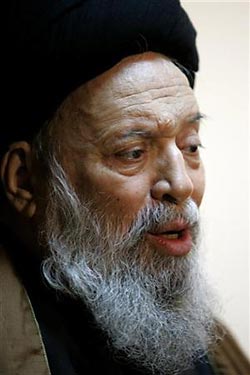
Ayatollah Fadlullah

Muslims worldwide this week mourned the loss of an icon of Islamic thought and jurisprudence. Omayma Abdel-Latif reflects on the lifelong struggle of Ayatollah Fadlullah

In one of his Friday sermons in January, 75- year-old Grand Ayatollah Sayed Mohamed Hussein Fadlullah, who died Sunday in Beirut, spoke to his followers about “true Islam”. “The true Islam,” he said, “wants us to base our lives on reason and to elevate it by means of knowledge, so as to enrich it and be enriched by it.” This sentence summed up Fadlullah, or Al-Sayed as his followers called him, and the doctrine he embraced across a lifelong struggle for Islam. It was also this doctrine that earned Al-Sayed iconic status across the Muslim world for his great contribution to Islamic thought and jurisprudence, elevating him as one of the great Islamic thinkers of his time.

On Tuesday, tens of thousands of mourners flocked to Beirut’s southern district to pay their last respects to a man that at times of bleak fitna (strife) emerged as a guiding light to millions of Muslims, regardless of their sectarian affiliation. At a time when very few Islamic figures were able to nurture a cross sectarian following, Fadlullah did. Although media outlets — both Western and non-Western — identify Fadlullah as a “Shia” scholar, this identification was one he did not subscribe to. His contribution to the renewal of Islamic thought and jurisprudence in general through his countless fatwas offering original insights was significant beyond his contributions to Shia faith.

Born in 1935 in the city of Najaf to Lebanese parents, Fadlullah grew up in a family of scholars. His father, Ayatollah Abdel-Raouf Fadlullah, migrated to Iraq to complete his religious education in Al-Hawza Al-Deeniya (the religious seminary). Fadlullah followed in his father’s footsteps and was the disciple of many celebrated Shia scholars, including Abul- Qassem Al-Khoei, Mohsen Al-Hakim and Mohamed Baqir Al-Sadr. Upon completing his religious education, Fadlullah displayed great talent in interpretation and inspired a growing following of students. In 1966, he went to Lebanon to establish the Institute of Islamic Jurisprudence.

Fadlullah’s Friday sermons were not just about religious teachings alone. What perhaps singled him out among his peers was that he never separated politics from religion. While the first parts of his sermons would tackle religious issues, Fadlullah was keen to address current affairs in subsequent parts. At the heart of his body of teaching, three key issues rose to dominance: the struggle for Palestine, fighting for Islamic unity, and resisting US hegemony and Arab despotism. Hardly a sermon went by without reference to these topics and Fadlullah always displayed an impressive knowledge of current affairs. He reserved the harshest words for Arab officialdom, the US and Israel. Indeed, his scathing criticism of US policies in the region and Israel’s occupation of Arab land made him a target of numerous assassination attempts on his life. The most dangerous was during the 1980s when an explosion targeted his headquarters in Al-Imam Al-Reda Mosque in Bir Al-Abad area. Fingers pointed to both the US and Saudi Arabia.

Over the years Fadlullah grew to become one of the most prominent scholars of Islamic thought and an inspiration for the nascent Islamic movement in Lebanon. When the Islamic Resistance Movement (Hizbullah) came into existence in 1982, Fadlullah became its spiritual leader. Along the years, the relationship grew complicated. The year 1994 represented a watershed. Fadlullah declared himself a marjie taqlid (a source of emulation) and addressed the issue of wilayat al-faqih (the guardianship of the clerics), which he did not accept. He maintained a distance from both Hizbullah and the Islamic Republic of Iran, presenting himself as an independent scholar and jurist. Despite being subject to smear campaigns from time to time, Fadlullah remained committed to the cause of resistance. Until his last days, Fadlullah defended both Iran and Hizbullah against campaigns that targeted them.

A notable number of Hizbullah followers continue to consider Fadlullah as their source of emulation. Hizbullah Secretary-General Hassan Nasrallah once described the relationship with Fadlullah by saying “both Hizbullah and Sayed Fadlullah have a unity of purpose and of vision.” Following Fadlullah’s death, Nasrallah issued a statement referring to himself and other resistance leaders as “among Fadlullah’s disciples”. The statement was viewed as a move to put an end to speculation surrounding the complicated relationship. After the 2006 Israeli war on Lebanon, Fadlullah was among the few voices that continued to lend support to the resistance, both in his sermons and interviews.

But perhaps Fadlullah’s greatest achievement, followers would argue, is the fact that he radically changed the ways in which religious scholars interact with their societies. He was a man of the people and he made frequent reference to his relationship with his followers. One reason he chose to be buried in Al-Emamyen Al-Hassanyein Mosque in Beirut’s southern district and not in Najaf, according to tradition, was in his words because “I want people to be able to reach me even after I am gone.” Identified as a great reformer, Fadlullah once explained that reform “does not mean to innovate Islam itself… rather innovation is in how to understand this revelation, the Holy Quran.”

Among the legacies Fadlullah is leaving behind is an extensive network of social institutions. This includes nine orphanages, 18 schools, and a large number of religious and cultural centres in Lebanon, Syria and Iraq.

source

An excellent meeting

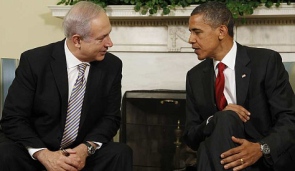
Prime Minister Benjamin Netanyahu meeting with U.S. President Barack Obama at the White House on July 6, 2010
Two statesmen met in Washington on Tuesday who are looking smaller and smaller, who are taking smaller and smaller steps. They have decided not to decide, which in itself is a decision. When the chance of a two-state solution has long since entered injury time, they have decided on more extra time. Get ready for the binational state, or the next round of bloodletting.

My question is, which nations are they referring to? Israel and Palestine or Israel and the USA??
An excellent meeting
Two statesmen met in Washington on Tuesday who are looking smaller and smaller, who are taking smaller and smaller steps.

By Gideon Levy

It really was an excellent meeting: The chance that a binational state will be established has improved as a result; relations between Israel and the United States are indeed “marvelous.” Israel can continue with the whims of its occupation. The president of the United States proved Tuesday that perhaps there has been change, but not as far as we are concerned.

If there remained any vestiges of hope in the Middle East from Barack Obama, they have dissipated; if some people still expected Prime Minister Benjamin Netanyahu to lead a courageous move, they now know they made a mistake (and misled others ).

The masked ball is at its peak: Preening each other, Obama and Netanyahu have proved that even their heavy layer of makeup can no longer hide the wrinkles. The worn-out, wizened old face of the longest “peace process” in history has been awarded another surprising and incomprehensible extention. It’s on its way nowhere.

The “warm” and “sympathetic” reception, albeit a little forced, including the presidential dog, Bo, the meeting of the wives, with the U.S. president accompanying the Israeli prime minister to the car in an “unprecedented” way, as the press enthused, cannot obscure reality. The reality is that Israel has again managed to fool not only America, but even its most promising president in years.

It was enough to listen to the joint press conference to understand, or better yet, not understand, where we are headed. Will the freeze continue? Obama and Netanyahu squirmed, formulated and obfuscated, and no clear answer was forthcoming. If there was a time when people marveled at Henry Kissinger’s “constructive ambiguity,” now we have destructive ambiguity. Even when it came to the minimum move of a construction freeze, without which there is no proof of serious intent on Israel’s part, the two leaders threw up a smoke screen. A cowardly yes-and-no by both.

More than anything, the meeting proved that the criminal waste of time will go on. A year and a half has passed since the two took office, and almost nothing has changed except lip service to the freeze. A few lifted roadblocks here, a little less blockade of Gaza there – all relatively marginal matters, a bogus substitute for a bold jump over the abyss, without which nothing will move.

When direct talks become a goal, without anyone having a clue what Israel’s position is – a strange negotiation in which everyone knows what the Palestinians want and no one knows for sure what Israel wants – the wheel not only does not go forward, it goes backward. There are plenty of excuses and explanations: Obama has the congressional elections ahead of him, so he mustn’t make Netanyahu angry.

After that, the footfalls of the presidential elections can be heard, and then he certainly must not anger the Jews. Foreign Minister Avigdor Lieberman is pressuring Netanyahu now; tomorrow it might be Likud MK Danny Danon, and after all, you can’t expect Netanyahu to commit political suicide. And there you have it, his term in office is over, with no achievements. Good for you, Obama; bravo Netanyahu. You managed to make a mockery of each other, and together, of us all.

Netanyahu will be coming back to Israel over the weekend, adorned with false accomplishments. The settlers will mark a major achievement. Even if they don’t not admit it – they are never satisfied, after all – they can rejoice secretly. Their project will continue to prosper. If they have doubled their numbers since the Oslo Accords, now they can triple them.

And then what? Here then is a question for Obama and Netanyahu: Where to? No playing for time can blur the question. Where are they headed? What will improve in another year? What will be more promising in another two years? The Syrian president is knocking at the door begging for peace with Israel, and the two leaders are ignoring him. Will he still be knocking in two years? The Arab League’s initiative is still valid; terror has almost ceased. What will the situation be after they have finished compromising over the freeze in construction of balconies and ritual baths?

Two statesmen met in Washington on Tuesday who are looking smaller and smaller, who are taking smaller and smaller steps. They have decided not to decide, which in itself is a decision. When the chance of a two-state solution has long since entered injury time, they have decided on more extra time. Get ready for the binational state, or the next round of bloodletting.

Source

Blog at WordPress.com.

Up ↑