The Olympia Food Co-op announced last week that no more Israeli products will be sold at its two grocery stores
Americans are far more supportive of Israel than Europeans, and most initiatives to boycott Israeli goods or to divest funds from companies working with Israel are unsuccessful in the United States.
But such projects have recently become more widespread, especially among students – although most divestment decisions by student bodies are not implemented on the colleges’ management levels.
 from Mairead Maguire
I write to ask for your help in gaining the freedom of a good man, a man of peace, and a man of conscience.
In the Jewish scriptures there is great emphasis on justice and freedom and it is for such, for one man, that I write to seek your help.
He will not be aware that I am writing this appeal, but I do so in the hope that with your help, it will produce his freedom, and not (and this I must risk) cause yet more punishment and cruelty to be inflicted upon him.
However, I feel when I tell you the story, it will touch your hearts and there will be those among you who will be able to help him gain his freedom.
In May 2010, this man was returned to prison to serve three months for allegedly breaking his prison release restrictions and speaking to the foreign media. On 11 July 2010, he had his first visit in seven weeks. His brother, Meir, was granted a 30-minute visit. There was a glass window between them and they spoke via phone. He wore a prison uniform. He is held in the harshest section there is in the prison. It holds the most notorious criminals in the country, well-known murder cases.
About a dozen are in severe isolation conditions. He is in a cell by himself for 24 hours a day, no window but a small wire-covered crack at the top part of one wall. He has about an hour’s walk a day in a very tiny yard. He was simply thrown in a cell by the security agents, the door locked, and left to suffer there all alone. He has not spoken to anyone in all the seven weeks and this visit was (apart from a short visit of his lawyer six weeks ago) the first conversation he had in seven weeks. His food is limited in quality and quantity, and his reading material is two books he has with him. Of course his spirits are down as a result of being put in such harsh, inhuman and cruel conditions.
His name is Mordechai Vanunu, and he is in an Israeli prison cell.
He is no stranger to prison. In 1986 Vanunu told the world that Israel had a nuclear weapons program and he was given 18 years imprisonment for doing so. He is the Israeli nuclear whistleblower and 24 years later continues to be punished for trying to warn the Israelis and protect both Israel and the world from a nuclear weapons disaster.
Vanunu served the full 18 years of his sentence (11 years in solitary) and upon release, instead of allowing him to leave Israel, the Israeli government placed severe restrictions upon him, including forbidding him to leave Israel and not to speak to the foreign media. It was the allegedly breaking of these restrictions and speaking to the media that resulted in Vanunu being returned to prison for three months.
He has six weeks left to serve in these harsh prison conditions, and even upon release from prison will still have to remain in Israel until April 2011 when the restrictions will be reviewed and probably renewed yet again, as they have been renewed each year for the past six. Some people say Vanunu will never be allowed to leave Israel but will die there, if indeed in the meantime his spirit is not broken by his ill treatment and he losses his sanity.
The Shabak continues to tell the Israeli government he is a security risk and must not be released and the Israeli Judiciary and Government obey them and keep him imprisoned. Vanunu is no risk to Israeli national security. He has no nuclear secrets. I have asked some Israelis why they think Israel refuses to allow him to leave Israel. Various reasons are given but the most frequent answer is they feel the Israeli government does not trust its citizens and holding Vanunu — forever if necessary — sends out the signal to Israeli citizens to behave themselves.
It seems, if this is so, that the strategy is working. To date only a few courageous Jewish people have raised their voices against such cruelty and injustice perpetrated upon Vanunu, and called for him to be allowed to leave Israel. But I don’t believe he will never be allowed to leave Israel and will die in Jerusalem. I have met Vanunu many times since he was released from prison on 21 April 2004. He is a good man, a man of peace, and a true Gandhian spirit. Instead of punishing him, Israel should be proud of him, and I believe that future generations of Israelis will look back and realize that there lived among them a great visionary and man of peace, not only for Israel, but for the human family. It was with great joy I nominated him several times for the Nobel Peace Prize, as did many other prominent names during the past 24 years. He richly deserves the prize, as he lives and acts in the true spirit of Alfred Nobel, who left his prize for those who would work for peace and disarmament.
However, it is with the deepest sadness that I acknowledge that in spite of world campaigns by many, including Amnesty International (and personal letters from myself to US President Barack Obama and Israeli President Shimon Peres), Vanunu continues 24 years later to be most cruelly imprisoned and punished by Israel. Most political and spiritual leaders, and international bodies of our time are silent in the face of Israel’s abuse of Vanunu’s basic human right to freedom of speech and liberty, which is in violation of many international laws.
However, I have hope that he will be free and I place my hope in those Jewish people who read this story and are moved to right a wrong continuing to be done to Mordechai Vanunu, and they will demand that their government give him his freedom, and allow him to leave Israel.
Mairead Maguire is a Northern Irish peace activist and winner of the Nobel Peace Prize. She was on board the Rachel Corrie, a Gaza-bound aid boat diverted by Israel’s navy to Ashdod on 3 June.
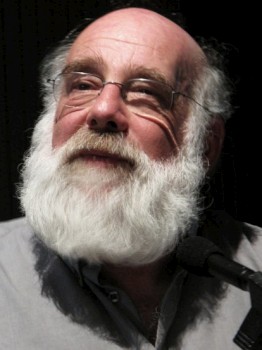
PNN: From reading the introduction of your book you talk a little about how you came to be involved in the conflict. Did you always see things the way you do now? [Note: Jeff Halper’s book is entitled: An Israeli in Palestine: Resisting Dispossession, Redeeming Israel]
Jeff Halper: I’m a child of the sixties here in the (United) States. I was always political. You almost had to be political in the sixties. I was in the anti-Vietnam War movement. I was in the civil rights movement. I was in Mississippi. I was at Woodstock even. I was always very political.
So when I went to Israel I didn’t stop being political. I was just going to another front of the revolution. It isn’t a story of a rosy-eyed Zionist who got to Israel and then got disappointed and became a leftist. The first thing I did was join the Israeli peace movement. From that point of view I knew where I was going, that there was an occupation, and I knew about Palestinians. Still, there was an attraction to Israel because I was alienated from the States. I really wanted to get out of the States. I had nowhere really to go. Israel I could go to because I’m Jewish. And I liked the idea of somehow developing a Hebrew society, the Hebrew language, things like that. So I was attracted to that. But again, I always knew there was an occupation, so I was always on the left.
PNN: In the sixties there was a great amount of Jews that went to the south (to fight for social justice during the American civil rights movement)
JEFF HALPER: Well, the Jews were disproportionately involved in both the civil rights movement and the anti-war movement. It’s the same thing today, maybe a little less. There was just an article written in the New York Review of Books (Peter Beinart, The Failure of the American Jewish Establishment) about the fact that Jews are liberal, and then (also that) young Jews have been taught to be Zionist or pro-Israel, go to Birthright, all that stuff. But there’s a conflict. And when there’s a conflict they go with their liberalism for the most part. So it was the same thing. I think there is a liberal element in Judaism, it just can’t be squelched completely. And that’s what led someone like me to go to Israel, even though I was critical.
PNN: You talked in the beginning of your book about “The Box,” the framing of the issue as “The Box,” and trying to poke holes in it to affect change. At the General Assembly this week I saw a dead-ringer for what you talked about there. Could you speak to that a little bit?
JEFF HALPER: Most people aren’t critical thinkers. You go to school, but school does not train you to be a critical thinker, it trains you to be a good citizen that doesn’t know anything. But you know what you need to know for the job market. They don’t want to train you to be an intellectual. And the political system, everything trains you to conform, basically. And that’s what people do. So they don’t ask questions. You saw that at this meeting. I don’t know how many commissioners there were in that Committee 14(the Presbyterian Church’s Middle East Study Committee at it’s 219th General Assembly). There were maybe forty. Maybe five of them talked. Most of them didn’t ask questions, all they did was raise their hands once and a while. And they raised their hands on completely diametrically opposed resolutions. So, that’s the way people are, they think in “The Box.” And “The Box” is all they need. It’s comfortable, you don’t have to go beyond it, you fit in, everybody likes you, you don’t have to think about things, and you have a good time. The pursuit of happiness is the American thing. So it’s very hard to get people out of the box.
PNN: To not be bothered
JEFF HALPER: To not be bothered, to ask questions, to be willing to be critical, to be criticized. In America to be popular is so important that people just resist getting out of “The Box.” And they don’t understand it and they don’t want to go there. That’s what makes it hard, because reality is not in “The Box.” Reality is much more complicated, it’s much more nuanced. All these slogans are just from ignorance. And you can’t do it in a sound byte. That’s the problem with the way the whole thing is structured in these conflicts, everybody gets a minute or two minutes to talk. You can’t get an idea across in a minute or two. It’s just a ping-pong of slogans back and forth. It doesn’t lead anywhere.
PNN: Could you talk about the popular movement among the Palestinians? The protests in Bil’in, in Nil’in and other places, and how you are involved with that?
JEFF HALPER: We’re partners with the Palestinians. We can’t fight their struggle. It’s true we initiate things in (regard to) house demolitions, rebuilding houses and resisting demolitions, but we do that always with Palestinians. We always work with them. We’re the junior partners. It’s their struggle. I go to Bil’in, I go to Sheikh Jarrah and Silwan and other things. I prefer, in a way to go to actions in the Occupied Territories initiated by Palestinians. That’s the solidarity. There are times in which we initiate things in the Occupied Territories. But like I said, it’s always in conjunction with Palestinians, in a partnership with Palestinians. So we see ourselves as partners. It’s a common struggle. Both peoples are going to continue to live in that country, so the vision is an inclusive vision. We both have a right and a duty to struggle together.
I have, in a way, liberation. I’ve got Israel. The Palestinians don’t have a state, in whatever form it takes. So in a way there’s that asymmetrical element. It’s their struggle for liberation that remains to be won. For example, our organization does not advocate a particular solution, one state or two state or whatever, because we say that’s the Palestinians prerogative. And if in the end they decide two states, and I don’t like the idea, it’s not my call. If they decide one state, then I have to go with that. In other words their liberation is in a sense their liberation. Their self-determination is their self-determination. I can’t second-guess them on it, I can’t tell them what to do, and therefore I think that partnership idea is very important.
PNN: One of the main reasons you came was to talk about Caterpillar and divestment…
JEFF HALPER: And apartheid
PNN: And apartheid. Can you talk a little more about these issues?
JEFF HALPER: In a way it’s phrased, this is an “American Church,” the Presbyterian Church USA. So it’s an American conversation. In some ways it’s important that they evaluate American policy. Well, Americans give economic, political and military support to Israel. It’s like an umbrella that insulates Israel from pressures. And that’s why Israel can be so aggressive. And people aren’t really aware of it. So they think the United States is helping Israel militarily because Israel needs that, and needs to be defended. But, in fact, Israel’s the fourth largest nuclear power in the world. It’s the third largest arms exporter. It can do very well without America. What it needs from the United States is access to military technology. It doesn’t really need the three billion dollars. The three billion dollars are very nice, but it doesn’t really need that.
PNN: In Israel, isn’t a large component of the economy military technology? For example, Drones?
JEFF HALPER: Yeah, military technology. The United States buys drones from Israel, not the other way around. And joint projects. The wall that the United States is building (on the border) with Mexico is being built by Boeing and Elbit Systems, which is an Israeli system of surveillance. So you know, Israel’s an equal partner, its not this little country that needs every bullet the United States sends. The United States also uses Israel to test its weaponry. For example, in Gaza. One of the reasons why Israel invaded Gaza, I think, was to field-test American weapons. The cluster bombs, the white phosphorus, what’s called DIME, Dense Inert Metal Explosives, based on Tungsten. Certain robotics, different kinds of crowd control gasses and sprays. There’s a lot of American weaponry that’s tested by Israel, it’s field tested in Gaza and in the West Bank as well. So there’s that whole part of it, and I don’t think Americans really understand the military part and how it has nothing to do with Israeli security, has nothing to do with really supporting Israel. It’s Israel being used by the United States for developing weaponry and for field testing, Israel using the United States to market military technologies and do joint projects. And all this is a military arrangement that on one hand contributes to the occupation, but it’s just a present to Israel. Its not that the United States is really defending Israel. Israel could have had peace twenty years ago, probably forty years ago if it had not occupied Palestinian land, if it had dealt with Palestinians and not tried to exclude them. So in a sense the American military, it’s bad on two counts. One is that it perpetuates the occupation, which isn’t good for Israel or for American interests in the Middle East, and on the other hand it contributes to American militarism. Those are both issues the churches’ should be concerned about. So what I was doing was trying to frame this issue in terms of American responsibility, American values, church values, rather than putting the emphasis on Israel itself. That was the thrust of what I was trying to say.
PNN: It seemed in the committee there was a lot of concern about demonizing Israel. A lot of people may not be familiar with the Israeli press and the way that Israelis in many cases are condemning what their government is doing. That same voice is not heard, say, in the New York Times.
JEFF HALPER: First of all there is a weird double standard. I mean, who ever talked about being afraid to demonize South Africa in the days of Apartheid? And who ever talked about balance? “We have to hear from the Afrikaner side. We can’t listen to the ANC (African National Congress) voice without listening to the white voice as well.” The whole dynamic here is completely different than anywhere else. You can criticize Iran, you can sanction Iran. You can do regime change in other countries. Not with Israel. There’s a very strange double standard there. And in addition to that, the point I try to make is that Israel’s a country. It’s not a religion, it’s not Jews, it’s not your next-door neighbor who’s Jewish, that you golf with. It’s a country! And it’s a country with a tremendous geopolitical importance whose policies tremendously impact the well-being of the United States. There’s no symmetry between Israel and the Palestinians. Palestinians don’t have an army. They don’t have a state. So first of all, why is criticizing a nuclear power, that’s an occupying power, why is that demonizing? And second of all, why is listening to the Palestinian voice by itself, with no Israeli additions, like we listen to Nelson Mandela’s voice, why is that forbidden? Why can’t you hear Palestinian voices, with the feeling that this is unbalanced and quick, quick, quick! We’ve got to get some Israeli voices! It’s very weird, that’s the only word you could use, a weird concept and dynamic of Israel that goes on.
There’s different reasons why, but you can’t do that in the world, you can’t take a nuclear power and say it’s beyond criticism. That’s a really dangerous thing. But people just don’t think, they just don’t think. And that was my disappointment here with the Presbyterians. They didn’t think, they didn’t ask questions. I was a resource person. I was called for one minute over two days. And the discussion was superficial, I think it was trivialized. In the middle of all these discussions of life and death, whenever there was a break they talked about their most embarrassing moments. Or prayer, all this prayer stuff. Prayer is nice but if it’s hollow, if it’s not balanced by action, justice, everything else, that was missing. I guess you have to give the Presbyterians some credit. At least they were dealing with some of these issues. I don’t think the process and the discussion they had did justice. It didn’t serve either the interests of the church or the issues under discussion, so I’m very critical of that process. But at the same time, we made some progress. Caterpillar was denounced, divestment still possibly could take place, (and) the Palestinian voice did come through. We lost the Apartheid overture, but the word was used, political consciousness was raised, and it’s an advance over the last time. Last time we had to argue whether there was an occupation or not. And so it’s a process, it’s true. What’s missing for me is the urgency, because it’s an urgent problem, which I feel as an Israeli, and Palestinians feel, that isn’t felt here. Here, it’s an exercise, and they study it for the next couple of years, and that’s why it gets trivialized. But nevertheless, I have to give some credit to the Presbyterians, they did kind of bite the bullet. Not every decision was what I wanted but we did make progress.
PNN: As an activist yourself, for a long time now, what is your advice to people who want to get involved? Maybe it’s the Israel/Palestine conflict, or maybe it’s something else. How do they help lift up the voices of the downtrodden?
JEFF HALPER: That’s a big problem, because the discourse is still in the old colonial. White voices are still privileged over the voices of peoples of color. The rich are still privileged over the poor. The west is still privileged over everybody else in the world. The militarily strong countries are privileged over the weaker ones. It’s still like that. The world is still in a colonial space. And the discourse is very colonial. Even the fact that these delegates didn’t want to listen international law or human rights, or the U.N. It was all American, American, American. And by American they meant white. Just look at the Presbyterian Church, its ninety-some percent white. Middle class. It’s very much a colonial discourse, and that’s something that we have to fight.
I think in the world, and Americans don’t really see this yet, the United States is getting very isolated, because I think the peoples of the world, the non-core, the periphery, the people of the peripheries in Latin America, Africa, Asia, Eastern Europe, are getting pissed off. You’re having the rise of what are called the BRIC nations. Which is Brazil, Russia, India, and China. And if you throw into there Turkey and Iran, maybe even Mexico and South Africa, you’re starting to get a new constellation of the world, of peoples that are kind of pissed off at the United States and Europe that are still dominating the main source of warfare today. The main form of warfare is what’s called resource wars. Wars that the west wage against poor countries that happen to be sitting on resources that they want. Whether its water or minerals or timber, or oil. And then at the same time, through the IMF and the World Bank, and the World Trade Organization and other institutions oppressing those peoples and not letting them enjoy their own resources, not giving them fair prices for their products, not giving them a fair go. And I think it’s changing. In the next few years the United States is not going to be as privileged as it is today. But it still has it’s feeling of entitlement, partly because of its military strength. The Pentagon gets almost a trillion dollars a year in funding. The United States pours thirty billion dollars of new weapons into the world every year. Ten billion go to the least developed countries. So that’s what gives the United States its clout. But its losing it economically, its losing it culturally, its losing it in terms of people caring about the United States. That’s part of the process. Part of what I try to do is help Americans try to understand that and change their policies, but they can’t because they’re so insulated. So much in “The Box.”
17.07.10
Jeff Halper is Co-Founder and Coordinator for the Israeli Committee Against House Demolitions (ICAHD). He was commissioned as a resource person for the Presbyterian Church’s Middle East Study Committee during its 219th General Assembly. We spoke at two different times over the course of the week on topics related to the conflict in Israel / Palestine.
This interview was conducted by Matthew Walleser for PNN
 WHEN I was first elected to the Knesset, I was appalled at what I found. I discovered that, with rare exceptions, the intellectual level of the debates was close to zero. They consisted mainly of strings of clichés of the most commonplace variety. During most of the debates, the plenum was almost empty. Most participants spoke vulgar Hebrew. When voting, many members had no idea what they were voting for or against, they just followed the party whip.
That was 1967, when the Knesset included members like Levy Eshkol and Pinchas Sapir, David Ben-Gurion and Moshe Dayan, Menachem Begin and Yohanan Bader, Meir Yaari and Yaakov Chazan, for whom today streets, highroads and neighborhoods are named.
In comparison to the present Knesset, that Knesset now looks like Plato’s Academy.
WHAT FRIGHTENED me more than anything else was the readiness of members to enact irresponsible laws for the sake of fleeting popularity, especially at times of mass hysteria. One of my first Knesset initiatives was to submit a bill which would have created a second chamber, a kind of Senate, composed of outstanding personalities, with the power to hold up the enactment of new laws and compel the Knesset to reconsider them after an interval. This, I hoped, would prevent laws being hastily adopted in an atmosphere of excitement.
The bill was not considered seriously, neither by the Knesset nor by the general public. The Knesset almost unanimously voted it down. (After some years, several of the members told me that they regretted their vote.) The newspapers nicknamed the proposed chamber “the House of Lords” and ridiculed it. Haaretz devoted a whole page of cartoons to the proposal, depicting me in the garb of a British peer.
So there is no brake. The production of irresponsible laws, most of them racist and anti- democratic, is booming. The more the government itself is turning into an assembly of political hacks, the more the likelihood of its preventing such legislation is diminishing. The present government, the largest, basest and most despised in Israel’s history, is cooperating with the Knesset members who submit such bills, and even initiating them itself.
The only remaining obstacle to this recklessness is the Supreme Court. In the absence of a written constitution, it has taken upon itself the power to annul scandalous laws that violate democracy and human rights. But the Supreme Court itself is beleaguered by rightists who want to destroy it, and is moving with great caution. It intervenes only in the most extreme cases.
Thus a paradoxical situation has arisen: parliament, the highest expression of democracy, is itself now posing a dire threat to Israeli democracy.
THE MAN who personifies this phenomenon more than anyone else is MK Michael Ben-Ari of the “National Union” faction, the heir of Meir Kahane, whose organization “Kach” (“Thus”) was outlawed many years ago because of its openly fascist character.
Kahane himself was elected to the Knesset only once. The reaction of the other members was unequivocal: whenever he rose to speak, almost all the other members left the hall. The rabbi had to make his speeches before a handful of ultra-right colleagues.
A few weeks ago I visited the present Knesset for the first time since its election. I went there to listen to a debate about a subject that concerns me too: the decision of the Palestinian Authority to boycott the products of the settlements, a dozen years after Gush Shalom started this boycott. I spent some hours in the building, and from hour to hour my revulsion deepened.
The main cause was a circumstance I had not been aware of: MK Ben-Ari, the disciple and admirer of Kahane, holds sway there. Not only is he not an isolated outsider on the fringe of parliamentary life, as his mentor had been, but on the contrary, he is at the center. I saw the members of almost all other factions crowding around him in the members’ cafeteria and listening to his perorations with rapt attention in the plenum. No doubt can remain that Kahanism – the Israeli version of fascism – has moved from the margin to center stage.
Recently, the country witnessed a scene that looked like something from the parliament of South Korea or Japan.
On the Knesset speaker’s rostrum stood MK Haneen Zoabi of the Arab nationalist Balad faction and tried to explain why she had joined the Gaza aid flotilla that had been attacked by the Israeli navy. MK Anastasia Michaeli, a member of the Lieberman party, jumped from her seat and rushed to the rostrum, letting out blood-curdling shrieks, waving her arms, in order to remove Haneen Zoabi by force. Other members rose from their seats to help Michaeli. Near the speaker, a threatening crowd of Knesset members gathered. Only with great difficulty did the ushers succeed in saving Zoabi from bodily harm. One of the male members shouted at her, in a typical mixture of racism and sexism: “Go to Gaza and see what they will do to a 41 year old unmarried woman!”
One could not imagine a greater contrast than that between the two MKs. While Haneen Zoabi belongs to a family whose roots in the Nazareth area go back centuries, perhaps to the time of Jesus, Anastasia Michaeli was born in (then) Leningrad. She was elected “Miss St. Petersburg” and then became a fashion model, married an Israeli, converted to Judaism, immigrated to Israel at age 24 but sticks to her very Russian first name. She has given birth to eight children. She may be a candidate for the Israeli Sarah Palin, who, after all, was also once a beauty queen..
As far as I could make out, not a single Jewish member raised a finger to defend Zoabi during the tumult. Nothing but some half-hearted protest from the Speaker, Reuven Rivlin, and a Meretz member, Chaim Oron.
In all the 61 years of its existence, the Knesset had not seen such a sight. Within a minute the sovereign assembly turned into a parliamentary lynch mob.
One does not have to support the ideology of Balad to respect the impressive personality of Haneen Zoabi. She speaks fluently and persuasively, has degrees from two Israeli universities, fights for the rights of women within the Israeli-Arab community and is the first female member of an Arab party in the Knesset. Israeli democracy could be proud of her. She belongs to a large Arab extended family. The brother of her grandfather was the mayor of Nazareth, one uncle was a deputy minister and another a Supreme Court judge. (Indeed, on my first day in the Knesset I proposed that another member of the Zoabi family be elected as Speaker.)
This week, the Knesset decided by a large majority to adopt a proposal by Michael Ben-Ari, supported by Likud and Kadima members, to strip Haneen Zoabi of her parliamentary privileges. Even before, Interior Minister Eli Yishai had asked the Legal Advisor to the Government for approval of his plan to strip Zoabi of her Israeli citizenship on the grounds of treason. One of the Knesset members shouted at her: “You have no place in the Israeli Knesset! You have no right to hold an Israeli identity card!”
On the very same day, the Knesset took action against the founder of Zoabi’s party, Azmi Bishara. In a preliminary hearing, it approved a bill – this one, too, supported by both Likud and Kadima members – aimed at denying Bishara his pension, which is due after his resignation from the Knesset. (He is staying abroad, after being threatened with an indictment for espionage.)
The proud parents of these initiatives, which enjoy massive support from Likud, Kadima, Lieberman’s party and all the religious factions, do not hide their intention to expel all the Arabs from parliament and establish at long last a pure Jewish Knesset. The latest decisions of the Knesset are but parts of a prolonged campaign, which gives birth almost every week to new initiatives from publicity-hungry members, who know that the more racist and anti- democratic their bills are, the more popular they will be with their electorate.
Such was this weeks Knesset decision to condition the acquisition of citizenship on the candidate’s swearing allegiance to Israel as a “Jewish and democratic state”, thus demanding that Arabs (especially foreign Arab spouses of Arab citizens) subscribe to the Zionist ideology. The equivalent would be the demand that new American citizens swear allegiance to the USA as a “white Anglo-Saxon protestant state”.
There seems to be no limit to this parliamentary irresponsibility. All red lines have been crossed long ago. This does not concern only the parliamentary representation of more than 20% of Israel’s citizens, but there is a growing tendency towards depriving all Arab citizens of their citizenship altogether.
THIS TENDENCY is connected with the ongoing attack on the status of the Arabs in East Jerusalem.
This week I was present at the hearing in Jerusalem’s magistrates court on the detention of Muhammed Abu Ter, one of the four Hamas members of the Palestinian parliament from Jerusalem. The hearing was held in a tiny room, which can seat only about a dozen spectators. I succeeded only with great difficulty in getting in.
After they were elected in democratic elections, in conformity with Israel’s explicit obligation under the Oslo agreement to allow the Arabs in East Jerusalem to take part, the government announced that their “permanent resident” status had been revoked.
What does that mean? When Israel “annexed” East Jerusalem in 1967, the government did not dream of conferring citizenship on the inhabitants, which would have significantly increased the percentage of Arab voters in Israel. Neither did they invent a new status for them. Lacking other alternatives, the inhabitants became “permanent residents”, a status devised for foreigners who wish to stay in Israel. The Minister of the Interior has the right to revoke this status and deport such people to their countries of origin.
Clearly, this definition of “permanent residents” should not apply to the inhabitants of East Jerusalem. They and their forefathers were born there, they have no other citizenship and no other place of residence. The revoking of their status turns them into politically homeless people without protection of any kind.
The state lawyers argued in court that with the cancellation of his “permanent resident” status, Abu Ter has become an “illegal person” whose refusal to leave the city warrants unlimited detention.
(A few hours earlier, the Supreme Court dealt with our petition concerning the investigation of the Gaza flotilla incident. We won a partial, but significant, victory: for the first time in its history, the Supreme Court agreed to interfere in a matter concerning a commission of inquiry. The court decided that if the commission requires the testimony of military officers and the government tries to prevent this, the court will intervene.)
IF SOME people are trying to delude themselves into believing that the parliamentary mob will harm “only Arabs”, they are vastly mistaken. The only question is: who is next in line?
This week, the Knesset gave the first reading to a bill to impose heavy penalties on any Israeli who advocates a boycott on Israel, in general, and on economic enterprises, universities and other Israeli institutions, including settlements, in particular. Any such institution will be entitled to an indemnity of 5000 dollars from every supporter of the boycott.
A call for boycott is a democratic means of expression. I object very much to a general boycott on Israel, but (following Voltaire) am ready to fight for everybody’s right to call for such a boycott. The real aim of the bill is, of course, to protect the settlements: it is designed to deter those who call for a boycott of the products of the settlements which exist on occupied land outside the borders of the state. This includes me and my friends.
Since the foundation of Israel, it has never stopped boasting of being the “Only Democracy in the Middle East”. This is the jewel in the crown of Israeli propaganda. The Knesset is the symbol of this democracy.
It seems that the parliamentary mob, which has taken over the Knesset, is determined to destroy this image once and for all, so that Israel will find its proper place somewhere between Libya, Yemen and Saudi Arabia.
http://zope.gush-shalom.org/home/en/channels/avnery/1279370237/
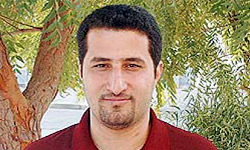
TEHRAN (FNA)- Shahram Amiri, an Iranian scholar who returned home after being kidnapped by CIA in Saudi Arabia last year, said that Israeli agents interrogated him while he was in the US.
Amiri made the announcement while talking to reporters upon arrival at the International Imam Khomeini Airport in southern Tehran this morning.
Amiri, a university lecturer, was kidnapped in the holy Saudi city of Medina on June 3, 2009 during a pilgrimage to Saudi Arabia. He was abducted by US agents with the help of the Saudi intelligence service.
The Iranian scientist, who took refuge in Iran’s interest section at the Pakistani Embassy in Washington on Tuesday, left the United States for Tehran Wednesday.
Amiri said he was under the harshest mental and physical tortures during the initial two months of his captivity in the US, adding that the US agents had threatened to transfer him to the Zionist regime’s prisons if he refused to cooperate with them.
“I was kidnapped during a joint operation by the US and Saudi intelligence agents when I was in front of my hotel in the holy city of Medina. I was made unconscious and was transferred to unknown places first in Saudi Arabia and then in the US,” he said.
He reiterated that by his abduction, Washington wanted to exert pressure on the Iranian government. “Washington, through a political play, was trying to announce to the world that I had applied for asylum,” Amiri added.
The released Iranian researcher dismissed remarks made by US Secretary of State Hillary Clinton saying he had freely come to the US and was free to go whenever he wanted.
He said US officials had even offered him $50 million if he changed his mind and decided to stay in the US. “They also assured to take my family out of Iran,” he added.
Amiri reiterated that he was a simple researcher and that he had nothing to do with the Natanz and Fordo sites. “I am a simple researcher who works in a university which is open to all and there is no secret work happening there,” he noted.
Love Boat or Hate Boat? An Interview with IHH from Cultures of Resistance on Vimeo.
July 16, 2010 By The Gaza Flotilla archive Leave a Comment
Slandering the Good Guys: Some Basic Facts About IHH
IARA LEE/CULTURES OF RESISTANCE—In the immediate aftermath of the massacre aboard the Mavi Marmara on May 31st, 2010, while journalists and activists were detained and isolated from the world, the Israeli government was quick to unleash their own version of events.
Like the physical assault on the boat, the Israeli media assault was also reckless, clumsy, malicious, and dangerous. They were cynical enough to understand that first impressions in the mainstream American media are what count, and with this in mind they began to frantically hurl the word “terrorist” in reference to both the victims of their attack, as well as one of the main organizers of the Gaza Freedom Flotilla, the Turkish NGO IHH.
It is a curious thing that few people asked the Israeli government why they would release “terrorists” that they had in their custody, and even fewer asked for (or received) solid evidence to support this claim. Despite the fact that several courageous journalists both in the US and abroad thoroughly debunked the Israeli account of what happened (this includes deliberately doctored footage along with the libelous accusations of links to terrorism), the damage was done.
Before speakers from the Mavi Marmara were scheduled to speak in New York about what happened on May 31st, local politicians began to put forth the rhetoric of their Israeli handlers, using slanderous language to demonize the victims of Israel’s illegal act of war. And most recently, 87 US senators have urged President Obama to launch an investigation of whether or not IHH should be added to the US list of foreign terrorist organizations.
I am a firm believer that actions speak louder than words, and in this spirit I thought it might help to take a closer look at IHH, and judge this group based on their actions, rather than empty words.
IHH began in 1992 as a humanitarian mission to offer relief to victims injured and displaced during the Bosnian war. They have held Special Consultative Status with the United Nations Economic and Social Council since 2004, and since becoming a fully-registered NGO in 1995, IHH — The Foundation for Human Rights and Freedoms and Humanitarian Relief — has accumulated more than 60,000 volunteers for their grassroots humanitarian efforts in 120 countries all over the world. Since May 31st, the number of volunteers has skyrocketed.
After the attack on the Mavi Marmara, I had an opportunity to ask the vice president of IHH, Huseyin Oruc, about accusations of IHH terror links. While he was not interested in dignifying such claims, he was very emphatic about the transparency of IHH’s work over the years, and hoped people would look at their large-scale sanitation and medical missions around the African continent — including 40,000 cataract surgeries in Sudan alone, clean water projects in Ethiopia- and IHH’s extensive work dealing with orphans in Iraq, Afghanistan, Pakistan, Bangladesh, and Gaza. While they are an Islamic organization, Oruc told me that IHH refuses to differentiate who receives attention based on religion, race, or political affiliation, and has noted their various projects in South America where Muslim populations are slight.
Their modus operandi is simple and direct. Given the neutrality of their humanitarian mission, IHH has been able to access some of the most inaccessible and dangerous regions of the world to help those most in need. Like most NGOs, this means they must coordinate with local governments in order to reach these populations. So while they must communicate with the Hamas government of Gaza to help civilians there, they must likewise do so with Fatah in the West Bank, Al Shabab in Somalia, the military junta in Myanmar and so on. Oruc was adamant that this did not mean IHH endorses any of those governments, and said that anyone who cared to investigate their work would find nothing other than great successes in helping ordinary people in situations of war, poverty, and natural disasters in places such as Haiti, Indonesia, and even the US in the aftermath of Hurricane Katrina. He also told me people were free to investigate their funding, most of which comes from lower and middle class donors, while the rest is raised through food fairs, auctions for Turkish artifacts, and other cultural events. By its own mandate, IHH is not beholden to any government or business interests.
We must remember that an attack on IHH is an attack on all humanitarian groups around the world. Given that IHH is among the most courageous humanitarian NGOs in the world — risking their lives to work in places like Somalia, cleaning up American messes in Iraq and Afghanistan — our politicians should perhaps be thanking them, rather than trying to tarnish their stellar reputation. Thankfully, IHH’s track record speaks for itself, as do the actions of their accusers — a comparison which does not calculate favorably for the Israeli government when asking just who, exactly, the terrorists are.
ISM , July 15, 2010
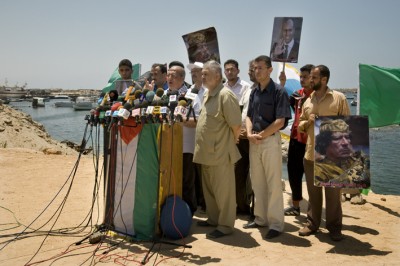
In a press conference at the port of Gaza city yesterday government officials, fishing associations, non-governmental organisations and civil society groups reiterated their support for the attempts by international activists to break the Israeli siege of Gaza by sea.
Yesterday (July 14th 2010) many people amassed at the Gazan port to urge on the latest attempt by activists to enter the strip, this time by a Libyan chartered aid ship. It was the first serious attempt to enter Gaza by sea since the horrifying attack by the Israeli navy on the Free Gaza Flotilla and the Mavi Marmara which saw 9 Turkish activists killed.
Mahfouz Kabariti, President of Palestine Sailing Federation and Palestinian Association for Fishing and Maritime Sports, was communicating with the Amalthea as it neared Gazan waters: “The last contact we had with them was at midnight and since then communication was cut by the Israeli navy. They told us the boat was surrounded by Israeli gunships, but that they were determined to attempt to dock in Gaza and not take the option offered by the Egyptian government to dock in El Arish.”
According to Mahfouz the roll of the Freedom Flotilla missions are two-fold: “First is the arrival with aid, and materials such as construction supplies still banned by the blockade. The second is to put a spotlight on the suffering of the people here. Even if they are attacked, the second message highlights even more the extent to which Israel will go to keep us in Gaza isolated from the rest of the world with this illegal blockade of our people.”
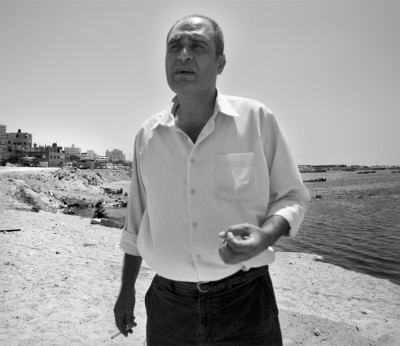
Amjad Shawa, Gaza Coordinator for Palestinian NGOs: “It is not enough to demand some kind of minor reduction of this illegal siege.”
As well as government representatives and the Popular Committee to Break the Siege, Amjad Shawa, Gaza Coordinator for Palestinian Non-Governmental Organizations (PNGO) was present. He emphasised the importance of international civil society persisting in trying to break the siege.
The need is especially acute because so far Israel’s response has only been to reduce the blockade on Gaza by a tiny fraction. The European Union, the United Nations, countless human rights groups and the International Committee for the Red Cross have all expressed the need for a return to the free flow of goods and people in and out of the Gaza Strip. This must include construction materials which are sorely needed to help rebuild the 17,000 houses severely damaged in the 3 week attack over the New Year period of 2009 that left over 1500 dead including over 400 children.
“Nothing has changed here,” says Amjad. “Just some more consumer products…but 80% of the people here still depend on humanitarian aid. It is not enough to demand some kind of minor reduction of this illegal siege. But we are thankful that the siege on Gaza has not been forgotten, and that our people are still in the minds of the world. These kinds of solidarity actions are very important for Gazans, we see that others share with us the values of justice and the principals of human rights.”
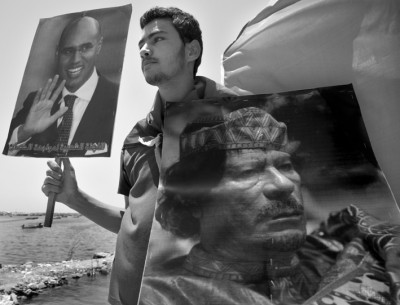
A Gaza resident holding pictures of Saif al-Islam Gadhafi – whose charity sponsored the aid ship – and his father, Libyan leader Muammar Gadhaf
When asked about the role of the international community to pressure Israel, Amjad is more critical: “We are so sorry that the international community until now has made no real intervention, put no real pressure on Israel to lift the siege totally or exerted pressure on Israel to have a transparent and accountable international inquiry into the Israeli crimes on the freedom flotillas.
“Still today we’re waiting for real international pressure from the international community. We hope that Israel will not use this silence as a chance to commit more crimes against the Palestinian people and international solidarity workers.”
The Libyan chartered boat was eventually forced to dock in El Arish, Egypt, after a wall of Israeli gunboats blocked its passage through to Gaza. But the Palestinians remain heartened by these attempts and the further missions planned this September. Says Mahfouz: “People here feel grateful to those internationals who try to arrive at the Gaza beach, it’s so important to us that other people worry and support us.”
Updated on July 15, 2010
:: Article nr. 67973 sent on 16-jul-2010 13:27 ECT
http://www.uruknet.info?p=67973
:: The views expressed in this article are the sole responsibility of the author and do not necessarily reflect those of this website.
 band annie's Weblog