It is after considerable contemplation that I have lately arrived at the decision that I must withdraw from the two performances scheduled in Israel on the 30th of June and the 1st of July.
One lives in hope that music is more than mere noise, filling up idle time, whether intending to elate or lament.
Then there are occasions when merely having your name added to a concert schedule may be interpreted as a political act that resonates more than anything that might be sung and it may be assumed that one has no mind for the suffering of the innocent.
I must believe that the audience for the coming concerts would have contained many people who question the policies of their government on settlement and deplore conditions that visit intimidation, humiliation or much worse on Palestinian civilians in the name of national security.
I am also keenly aware of the sensitivity of these themes in the wake of so many despicable acts of violence perpetrated in the name of liberation.
Some will regard all of this an unknowable without personal experience but if these subjects are actually too grave and complex to be addressed in a concert, then it is also quite impossible to simply look the other way.
I offer my sincere apologies for any disappointment to the advance ticket holders as well as to the organizers.
My thanks also go to the members of the Israeli media with whom I had most rewarding and illuminating conversations. They may regard these exchanges as a waste of their time but they were of great value and help to me in gaining an appreciation of the cultural scene.
I hope it is possible to understand that I am not taking this decision lightly or so I may stand beneath any banner, nor is it one in which I imagine myself to possess any unique or eternal truth.
It is a matter of instinct and conscience.
It has been necessary to dial out the falsehoods of propaganda, the double game and hysterical language of politics, the vanity and self-righteousness of public communiqués from cranks in order to eventually sift through my own conflicted thoughts.
I have come to the following conclusions.
One must at least consider any rational argument that comes before the appeal of more desperate means.
Sometimes a silence in music is better than adding to the static and so an end to it.
I cannot imagine receiving another invitation to perform in Israel, which is a matter of regret but I can imagine a better time when I would not be writing this.
With the hope for peace and understanding. Elvis Costello
Popular resistance to Israel’s apartheid is growing globally! In Palestine, non-violent resistance to land confiscation and settlement expansion is gathering momentum.
Weekly non-violent demonstrations in the West Bank and Gaza have tripled since January, and continue to increase in size and number. The tents are standing strong in Jerusalem’s threatened communities of Sheikh Jarrah and Silwan, and resistance to settler attacks and land grabs in the Jordan Valley is also building.
The International Solidarity Movement is committed to supporting these communities in their struggle for justice and freedom. We stand alongside Palestinians in demonstrations, stay in the tents and homes of threatened areas, and walk with farmers to their land. By documenting and helping to resist the evils of apartheid, ISM projects the Palestinian struggle to a global audience, and shows Israel that the world is against its actions.
Come and join the Global Intifada in Palestine! Committed volunteers are needed in the West Bank this summer. This new wave of unarmed resistance is exciting and powerful, and it needs your support. Whether for 2 weeks or for 3 months, your contribution is needed. See www.palsolidarity.org for more information, or email us at palreports@gmail.com.
From abroad: Under the banner of “Global Intifada”, solidarity actions are needed worldwide. Please consider organizing an action in your hometown.
The growing Boycott, Divestment and Sanctions movement is crucial, and is a great way for you to get involved in your own country. Similar tactics were used in ending South African apartheid. For more information, go to bdsmovement.net
Please join the Global Intifada. We look forward to seeing you here.
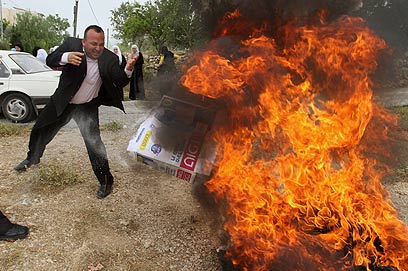
Boycott taken a step further in West Bank's Salfit village (Photo: AP)
Palestinian governors urge citizens to cooperate with settlement product ban; activists distribute pamphlets listing banned items. ‘We can manage this economic system,’ says Palestinian-appointed Jerusalem governor
News
Hundreds of activists took to the streets of the West Bank on Tuesday and distributed brochures calling on the Palestinians to boycott settlement products.
The Palestinian Authority held a press conferences, briefings and ceremonies in which the local governors urged the public to cooperate with “you and your conscience” campaign – that is meant to reach every single household.
Closed Market
Yesha Council responds to new Palestinian campaign distributing list of banned Israeli companies, calls for ‘immediate response’. Prime Minister Netanyahu urged to refuse to take part in proximity talks
* See previous post for full list of banned products
Bethlehem Governor Abdul Fattah Hamayel said the campaign was a breakthrough in the Palestinian struggle, as part of “the open war against the occupation.
“Our goal is to cut off the settlements that harm us and steal our resources on a daily basis,” he said.
Nablus governor Jibreen al-Bakri said the boycott has led to the closure of 17 factories in the settlements thus far, and called on the Palestinian public – and especially the merchants – to honor the new law.
Palestinian activists were hopeful the campaign would lead to mass mobilization of the public, and help weaken the settlements, which will contribute to the success of negotiations. Most Palestinians view the settlements as the major impediment to a political arrangement with Israel.
The boycott campaign also reached the capital, and Palestinian-appointed governor of Jerusalem Adnan al-Husseini said it was important because it emphasizes the exploitation that the Palestinians are subjected to.
Speaking at a press conference in north-east of Jerusalem, al-Husseini said, “I call all the citizens worldwide to boycott the settlement products deemed illegal by the world. We can manage this economic system,” he said.
The press conference was also attended by the mufti of the Palestinian Authority and senior Palestinian officials in the Jerusalem area.
Ann Wright, retired U.S. Army Reserve Colonel and former U.S. diplomat who resigned in March, 2003 in opposition to Bush’s war on Iraq, will join the 8-ship Free Gaza boat flotilla (www.freegaza.org) that will break the Israeli government naval siege/blockade of Gaza and bring reconstruction materials and humanitarian assistance items to the Palestinians of Gaza.
The Blockade of Gaza is three years old and is suffocating the Palestinians of Gaza. After the 22 day Israeli attack on Gaza in December, 2009 through January, 2010 that killed 1440, wounded 5,000, left 50,000 homeless and destroyed most of the civilian infrastructure-water, sewage and electrical systems. No reconstruction materials have been allowed into Gaza by the Israeli or Egyptian governments.
Colonel Wright travelled three times into Gaza in 2009 and was an organizer for the Gaza Freedom March (www.gazafreedommarch.org) that brought 1350 persons from 44 countries to Cairo, Egypt to go into Gaza, but Egyptian authorities refused to allow the majority of the group to go into Gaza.
Colonel Wright said “the Israeli siege of Gaza is illegal and a violation of international law. We demand that the Israeli, Egyptian, United States and European governments end this siege. If the governments will not stop the siege, it is up to the citizens of the world to break it—and that is what we will do!”
Ms. Wright will depart the United States for Athens, Greece on May 19, 2010.
aicvideo — 13 mai 2010 — the 12th of May 2010, an Israeli Magistrates Court extended the political detentions of Palestinian civil society activists Dr. Omar Said and Ameer Makhoul by 4 and 5 days, respectively. The extensions were issued in closed door hearings in which Said and Makhoul were not permitted to meet their legal representatives.
There now follows a summarised version of Girls Of Riyadh.
Girls Of Riyadh – Beginnings
An unknown girl in her early twenties decides to tell the story of her friends. She is like a modern Scheherazade who narrates these stories every weekend. Her motivation is to avenge the tyranny of life and society against her friends. Each chapter in the novel starts with a piece of poetry, a verse from the Quran, or lyrics from a famous song that captured the idea of the chapter.
The Book Stirs The Media
The narrator sends e-mails from her internet group to the subscribers. Those e-mails, as the narrator forecasts in the novel, stir the media. Popular newspapers in Saudi like Al-Riyadh, Al-Watan and Al-Jazeerah are all buzzing – mirroring what happened in real life after the novel was published. This kind of forecasting adds reality and intrigue to the novel. In one segment, the narrator says that she will probably be interviewed on Al-Arabiya TV by one of the most important interviewers in the Arab World: Turki Al-Dakheel (his style is similar to Tim Sebastian in Hard Talk on BBC or Ted Koppel on ABC news) which also took place in real life.
The Girls Of Riyadh
The novel describes four Saudi girls who are studying at the university in Riyadh, the Capital of Saudi Arabia. Their names are Sadeem, Qamrah, Lamees and Mashael (her name is similar to Michelle in pronunciation. She is half Saudi and half American. Her American mother and friends prefer to call her Michelle). Lamees
The four girls are bound by a strong friendship despite their differences. Each one of them explores her own failures – except Lamees who finds success in both her professional career and her love life. She marries a man of her choosing and moves with her husband to Canada to get her Boards in Medicine. There, she commences research into MRSA infection, as part of her doctorate. Lamees is the fortune teller of the group. She is consulted by her friends about their future matches and emotional relationships. At one point in the novel she has to sever her friendship with a girl called Fatima due to religious differences. Fatima was from the Shiites minority while Lamees belonged to the Sunnites majority. Lamees likes Fatima’s brother who is studying Medicine at the same University, but the relationship has to end abruptly after they are both caught in a café by the Police of Morals and Virtue (dating is not allowed in Saudi and is an offense punishable by the Men of Religion). Her father is more like her friend and was very understanding. However, he insists that she never meet anyone outside the university in the future. Fatima’s brother, on the other hand, suffers at the hands of the Moral Police and his suffering is compounded since he is a Shiite.
Lamees has a kind heart. She helps her friends solve their problems and supports them in times of need. For example, she teaches her ill-treated friend, Qamrah, how to use the internet, send e-mails and chat online to break through the isolation that is imposed upon her after she is divorced and left with a baby.
Qamrah
Qamrah marries Rashid after an arranged sighting where the two families allow the prospective husband to see the girl only once to decide whether he likes her or not. As it happens he does and they marry. There is no dating, no exchange of ideas or thoughts. “See the girl once and make up your mind!” The girl also uses the same chance to see the man and give her opinion. Since they both agree, their families proceed with the marriage. The story unfolds with this beginning as the narrator continues to describe the Muslim wedding of Qamrah and how the tape for the walk-down the aisle music gets stuck which symbolically signals the failure of that marriage. The newlyweds go to Chicago so that Rashid can finish his postgraduate studies in electronic commerce. Seven nights pass and he does not care about his wife’s feelings. He stays away from her and doesn’t touch her. Soon the quarrels start and ecentually reach a climax when Rashid declares his hate for his new wife. He forces her to give up her hijab and she does so in the hope that she can win his heart (Moslem women are supposed to wear lose garments that do not reveal the silhouette of their bodies and they should not reveal any body parts except their face and hands). When he sees her without hijab, he thinks she looks very ugly and asks her to wear the Hijab again to hide the ugliness. Qamrah loves Rashid despite his cruelty. When she learns of his betrayal with an American-Japanese woman called Carry, she loses her mind. She insists on meeting the mistress and Carry mocks her by calling Rashid in front of her. Qamrah in return takes revenge by not taking her contraceptive pill. She becomes pregnant. In the back of her mind, she thinks she can change the behaviour of her husband through her pregnancy as her mother advised her. When Rashid finds out she is pregnant, he slaps her and sends her back to Riyadh followed by her divorce papers. Her second tragedy unfolds when Qamrah uses the first name of Rashid’s father to name her new baby in a last attempt to win the sympathy of her husband (it is a tradition in Saudi that babies are first-named after the first name of their grandparents as a gesture of love and respect). The husband does not care and his family shows callous reactions. Qamrah becomes a single parent and lives at her father’s house in isolation. Her family prevent her from going out since she is now divorced and such actions from a divorced woman may bring her ill-reputation. Divorced women in their opinion only bring problems. But her friends manage to get her out of that unbearable jail every now and then.
Sadeem
Sadeem’s story is not less tragic than that of Qamrah. This girl, who was raised by her father as her mother died soon after her birth, would lose her first love and the second one. She avenges both through her marriage to her cousin Tarik whom she never thought would marry despite his strong feelings towards her (Consanguineous marriages are discouraged by Islam but are not prohibited. In a society that separates men from women in all social gatherings, there is no chance to see a woman except those who are relatives, which is another reason why consanguineous marriages make a big share of all marriages in Saudi). Her first emotional tragedy is caused by her fiancé Walid who deserts her after they are officially wed for a few months and before their wedding party. She gives herself to him one night considering that he is her husband officially despite the wedding not having yet taken place. He suddenly disappears after that night and never shows up again. He eventually sends her divorce papers. It is a shock that she blames on herself as she did not wait until after the wedding party. Sadeem never tells her family about that night and she collapses emotionally into herself. She believes the reason that Walid divorced her was that he thought she had previous sexual experiences (In Saudi, engagement is different from the West. The man and woman are considered officially engaged when their marital vows are exchanged and documents are signed. The period from the time of signing the documents till the night of the wedding when they practice sex together for the first time is the engagement period. The virginity of the woman is flowered on that night. There is nothing in Islam to prevent them from practicing sex before that night as they are officially wed, but that is considered a big mistake by the society and men usually get the impression that the girl is too easy or she had extra-marital relations with others if she does such a thing.
The second shock is caused by Firas whom she met in London while she was recuperating from her first tragedy. She fell in love with him as he did with her. But his elite position in Saudi and the fact that he has never married before prevents him from getting married to a divorced woman as it would have brought him bad gossip which he does not need (divorced women in the Saudi society are associated with ill-reputation especially if they traveled outside the country and met men as Sadeem did). Instead, Firas marries one of his relatives. He later calls Sadeem and offers to continue the relationship without leaving his wife. Sadeem refuses the offer and becomes more desperate. Her suffering increases as Firas continues to call her. She finally decides to forget all about him and establishes her own bridal arrangement company which is an irony in itself. Her friends help her establish the company. In the end, Sadeem finds herself in front of her cousin Tarik who adores and reveres her. She cannot help but marry him and revenge both men in her past who nearly destroyed her.
Mashael
Mashael as her real Arabic name or Michelle as her mother and friends used to call her is more realistic and more liberal. She enjoys more freedom than her friends. Michelle was born to a Saudi father and an American mother. One day, she stumbles into Faisal by coincidence when he asks her along with her girlfriends to allow him to enter the shopping mall with them as a brother (In Saudi, single young men are not allowed to enter certain famous shopping malls to avoid the harassment and flirting they initiate towards women). This brief encounter is the start of a mutual love and a happy Valentine’s Day for the first time in her life. After Valentine memorabilia is spread everywhere, the university officially decides, based on the request of the Police of Morals and Virtue, to ban all forms of festivity of Valentine’s Day since it was a Christian event that ignited unvirtuous feelings between boys and girls. The love lasts a year and when Michelle asks Faisal to marry her, he backs off since his mother refuses to allow him to marry a girl not of the family’s choosing and on top of that born to an American mother. She loses her faith in men. After such a disappointment, she travels to San Francisco to study in the company of her American cousin. They develop a mutual admiration, but things never progress to love. Faced with this confusing relationship, she travels back to her father who decides to move the whole family to Dubai to avoid the gossip and ill-reputation that haunts his daughter. He is a liberal and adores his American wife who lost her uterus to cancer. They decide to adopt a baby boy whom they called Mish-´al and they nickname him Misho. Being forthcoming and simple characterises Michelle’s personality. She hates hypocrisy and lies. When she moves to Dubai, she works at one of the satellite TV channels owned by the father of her Emirati girlfriend, Jumanah (Emirati belonging to United Arab Emirates where Dubai is located). She succeeds in her work and lives freely. Michelle admires a TV director who works with her, but remains confused about whether she loves him or not. She asks her father if he will allow her to appear on TV as there is an opening for a TV hostess, but he refuses and convinces her that her appearance on TV would lead to reverberations that might reach Saudi and his family. He explains that he does not want that kind of headache. Michelle does not speak Arabic fluently and always uses English words when her Arabic fails her. She took revenge on Faisal when she attends his wedding uninvited and leaves him a message on his cell phone telling him that she is in the ballroom. Michelle bewilders him. After some delay, he enters and finds Michelle dancing among the girls. He starts to worry: “what next?”, but Michelle leaves before others recognise her. She feels so happy after what she did. Um Nowayer
There is one more character who is connected with the four girls: Um Nowayer. In the Arab World, the mother and the father are nicknamed after their offspring as a sign of respect. The offspring name appears preceded by a prefix Abu for the father and Um for the mother. Um Nowayer was a Kuwaiti lady who was married to a Saudi who left her and her son after 15 years of marriage. She opens her house to the girls to meet when they cannot find anywhere else. She becomes a friend to them all, helps them in times of need and works sometimes with them. Um Nowayer is in her 39th year, a bald woman who is able to face her only son’s problem with courage. Her son’s name is Nouri, but he is gay and that made people call him Nowayer which is a feminine name close to Nouri. Consequently, everyone calls her Um Nowayer instead of Um Nouri. At first, she does not mind the ridicule, but she defies her neighbours and insists later on being called Um Nowayer. She seeks medical treatment of her son’s condition. One doctor tells her it is a psychological problem and not a physical one and that it may be related to the loss of the parental figure in the family. The son eventually grows out of it after two years of psychological treatment.
The title of the novel is full of irony. It was taken from a song by a very famous Saudi singer and the internet address of the group was called “Memoirs Exposed” which is a twist on the name of a famous TV show called “Memoirs Disclosed”. The novel was also full with humour and laughs as the narrator comments on the events with her trademark witty style. For example, she describes how the girls dance in the wedding in a hilarious way and the way women look at each other with jealousy. She also describes how men walk in their ugly underwear in the house after marriage and makes fun of that.
The novel ends with one success which is the marriage of Lamees to her colleague in Medical School. It seems that Lamees learns from the mistakes of her friends and never repeats them. In fact, she plans a strategy to win her colleague’s heart after she saw him and fell in love with him at first sight. She uses everything at her disposal to lure him into her net. Her successful strategy culminates with a lovely wedding and a trip to Canada to obtain her boards in Medicin

 band annie's Weblog