Search

band annie's Weblog

I have a parallel blog in French at http://anniebannie.net

Month

December 2009

update Viva Palestina

Dear friends and comrades,

As most of you know, the Viva Palestina humanitarian aid convoy has been forcibly trapped in Aqaba, Jordan as the Egyptian authorities have denied them entry. Convoy members are in high spirits and have requested that we contact our embassies and local MPs to contact the Egyptian authorities and grant them safe passage through Egypt to Gaza.

TEMPLATE LETTER:

[Your address]

Dear ——

I have been following the progress of a convoy taking aid to the Gaza strip. The convoy consists of over 200 vehicles carrying many thousands of pounds worth of aid, and has been organized by Viva Palestina and Code Pink. Many of the activists taking part have gone from the United Kingdom.

It has recently come to my attention that Egyptian authorities have blocked the progress of the convoy by denying entry to Egypt. The convoy is currently waiting in Jordan to be permitted to board a ferry across the Red Sea. I have heard from one person in the convoy who has described how they are cold and have little access to food at the moment.

I am kindly requesting that you use your position and influence to help us persuade the Egyptian authorities to permit the convoy to pass safely. This is very important to me, both for my hope that the people in Gaza will receive the much-needed aid, and also out of concern for my friends in the convoy.

Kind regards,

[Your full name]

CONTACTS:

Your local MP: http://www.facebook.com/l/457ba;findyourmp.parliament.uk/

Egyptian Embassy in London
020 7499 3304/2401
eg.emb_london@mfa.gov.eg

Jeremy Corbyn (Labour MP for Islington North)
corbynj@parliament.uk
020 7561 7488

Clare Short (Independent MP for Birmingham Ladywood)
shortc@parliament.uk
020 7219 4264/4148

David Miliband (Foreign Secretary/Labour MP for South Shields)
milibandd@parliament.uk
(0191) 456 8910

Nick Clegg (Leader of Lib Dems, MP for Sheffield Hallam)http://www.facebook.com/l/457ba;www.guardian.co.uk/commentisfree/2009/dec/22/lift-the-gaza-blocade-nick-clegg
nickclegg@sheffieldhallam.org.uk
cleggn@parliament.uk

British Embassy in Egypt
Tel: +(20)(2)27916000
information.cairo@fco.gov.uk

NB. The embassy email addresses are only meant for information, so you could include a kind note to forward the message to the appropriate diplomatic staff.

Huge thank you to the Queen Mary University of London Palestine Solidarity Society for providing this information.

Please share this note with your friends and let us do everything we can to help our comrades, who are tired and cold waiting for a ferry to Egypt!

IN SOLIDARITY!

———————
Alice Howard
Viva Palestina UK – Administration Manager
Tel: 07944 512 469
Email: alice@vivapalestina.org
Website: http://www.vivapalestina.org/
update Gaza Freedom March

December 25, 2009
Dear Gaza Freedom March delegates,
We’re here in Cairo and things are hopping. People are coming in from all over the world with all sorts of great ideas. Can’t wait to see you all here!!!
As you may have heard, the Egyptian government has denied our request to go into Gaza and has cancelled our permits for our orientation at the College Holy Family for December 27 at 7pm.
To update people we will do briefings each morning at 8:30 am, starting on Sunday, at the Lotus Hotel, Sun Hotel and Select Hotels and share evolving plans. We have come too far to be tourists as the Egyptian Government has suggested. Recognizing that our creativity and flexibility are one of our most powerful tools we are exploring new and exciting ways to get our message out and keep the pressure on!
This may mean some increased risks. We are asking you and your group, if you are part of one, to consider what kinds of risks you may be willing to take. In theory any gathering over six people is considered illegal. But challenging laws is part of our work and the worse consequence you could expect is arrest and deportation which becomes an action itself.
If we do it right, this may be politically difficult for Egypt to do. We need people who are willing to take such risks, people who are willing to support them and people who will take minimal to no risks. No matter what risk you are willing to take, there is important work for you to do here.
Around the world people are watching and are taking action demanding that Egypt open the border.

Plans for December 27
Commemoration of the Dead of Gaza on the One Year Anniversary of the Israeli Attack
For those delegates in Cairo on December 27, from 11 am to 1pm, delegates can go individually or in small groups to the 6 October Bridge to tie flowers or letters with the names of the dead on the wrungs of the bridge on the south side of the bridge facing Semiramis Hotel. Talk with your group leader or the coordinator in your hotel (Select Hotel-Lisa Fithian; Sun Hotel-Billy Kelly; Lotus-Ann Wright)

In a more concerted effort to commemorate those killed in Gaza during the Israeli attack on Gaza, we are going to meet at 4:30pm on December 27 on the Nile River Corniche across from the Grand Hyatt hotel. We are going to take tens of feluccas (Nile river boats that hold 25 people each) onto the Nile and place 1400 lighted candles in bio degradeable “boats” /baskets into the Nile that will then float down the river.
While we are in the boats, we will have group coordinators on each felucca to brief delegates on plans for the week. You can also purchase your Gaza Freedom March t-shirts $10 each. These will be important for the rest of the week.
December 28, 2009
Our 85 year old Holocaust survivor Edy Epstein will begin a hunger strike demanding that Egypt open the border. Other hunger strikers are welcome! We are asking delegates to wear their Gaza Freedom T-shirt and converge promptly at 11 AM in Taher Square. Everyone is encouraged to support this action by holding the space, whether that be in the Square or surrounding sidewalks.
More actions after December 28 will be discussed at the morning meetings.
Lodging and Food
To give delegates more freedom of movement, we will return 50% of the monies paid to the Gaza Freedom march so delegates can use that money to pay for their own lodging and food whether you stay in Cairo or go towards the border—or get into Gaza!!!
Delegates are responsible for extending their stays in lodging they are in, or finding new housing. For those who need very, very inexpensive lodging, there are dormitory rooms available and we can provide information.
We will ask group leaders to assist us in returning funds to members of their group. For those not in any group, please see Ann Wright.
We are thrilled that you are coming to Cairo for the people of Gaza!
Despite all the changes, this is an experience you and the people of Gaza will never forget!!!

A one-state solution in the area is not as farfetched as it might seem.

Steps to create an Israel-Palestine

By Jonathan Kuttab
December 20, 2009

For a while, it seemed that a two-state solution might actually be achievable and that a sovereign Palestinian state would be created in the West Bank and Gaza, allowing Jews and Palestinians at last to go their separate ways. But these days, that looks less and less likely.

With Israel in total control of the territory from the Mediterranean to the Jordan River and unwilling to relinquish a significant part of the land, it’s time to consider the possibility that the current situation — one state, in effect — will continue. And although Jewish Israelis may control it now, birthrates suggest that, sooner or later, Jews will again be a minority in the territory.

What happens at that point is unclear, but unless continued military occupation and all-out apartheid is the desired path, now may be the time for Israelis to start putting in place the kinds of legal and constitutional safeguards that will protect all minorities, now and in the future, in a single democratic state of Israel-Palestine. This is both the right thing and the smart thing to do.

In recent years the idea of a one-state solution has been anathema to Israelis and their supporters worldwide. This has been fueled by the fear of the “demographic threat” posed by the high Palestinian birthrate. Indeed, many Israeli supporters of a two-state solution came to that position out of fear of this demographic threat rather than sympathy with Palestinian national aspirations.

At the root of their fear was the belief that despite Israel’s best efforts to push Palestinians from land and property and to import Jewish settlers in their stead, the Arab population would keep climbing. And that, when the Arabs reached the 51% mark, the state of Israel would collapse, its Jewish character would disappear and its population would dwindle into obscurity.

Yet that scenario is not necessarily the inevitable result of either demography or democracy. Religious and ethnic minorities have successfully thrived in many countries and managed to retain their distinctive culture and identity, and succeeded in being effective and sometimes even dominant influences in those countries. Those who believe in coexistence must begin to seriously think of the legal and constitutional mechanisms needed to safeguard the rights of a Jewish minority in Israel-Palestine.

It is true that the experience of Israel with its Palestinian minority does not offer a comforting prospect. The behavior of the Jewish majority toward the Palestinian citizens of Israel has not been magnanimous or tolerant. Where ethnic cleansing was insufficient, military rule, land confiscation and systemic discrimination have all been employed. The relationship was not helped by the actions of Palestinians outside Israel who resented losing their homeland or by the behavior of some Arab countries, neither of which accepted the imposed Jewish character of Israel.

Yet it is possible, especially during this period when Jews are still the majority in power in Israel, to begin to envision the type of guarantees they may require in the future. Other countries have wrestled with this problem, and while each situation is different, the problem is by no means unprecedented.

Zionism will ultimately need to redefine its goals and aspirations, this time without ignoring or seeking to dispossess the indigenous Palestinian population. Palestinians will also have to deal with this reality, and accept — even enthusiastically endorse — the elements required to make Jews truly feel at peace in the single new state that will be the home of both people.

Strong, institutionalized mechanisms will be needed to prevent the “tyranny of 51%.” A bicameral legislature, for example, should be installed, in which the lower house is elected by proportional representation but the upper house has a composition that safeguards both peoples equally, regardless of their numbers in the population. A rotating presidency may be preferable to designating certain positions for each minority (as in Lebanon). And constitutional provisions that safeguard the rights of minorities should be enshrined in a constitution that can only be amended or altered by both houses of parliament with a large (80%) majority.

Both Hebrew and Arabic will be designated as official languages, and governmental offices will be closed for Jewish, Muslim and Christian holidays. New laws will be enacted that strengthen the secular civil courts in personal status matters, while leaving some leeway for all religious communities to have a say in lawmaking, including Reform and Conservative Jews who currently chafe under the Orthodox monopoly over Jewish personal status matters in Israel. Educational systems that honor and cater to the different communities will give each a measure of control over the education of its children within a national system that maintains professional standards for all publicly-funded schools. Strong constitutional provisions will be enacted to prohibit discrimination in all spheres of life, while independent courts will be enabled to enforce such provisions.

Many on both sides, Israeli and Palestinian, will reject this line of thinking, and in all cases, it is clear that a lot of goodwill and much careful thinking is necessary. But as the options keep narrowing for all participants, we need to start thinking of how we can live together, rather than insist on dying apart.

Jonathan Kuttab is a Palestinian attorney and human rights activist. He is a co-founder of Al
Haq and the Mandela Institute for Political Prisoners.

http://www.latimes.com/news/opinion/commentary/la-oe-kuttab20- 2009dec20,0,3289579.story

Two successful convoys spur flood of humanitarian assistance!

George Galloway interview with Richard Hall at leading English Newspaper in the Middle-East – The Daily Star (Beirut)

BEIRUT: It was a typically cold London day in January earlier this year when, in front of thousands of people demonstrating against the Israeli invasion of the Gaza Strip, British MP George Galloway announced a convoy of aid would be travelling from London to Gaza under the banner “Viva Palestina.”

Almost a year later and after two successful convoys, 86 vehicles of all shapes and sizes are currently making their way through Turkey, hoping to deliver humanitarian aid to the population of the Gaza Strip.

The first Viva Palestina convoy made the journey in March this year, travelling by land to Italy where it crossed the Mediterranean by ferry to Greece. From there it made its way through Turkey, Syria, Jordan, finally entering Gaza at the Rafah border crossing in Egypt. The current convoy, dubbed “Return to Gaza,” will take the same route. The second convoy from the United States departed on July 4 this year, flying into Cairo before also crossing in Rafah.

Viva Palestina organizers aim to highlight the blockade’s damaging effect, while delivering much-needed aid to Gazans.

“The people of Gaza are dying because of a siege imposed for no other reason than that, in a free and fair election, they voted for a party that the big powers and the Israelis didn’t like. We think that’s immoral, so if our government will not do something about it, we will,” Galloway told The Daily Star.

Following the election of Hamas in 2006, Israel imposed a blockade on Gaza. Only basic humanitarian supplies were allowed to enter the territory, causing a “humanitarian catastrophe” in the words of commissioner general of UNRWA, Karen Abu Zayd.

This blockade was tightened following the Israeli invasion in December last year.

The convoy aims to cross into Gaza through the Rafah crossing with Egypt on December 27, the one year anniversary of “Operation Cast Lead.” The Israeli military operation, which began with air strikes, caused the death of over 1,400 Palestinians, most of whom were civilians, and 13 Israelis, including three civilians.

Approximately 260 members of the British public departed with the convoy on December 3, among the volunteers are hairdressers, mechanics, chefs, unemployed and retired, with many more joining along the way.

“We stayed in our cars and tents in car parks, we had a night on a boat and we slept in a sports stadium, who knows where we will stay next,” said Joti Brar, a web producer from the United Kingdom taking part in the convoy.

Joti, who decided to take part in the convoy at the last minute, says she was surprised at the generosity of the general public when fundraising for her trip.

“It wasn’t only the amount people were giving, what amazed me was the kind of people who were willing to give – non-political people, people who you would never expect. I think a lot of people in Britain have been touched by what happened to the Palestinians, and are very pleased to know they can do something,” she said.

Joti’s own reason for getting involved was that the Palestinians “are victims of an unjust situation that isn’t of their making,” a sentiment she says is shared among other volunteers on the convoy.

Organizers say the name “Viva Palestina” was inspired by the British “Aid to Spain” movement of the 1930s, where labor organizations sent medical supplies and personnel to Republicans fighting in the Spanish Civil War.

All those taking part have spent the past few weeks fundraising for the voyage, relying on donations from well-wishers to pay for the supplies they have taken with them.

“We brought all sorts of things, mostly medicine and medical supplies. Then there’s blankets, clothes, toys for children, pens and pencils. We have brought as much as we can fit into the vehicles. Hopefully what we’ve brought is things that are useful,” said Joti.

Organizers have emphasized that, more than just delivering supplies, the convoy aims to show solidarity with the people of Gaza. On the day of its departure, Galloway spoke of the convoy’s “symbolic” and “totemic” value, designed to “inspire public opinion to demand an end to the siege.”

However, it is not only public opinion the convoy aims to inspire, says Galloway, but those taking part.

“The chances are that the people taking part have a life changing experience. They go to the Gaza Strip, they see the situation, and they are determined to come back. That is what happened to me. In 1977 I visited Lebanon for the first time, I went to the Palestinian camps there and 35 years later I’m still involved.”

There are worries among volunteers as to whether the Egyptian government will allow the convoy to pass into Gaza.

Both previous convoys faced problems entering the territory, with the US contingent having to wait 10 days before being allowed to enter.

Organizers and participants alike say they will not return home until they are given permission to deliver the aid.

“We will stay at the border until we are allowed in. The fact that we have come this far shows we are committed,” insisted Brar.

Galloway echoed that sentiment, urging the Egyptian government to allow them entry.

“I hope they have no problems. I think it would be a big mistake for the Egyptian government to divert attention from where it should be: on Israel, on the anniversary of its infamous attacks on the Gaza Strip. Who knows, but one lives in hope.”

As the third Viva Palestina convoy nears its destination, plans are already afoot for several more.

“Next year we will bring a Viva Palestina Hugo Chavez convoy from Venezuela, maybe one from Iran which we are currently discussing. And people from other countries such as Australia and South Africa are also asking if they can get involved,” said Galloway, adding that the convoy may also travel to Lebanon.

“If we can save a day in Turkey and a day in Syria, then we may try and send the convoy for one day into Lebanon and then back out again into Syria.”

End
———————
Alice Howard
Viva Palestina UK – Administration Manager
Tel: 07944 512 469
Email: alice@vivapalestina.org
Website: http://www.vivapalestina.org/

Palestina aid convoy to Gaza received Syrian boost.

The international convoy carrying humanitarian aid from London to Gaza has swollen in size during its journey from Syria into Jordan.

More than 400 people from around the world are now travelling on the convoy after volunteers from as far afield as Italy and Malaysia joined up in Damascus.

The amount of aid being carried in approximately 150 vehicles has also grown following donations of medical supplies and equipment received in Syria.

The convoy, organised by the charity Viva Palestina and the Palestine Solidarity Campaign, received a huge welcome from Syrians and Syrian’s exiled Palestinian population as it passed through the country.

Flag waving people took to the streets to cheer on the convoy, while a number of official receptions were held, including one at the Syrian border as the convoy arrived from Turkey.

Kevin Ovenden, convoy organiser, said ‘the level of support has been tremendous, and I would like to thank Syria for welcoming us so warmly. Unlike in Britain and the United States, in Turkey and Syria, the issue of Palestine, the people, the civil society and the Government are as one.’

He added ‘However, the international nature of this convoy demonstrates the depth of popular support for the Palestinian people around the world, and more governments need to recognise this reality, including those in Britain and US.’

The convoy, which includes ambulances, trucks, vans and jeeps, has now entered Jordan and hopes to land in Egypt on Christmas day, following a ferry crossing at Aqaba.

It will attempt to break Israel’s illegal three and a half year blockade of Gaza on 27th December by passing through the Rafah crossing to deliver its cargo of medical, humanitarian and educational aid.

The date marks the first anniversary of the beginning of Israel’s 3 week assault on Gaza which left more than 1,400 Palestinians dead.

For further information on Viva Palestina or to make a donation visit http://www.vivapalestina.org

Press information from Alice Howard on Tel:07944 512 469 or via email alice@vivapalestina.org

———————
Alice Howard
Viva Palestina UK – Administration Manager
Tel: 07944 512 469
Email: alice@vivapalestina.org
Website: http://www.vivapalestina.org/

Gaza marchers vow to go forward despite red light from Egyptian gov’t

by Philip Weiss on December 21, 2009 · 28 comments

Earlier today we got the following press release from the Gaza Freedom March Steering Committee. At the bottom I have added numbers that our friends can call to pressure the Egyptian government to let our people in.

Gaza Freedom March is determined to break the siege
1,360 International Delegates appeal to Egypt to let the March proceed

Citing escalating tensions on the Gaza-Egypt border, the Egyptian Foreign Ministry informed us on December 20 that the Rafah border will be closed over the coming weeks, into January. We responded that there is always tension at the border because of the siege and that if there are any risks, they are risks we are willing to take. We also said that it was too late for over 1,360 delegates coming from over 42 countries to change their plans now.
Although we consider this as a setback, it is something we’ve encountered—and overcome–before. No delegation, large or small, that has entered Gaza over the past 12 months has received a final OK before arriving at the Rafah border. Most delegations were discouraged from even heading out of Cairo to Rafah. Some had their buses stopped on the way. Some have been told outright that they could not go into Gaza. But after public and political pressure, the Egyptian government changed its position and let them pass.
Our efforts and plans will not be altered at this point. We have set out to break the siege of Gaza and to march in Gaza on December 31 against the international blockade. We are continuing the journey.
Egyptian embassies and missions all over the world will be hearing by phone, fax and email from delegates and the supporters of the Gaza Freedom March over the coming crucial days, with the clear message: Let the international delegation enter Gaza and let the Gaza Freedom March proceed.
Many delegates are already in Cairo and more are arriving daily. Delegates cancelled holiday plans months ago to come on the Gaza Freedom march and air tickets were purchased. We anticipate that virtually all of the 1,360 delegates will come to Cairo.
Because of the incredible humanitarian crisis in Gaza caused by the Israeli attack on Gaza a year ago and by the international siege on Gaza, we feel morally obligated to continue our mission to bring more international attention to the plight of the 1.5 million people imprisoned in Gaza.
The Gaza Freedom March Steering Committee
For more information, contact Ann Wright
019 508 1493 (cairo), microann@yahoo.com

Contact your local consulate here:
http://www.mfa.gov.eg/MFA_Portal/en-GB/mfa_websits/

Contact the Palestine Division in Ministry of Foreign Affairs, Cairo
Ahmed Azzam, tel +202-25749682 Email: ahmed.azzam@mfa.gov.eg

In the U.S., contact the Egyptian Embassy, 202-895-5400 and ask for Omar Youssef or email omaryoussef@hotmail.co

‘Whoever has Palestine in his heart is a Palestinian’ – Stories from Viva Palestina Convoy Members

Viva Palestina convoy participants have interesting stories to tell – Few of them are Palestinian, but they all say “Whoever has Palestine in his heart is a Palestinian.”

Gaza aid convoy, named “Return to Gaza,” have attended various events (over the past few days) in the Syrian capital Damascus. It has attracted extensive interest from Syrians.

Şakir Yıldırım, 40, bought an ambulance on his own in Bristol and managed to take it to Gaza overland last year. He is now taking a trailer to Gaza along the convoy. Yıldırım set up an association in Bristol called Gazze Link. He and his friends purchased a trailer and four vehicles with the money they raised.

“Intention is very important. I am sure about this now,” he said as he was talking about the trip to Gaza.

Yusuf, a Palestinian, set off from Texas, the United States, to go to Gaza. With the money he collected in Texas he will buy a vehicle and relief materials in Egypt and take them to Palestine, where he was born. The Israeli occupation forced him to leave his country and move to Lebanon and to the US. He flew to Istanbul and joined the convoy there.

“I will meet my relatives when I reach Palestine. I am away from them but I have never forgotten them and Palestine. I grew up with them and I am a Palestinian. In my opinion, you are Palestinian too. You do not have to have been born there. Whoever has opened his heart to Palestine is a Palestinian,” he said.

Al-Quds-born Talal Abdulrashed said: “I am coming from Britain. I am a Palestinian. We set off from Britain to break the embargo. Allah willing we will reach Gaza. Israel drove us from our land in 1982. We moved from Lebanon to Britain. I have relatives in al-Quds.”

Lia Lewelyn, 55, is driving an ambulance. She is a British Jew coming from London. She expressed her feelings as: “There are many Jews who oppose Israel’s war politics regarding Palestine. I am one of them. I do not know whether we will be able to enter Gaza or not, but I believe we will put huge pressure on Egypt and Israel through media and public. I cannot say Israeli pressure is tied to religion. It is entirely acting by colonization logic. I am worried about forefronting religion in such policies. We hit roads to end a six-decade war. God willing we will succeed.”

“I was very touched by the brutality of the latest Gaza attacks. I even got sick with sadness and deteriorated psychologically. Later I started searching for ways to help and learnt about the convoy. I am a pharmacology expert. I am not a Muslim, but it upsets me that most of wars, oppressions take place in the Islamic world,” said Sam Rez, who joined the convoy in London.

The next stop of the convoy is Jordan.

———————
Alice Howard
Viva Palestina UK – Administration Manager
Tel: 07944 512 469
Email: alice@vivapalestina.org
Website: http://www.vivapalestina.org/

CARTER: Gaza must be rebuilt now

http://www.guardian.co.uk/commentisfree/cifamerica/2009/dec/19/gaza-rebuilt-peace-process-suffering

Jimmy Carter The Guardian, Saturday 19 December 2009

It is generally recognised that the Middle East peace process is in the doldrums, almost moribund. Israeli settlement expansion within Palestine continues, and PLO leaders refuse to join in renewed peace talks without a settlement freeze, knowing that no Arab or Islamic nation will accept any comprehensive agreement while Israel retains control of East Jerusalem.

US objections have impeded Egyptian efforts to resolve differences between Hamas and Fatah that could lead to 2010 elections. With this stalemate, PLO leaders have decided that President Mahmoud Abbas will continue in power until elections can be held – a decision condemned by many Palestinians.

Even though Syria and Israel under the Olmert government had almost reached an agreement with Turkey’s help, the current prime minister, Benjamin Netanyahu, rejects Turkey as a mediator on the Golan Heights. No apparent alternative is in the offing.

The UN general assembly approved a report issued by its human rights council that called on Israel and the Palestinians to investigate charges of war crimes during the recent Gaza war, but positive responses seem unlikely.

In summary: UN resolutions, Geneva conventions, previous agreements between Israelis and Palestinians, the Arab peace initiative, and official policies of the US and other nations are all being ignored. In the meantime, the demolition of Arab houses, expansion of Israeli settlements in East Jerusalem and the West Bank, and Palestinian recalcitrance threaten any real prospect for peace.

Of more immediate concern, those under siege in Gaza face another winter of intense personal suffering. I visited Gaza after the devastating January war and observed homeless people huddling in makeshift tents, under plastic sheets, or in caves dug into the debris of their former homes. Despite offers by Palestinian leaders and international agencies to guarantee no use of imported materials for even defensive military purposes, cement, lumber, and panes of glass are not being permitted to pass entry points into Gaza. The US and other nations have accepted this abhorrent situation without forceful corrective action.

I have discussed ways to assist the citizens of Gaza with a number of Arab and European leaders and their common response is that the Israeli blockade makes any assistance impossible. Donors point out that they have provided enormous aid funds to build schools, hospitals and factories, only to see them destroyed in a few hours by precision bombs and missiles. Without international guarantees, why risk similar losses in the future?

It is time to face the fact that, for the past 30 years, no one nation has been able or willing to break the impasse and induce the disputing parties to comply with international law. We cannot wait any longer. Israel has long argued that it cannot negotiate with terrorists, yet has had an entire year without terrorism and still could not negotiate. President Obama has promised active involvement of the US government, but no formal peace talks have begun and no comprehensive framework for peace has been proposed. Individually and collectively, the world powers must act.

One recent glimmer of life has been the 8 December decision of EU foreign ministers to restate the long-standing basic requirements for peace commonly accepted within the international community, including that Israel’s pre-1967 boundaries will prevail unless modified by a negotiated agreement with the Palestinians. A week later the new EU foreign policy chief, Baroness Catherine Ashton, reiterated this statement in even stronger terms and called for the international Quartet to be “reinvigorated”. This is a promising prospect.

President Obama was right to insist on a two-state solution and a complete settlement freeze as the basis for negotiations. Since Israel has rejected the freeze and the Palestinians won’t negotiate without it, a logical step is for all Quartet members (the US, EU, Russia and UN) to support the Obama proposal by declaring any further expansion of settlements illegal and refusing to veto UN security council decisions to condemn such settlements. This might restrain Israel and also bring Palestinians to the negotiating table.

At the same time, the Quartet should join with Turkey and invite Syria and Israel to negotiate a solution to the Golan Heights dispute.

Without ascribing blame to any of the disputing parties, the Quartet also should begin rebuilding Gaza by organising relief efforts under the supervision of an active special envoy, overseeing a ceasefire between Israel and Hamas, and mediating an opening of the crossings. The cries of homeless and freezing people demand immediate relief.

This is a time for bold action, and the season for forgiveness, reconciliation and peace.

Israeli women’s group tells Livni to turn herself in

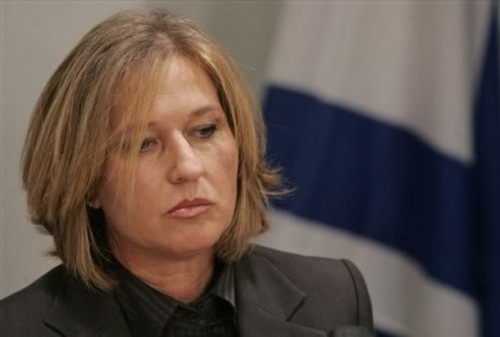
War Criminal - Tzipi Livni

The Women’s Coalition for Peace sent a letter on Wednesday to Israel’s former Foreign Minister, Tzipi Livni, calling on her to cooperate with international investigations into her role in the assault on Gaza last winter, after a British court issued an warrant for her arrest on Monday.

The Israeli organization wrote in the letter, which was attached to a translated copy of the Goldstone report on alleged war crimes in Gaza, “We are convinced that if you refer to the report you will understand why British citizens and organizations have turned to the courts with a request to issue a warrant for your arrest.”

read on

Blog at WordPress.com.

Up ↑