Search

band annie's Weblog

I have a parallel blog in French at http://anniebannie.net

Month

August 2008

About the Turkish musalsalat dubbed in Arabic

An interesting muqabala from Al Jazeera in Arabic.
Thank you O.W.

I am reposting this because the topic is close to the previous one and I have in the meantime received an interesting comment :

Saracen Says:
August 17, 2008 at 12:27 pm

They’re both so convincing I feel like a Buridan horse (ego too frail to put up with ass). But seriousness aside, this turkish drama business does smell of the figurative rodent. Each year, a screen drama of some kind seems to be causing a life drama for the arabs. And it’s incredibly hard to tell why. Consider this. A syrian series is currently on MBC. It’s aired only two hours before Nour. It features several stories, one of which involves an extra-marital pregnancy with the woman being muslim and the man christian. The bastard refuses to convert, hence leaving my creed-sister in the metaphorical sh*t. On the Arab-cultural-rage seismometer, that would give a higher reading than Nour et al. But still, it didn’t cause an uproar of any kind. The dramatic calibre of the aforementioned syrian series is also superior to the Yahya/Lamees dross, but it couldn’t attract even half the audience.

Somesing iz vierd..

Noor… What’s your secret?

Salonaz Sami ponders

The palatial mansion of Mohamed Aboud Afandi overlooking the Bosphoros is the setting of the Sha Ughlo family in the series; Noor and Mohannad

We’d been chatting on the phone a little while, and things were going smoothly. But once she’d realised it was 9:50pm, I could hear how my mother was growing fidgety. And I knew the reason why: 10 minutes later her favourite soap opera, Noor, was due to begin. Annoying though this was, given that I was watching my own mother choose Noor over talking to me, I could barely complain given that it had been me who had introduced her to the Turkish TV serial. But in her addiction, my mother is by no means alone. Gèmès or Noor as we know it in the Arab world has become a social and behavioural phenomenon, worthy of study.

Granted, men presume we watch it for the sake of the blue- eyed-blond and Best Model of the World 2002, who plays the lead male in the series. But the truth is far from that, explained Farida Ahmed, a housewife who is also hooked to Noor. “Mohannad, the main character, has indeed glued women to their TV sets, but it is not only because he is cute,” she told Al-Ahram Weekly. “It’s mostly because he offers things many of us lack nowadays in our lives — including romance, compassion, loyalty, and a partner who is supportive to his independent wife. He has become the role model against which many women have started to compare and judge their significant others,” she added.

READ ON

Darwish encore : The Palestinian Che Guevara ?

by Marty Peretz

I don’t mean to harp on the death of the Palestinian poet Mahmoud Darwish, and it would be somewhat ghoulish to do so. But this clutching at his remains by the Western press seems to reflect more a desperation by journalists to prove that the Palestinians are a poetic people than the more banal reality of the case. The FT has already reported this story thrice. The Boston Globe also, I think, three times.

The last of these dispatches ironically makes the very point I made in the first of my two previous postings. Or rather a point I quoted Darwish as making himself: A poem about his mother was not about Palestine. It was about his mother, whatever his mourner thinks or feels.

As it turned out the funeral was not the kind of mass mobilization the reporters expected. An article in today’s Los Angeles Times by Ashraf Khalil reports that the crowd was a mere 5,000, much less than would turn out for the interment of any martyred young jihadi in Jenin.

It also turns out that Darwish was a communist. “So what?” you say. But he was a noted communist, and so he was honored by one of the most brutal regimes in history with two prizes: the Lenin Prize and the Stalin Prize. And how many poets did these fathers of the revolution murder? Too numerous to count.

One mourner at the memorial observed that he was a Palestinian Che Guevara, an apt analogy.

And, by the way, according to Thursday’s FT, “hundreds of Palestinians living in Israel were also ferried in on buses.”
article here

One answer I liked :

boneill said:

How, Marty? How was it apt that some know-nothing jackass called him a Che? Back it up. Darwish always humanized the enemy. Even if he didn’t like them, and even if you don’t like his politics, the man as a good poet. Not “good” as in “could write decent verse, but “good” as in hit the painful contradictions of human experience (and with good verse).

Jack, my friend, maybe he wasn’t as brave as Akhmatov or even poor Mandelstem, sent to his horrid grave made insane by a madman’s system. But: who among us is? The comparison is impossible.

Marty, stop writing things that are stupid. Yes, a poem about his mother is just about his mother. That makes him far closer to Camus than Sarte. So why the fuck do you insist on tarnishing him? Have you read anything he has written? Ever?

Seriously, back up how he was Che. Che was a murderous, sociopathic killer, whose “poetry”, or ferocity of prose, is only admired by those who think Jim Morrison is a Deep and Meaningful artist. Darwish was not of that ilk. Your pathologies distort you. Anyone who cares for poetry or art or the complex and hideous contradictions that make us all would at least appreciate Darwish. All you can do is call him Stalin and Che.
August 15, 2008 12:50 AM

Free Gaza and SS Liberty sail to Gaza

By Ramzi Kysia in Cyprus

“Come, my friends / ‘Tis not too late to seek a newer world. / Push off, and
sitting well in order smite / The sounding furrows; for my purpose holds / To
sail beyond the sunset…”
–TS Eliot, “Ulysses”
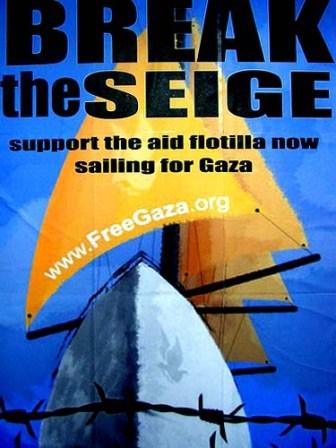
Limassol, Cyprus – In a few, short days, the Free Gaza Movement, a diverse group of international human rights activists from seventeen different countries, will set sail from Cyprus to Gaza in order to shatter the Israeli
blockade of the Gaza Strip. I’m proud to stand with them. Over 170 prominent
individuals and organizations have endorsed our efforts, including the Carter
Center, former British Cabinet member Claire Short, and Nobel Peace Prize
laureates Mairead Maguire and Desmond Tutu.

Adam Qvist, a 22 year old student and filmmaker from Copenhagen, Denmark, is
one of the human rights workers sailing to Gaza. He explains his participation
in the project in this way:

“I’m interested in telling narratives and advocating people’s existent
feelings. The idea of sailing to Gaza is kind of crazy, but it’s also very
straight-forward. The whole idea of having just one Palestinian who’s been
forced off their land and who is able to return to Palestine – this is
something that could demolish the whole Zionist venture. And it just has to be
one person. If one person can do it, then others can do it. This project, this
boat, is about giving people the freedom to take responsibility. You
shouldn’t expect something from others if you can’t do it yourself, and
this is true both on a very personal but also on a political level.

“This mission is an amazing opportunity to have a huge impact on this
hard-locked, heart-locked, crisis. I’ve never been to Gaza, myself, but I
know that Gaza is the forgotten little brother of the Middle East, or at least
of the Israeli-Palestinian crisis. Everything about this crisis is clearer in
Gaza. The Israeli occupation strategy is much clearer in Gaza, because it’s
not specifically about taking more land. It’s mostly about completely
destroying a people.”

Over two years ago, in an election process advocated by the United States, the
party of Hamas was elected to power in Occupied Palestine. In response, Israel
and the United States imposed a near total blockade on the people of Gaza in an
illegal act of collective punishment.

For more than two years, Israel has blocked Gaza’s access to tax revenues,
humanitarian aid, and even family remittances from Palestinians living abroad.
Predictably, Gaza’s economy has completely collapsed, and malnutrition rates
have skyrocketed. Today, because of the blockade, eighty percent of the people
of Gaza are dependent on United Nations’ food aid just to be able to eat.

This is intolerable.

U.S. Presidential candidate Barack Obama often speaks about the “audacity of
hope.” But hope can never be a passive emotion. Centuries ago, St. Augustine
wrote that Hope has two, beautiful daughters: Anger and Courage. To hope for a
better world is to be angry at the injustices that prevent that world from
emerging, and it requires the courage to stand up and create newer worlds for
ourselves.

Tom Nelson, a lawyer from Welches, Oregon, is sailing to Gaza to seek that
newer world. According to Tom:

“Americans are terribly ignorant of the human effects of what they support. I
think this boat is one of the most effective means of raising consciousness –
particularly American consciousness – about the problems caused by American
foreign policy. Americans have to know the consequences of these policies …
I’m sixty-four years old, my children are grown, and my affairs are in order.
I think about Rachel Corrie, and about what Israel may do to us. I know it’s
risky, but I take a risk when I ride a motorcycle, and I think that if we’re
really going to change things then somebody has to begin putting something on
the line for that change to happen.”

Eliza Ernshire is a thirty-two year old schoolteacher from London. Her reasons
for sailing to Gaza are much the same:

“For years and years – seeing place in the world that were being totally
destroyed, and people that were being totally destroyed by other people and
governments – I thought there’s nothing that I could do. But I realized that
we can change things in small ways, and we have a responsibility to do this.

“No one is paying attention to what’s happening in Gaza. No one is
listening to Palestinians. They are slowly being strangulated by Israel, and no
one is even listening. I can’t sit outside of this and just let it happen …
We as human beings have an obligation to stand up, and I can’t be passive
about it. You can’t stand up in London and just say that you don’t agree.
We need to find ways to connect people in the Middle East, particularly young
people, to people and groups in wealthier countries. Together we can inspire
each other, and together we can be much more than we are alone.”

Eliza speaks a powerful truth. Politicians and pundits often complain that the
conflicts in the Middle East are complex and intractable, but two things are
absolutely clear: One is that the use of violence – and, in Israel’s case,
overwhelming violence – has not helped any side to achieve peace or security.
And the other is that our governments, across our entire world, have completely
failed to do anything productive to address this crisis.

It’s time we the people stand up for ourselves against unjust laws, wanton
violence, criminal blockades, and the hardness of heart that makes these thing
possible. It’s time we stand against fear-mongering and war-mongering, and
build connections, for ourselves, with our sisters and brothers in the Middle
East. Our politicians have long since failed us. Now it’s our turn to stand
up and seek a newer world for ourselves.


Ramzi Kysia is an Arab-American writer and activist, and a member of the Free
Gaza Movement. You can receive regular updates on their efforts to break the
siege of Gaza by signing up for their newsletter. If you’d like more
information, or if you’d like to donate to their efforts, please visit their
website at FreeGaza.org.

The laureate of all Arabs

by Ahdaf Soueif

Ahdaf Soueif

Mahmoud Darwish is dead, but the voice of the Palestinian resistance will live on in all of us

* The Guardian,
* Tuesday August 12 2008

None of us really thought he’d die. Our loss is great, we tell each other. In our minds we think of Edward Said, of Haider Abdel-Shafi, of Faisal Husseini, and even – yes – of Yasser Arafat. The “big men” of Palestine. And now, Mahmoud Darwish.

He was seven when – in the Nakba of 1948 – he fled from Birweh, his village in the Galilee. At the age of 12, living in Deir el-Asad, in what had become Israel, with a reputation as a precocious child poet, he was asked to compose a poem for a public reading. The occasion was the celebration of Israel’s “Independence Day” and the poem he read described the feelings of a child who returns to his town to find other people sleeping in his bed, tilling his father’s lands. He was summoned to the military governor who told him that if he continued to write subversive material his father’s work permit would be revoked. That incident set the tone, I think, for Darwish’s life.

READ ON

Darwish: again, and again

from Angry Arab

Darwish’s prose is as beautiful as his poetry, but in different ways. What I love about him is that this poet speaks Arabic in a very concise way when being interviewed. I watched an interview with him from 2002, and he was magnificent. He said that while Israel imposes a siege on the Palestinian people, the U.S. (after Sep. 11) imposes a siege on the world. He talked about his poem State of Siege. He made me re-read it: it is incredible. There is a passage there when he calls on the occupier to try to some Arabic coffee: and you read the passage and it is a poetic expression of that famous section about master and slave in Hegel’s Phenomenology of Mind. He said that it is not possible to make peace with a state that have not been able in 60 years to make peace with “its” Arab citizens of the state. He said that Israel only extends its tanks and jets. He said that the debate in the Knesset about the use of his poetry in school curricula indicated that weakness of the identity of the state. He also made the important point about the culpability of Israeli society: that Israelis democratically elect those governments that practice war crimes as a matter of policy. I have always believed this to be true: Israel its supporters can’t have it both ways. Can’t insist on bragging about the democracy of Israel (for its Jewish citizens only of course) and yet expect us to absolve the voters of Israel from the moral, ethical, political, and even legal responsibility for the crimes that are committed by the successive governments of Israel.
Posted by As’ad at 7:22 AM

And also, later : Instead of writing about shoes and Arab culture, why don’t these foreign correspondents write about the place of poetry in Arab culture? At least classical Orientalists, like Philip Hitti (who I still like to read), used to write about that. I can’t imagine a funeral like that for a poet in the U.S. Is Donald Rumsfeld considered a poet?

I would add Scotts to Arabs for their love of poetry but may be not on the same scale.

Dicing with death for Gaza: Day 12

Wed, 13 Aug 2008 11:51:02 GMT
By Yvonne Ridley, Press TV

By the time you read this, our two boats, the Free Gaza and SS Liberty should
be sailing from Chania’s old port in Crete despite a gloomy forecast of storms
ahead.

Our captains have decided it is time to quit our dock for security reasons and
so we are heading along the Crete coastline on our way to pick up the rest of
our passengers who have been waiting patiently in Cyprus.

We could be in for a rough ride, but without going into too much detail, we
probably are more at risk by not moving.

Israel has a history of using Mossad and Kidon to sabotage and destroy peaceful
operations designed to help or show solidarity towards Palestinians.

From Crete we will head towards larnaca, Cyprus to pick up the rest of our
group and then we are bound for Gaza to break the medieval siege imposed by
Israel.

Media interest is once again gathering momentum and there are those who want to
join us on board while others are considering hiring their own boats … the
more the merrier. Wouldn’t it be great if we had a huge flotilla?

However, there are concerns from the media because Israel has a history of
shooting, killing, and arresting journalists who try to report the truth about
the brutal occupation of Palestine.

I was reminded of this only this morning as I read a release a few minutes ago
from Reporters Without Borders. The human rights group was condemning today’s
announcement by the Israeli Occupation Forces (IOF) to detain Ibrahim Hamad, a
soundman employed by the Palestinian news agency Ramattan, for six months
without bringing charges and without taking him before any court.

Hamad was arrested by Israeli soldiers at his home in Qalandiyah, near the West
Bank city of Ramallah, on July 15. “The Israeli military may not under any
circumstances arrest journalists or media assistants without giving a
reason,” Reporters Without Borders said.
“If they think a journalist has done something wrong, they must say what it
is and they must explain why they are arresting him. We call for Hamad’s
immediate release.”

When reached by Reporters Without Borders, the management of Ramattan firmly
condemned his arrest and called for his release.

They also called on the Israeli authorities to explain why they are holding
him. “This is not the first time that one of our employees has been arrested
by the Israeli military,” the agency said.

Israeli boasts it is a democracy … these are not the actions of a democratic
state. These are the actions of a brutal state which tries to crush those
dedicated to telling the truth about the full horrors of the Zionist regime and
its determination to see through its deliberate and slow genocide of the
Palestinian people.

We will be able to see in a few days time exactly how the Israelis react to a
group of peaceful activists who want to sail into Gaza armed with nothing more
than love and support for their Palestinian brothers and sisters.

If Israel is really a free and open democracy then its Navy will let us past,
Mossad will stop trying to sabotage our journey and all of the journalists on
board, including myself, will be able to report the truth about what is
happening in the world’s largest open air prison called Gaza.

In the meantime, I would urge the IOF to release our brother Ibrahim Hamad and
allow him to continue his media work.

A Flash of Insight: LCROSS Mission Update

August 11, 2008: There are places on the Moon where the sun hasn’t shined for millions of years. Dark polar craters too deep for sunlight to penetrate are luna incognita, the realm of the unknown, and in their inky depths, researchers believe, may lie a treasure of great value.
NASA is about to light one up.

Sometime between May and August 2009, depending on launch dates, the booster stage for NASA’s LCROSS probe will deliberately crash into a permanently-shadowed lunar crater at 9,000 km/hr, producing an explosion equivalent to about 2,000 pounds of TNT (6.5 billion joules). The blast will jettison material out of the crater into broad daylight where astronomers can search the debris for signs of lunar water.

Water is the treasure. NASA plans to send people back to the Moon by 2020 and eventually set up a lunar outpost. Water would be an invaluable resource for astronauts living and working on the Moon. Not only could people drink it, but water could be used to grow plants for food, or it could be split into hydrogen for rocket fuel and oxygen to replenish the outpost’s air. It even could shield astronauts from dangerous space radiation.

Hence the kamikaze mission, called the Lunar CRater Observation and Sensing Satellite (LCROSS), to search for H2O on the Moon. “If LCROSS’s booster stage hits a patch of lunar regolith that contains at least 0.5 percent water ice, water should be detectable in the plume of ejecta,” explains Anthony Colaprete, principal investigator for LCROSS at NASA’s Ames Research Center.

READ ON

Mahmoud Darwish : As’ad’s eulogy

From angryarab.blogspot.com

Mahmud Darwish. I should write something about Mahmud Darwish. I have translated quite a few of his poems here. I like his oldest Diwan very much and have read it repeatedly over the years. My taste in Arabic poetry is rather old-fashioned: I like the classical ones, and I like the modern Iraqi poets, but have always appreciated Darwish. I was perhaps avoiding writing about Darwish because there is so much emotions involved. His death is a big deal in the Arab world: a Mauritanian poet was talking to AlJazeera about the sadness in Mauritania. His death in the Arab context is comparable to the death of say, Pushkin for Russian, or like the death of Victor Hugo in France when people roamed the streets yelling that Victor Hugo has died. At the personal level (as I knew a lot about him), I did not like him. At the political level, I did not like him at all. But at the literary level: he is peerless. It is a joke that Naguib Mahfouz won that silly Nobel Prize. He is our greatest living writer of Arabic, but he is not Egyptian and did not like the Egyptian-Israeli peace treaty. My friend Sinan was telling me that so many of the Arab eulogies were annoying, and I could not agree more. Saudi media hated him, and to his credit, and despite all my political disagreements with him (not that he knew about them or cared), he really never liked the Gulf regimes and did not visit there to my knowledge. He had that visit to Iraq, and Al-Watan Al-`Arabi reported at the time that he called Saddam “the knight of Arabism” but other people who knew him well said that it was not true, and that he was not pleased with the visit. But his relation with Arafat was very problematic. He could not break with Arafat at all, and wanted to have it both ways: to pretend that he was some independent Palestinian intellectual while maintaining that poisonous relations with that awful figure of Palestinian national politics. There is so much that can be said about his literary genius, but for me his major accomplishment were: 1) that he was able to extricate himself artistically from the adulation of the masses: he once said in the early 1970s in a major reading in Beirut–according to a witness who told me–something to the effect: please spare me that love; 2) that he was courageous in expressing himself poetically without regard to mass taste. No matter how much we wanted him to go back to the early years of direct political poetry, he continued ot develop his own style as if living in his own world. That is his greatest fete as a poet. Compare that, say, to the poetry of Sa`id `Aql (as much as I like it) or to Samih Qasim who stagnated poetically. Adonis is a different story as his early poetry was better than his later ones when he thought he was being profound. 3) his prose is not much appreciated. If he was being interviewed, I used to be mesmerized. Nobody I know uses Arabic prose or write it as he did. It was incredible. I have many favorites in Darwish’s poetry, but his poem after the fall of Tal Az-Za`tar is one of my favorites (Ahmad Az-Za`tar–I translated most of it before here).

Blog at WordPress.com.

Up ↑