Search

band annie's Weblog

I have a parallel blog in French at http://anniebannie.net

Month

April 2008

Deir Yassin : April 9 1948

Sixty years ago today, early in the morning of April 9th 1948, commandos of
the Irgun (headed by Menachem Begin) and the Stern Gang attacked Deir

Yassin, a beautiful Arab village with cut stone houses located on the westside of Jerusalem.

It was several weeks before the end of the British Mandate and the declaration of the State of Israel. The village lay outside the area to be assigned by the United Nations to the Jewish state; it had a peaceful reputation; it was even said by a Jewish newspaper to have driven
out some Arab militants.

But it was located on high ground in the corridor between Tel Aviv and Jerusalem, and with the knowledge of the mainstream Jewish defence force, the Haganah, it was to be conquered and held.

In spite of being better armed, the two Jewish gangs were at first unable to
conquer the village. But after they elicited the help of a small band of
Palmach troops (the elite fighters of the Haganah), Deir Yassin soon fell.
The Palmach soldiers left; it was then that the massacre began.

That evening, over tea and cookies in the neighbouring Jewish settlement of Givat
Shaul, gang members told foreign correspondents that over 200 Arabs were
killed and forty taken prisoner.

This was reported in the New York Times the very next day (4/10/48, p.6). The terrorists claimed to have lost four of their own forces. They boasted of the “battle” but made no mention of the male Palestinians whom they had loaded onto trucks, paraded through some
Jewish sections of Jerusalem, and then taken back to a stone quarry between
Givat Shaul and Deir Yassin and shot to death.

On April 13th the New York Times reported that 254 Arab men, women, and children had been killed at Deir Yassin; there was no mention of prisoners.

The official Zionist leaders of the Haganah denounced the dissidents of the
Irgun and the Stern Gang accusing them of massacre, robbery, looting and
barbarism. Ben Gurion even sent an apology to King Abdullah.

But this horrific act served the future state of Israel well. As Begin said, “Arabs
throughout the country, induced to believe wild tales of ‘Irgun butchery’
were seized with limitless panic and started to flee for their lives. This
mass flight soon developed into a maddened, uncontrollable stampede.

The political and economic significance of this development can hardly be
over estimated.” (The Revolt, p.164) While modern historians argue that
Begin’s claims were exaggerated and that the actual number of Arabs killed
was closer to 100, they all agree that the massacre at Deir Yassin marked
the beginning of the depopulation of over 400 Arab villages and the exile of
over 700,000 Palestinians.

In spite of protests by Martin Buber and other noted scholars, within a year
the village was repopulated with orthodox Jewish immigrants from Poland,
Rumania and Slovakia. Its cemetery was bulldozed and its name was wiped off
the map.
Source

War game’ where office workers shoot enemies dressed as Arabs

I fully agree with the outrage; looks like there is a world wide anti Arab and anti Muslim campaign

Muslim outrage over ‘corporate war game’ where office workers shoot enemies dressed as Arabs

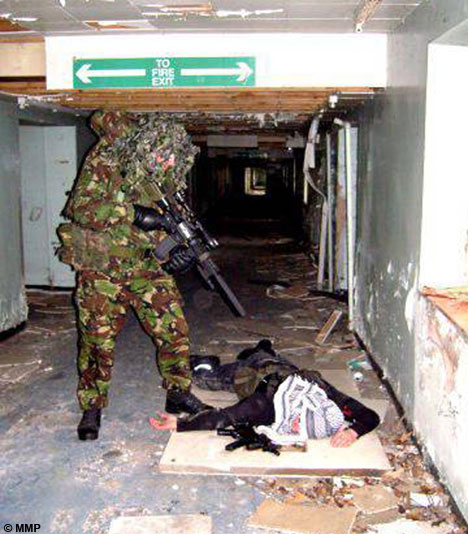
Muslim leaders condemned a new war game where teams of soldiers shoot at enemies – dressed as Arabs.

Men in camouflaged military gear battle opponents wearing shemaghs – the traditional headdress of Arab men – at Zulu 1 Tactical Airsoft Simulations.

Participants use replica machine guns, pistols and sniper rifles which fire 6mm BB rounds at a 20-acre former RAF hospital in Nocton, Lincs.

Images from the company’s website show soldiers pointing rifles at hooded “Arab” men spreadeagled on the floor following “close quarter battles.”

Founders Peter Jenkins, 41, and Darren Howells, 42, denied the use of Arab headdress was racist, claiming it was the “easiest way to tell who the enemy are.”

Over 40 people have signed up for the game\'s grand opening on May 25, held at a former RAF hospital in Nocton, Lincs

Over 40 people have signed up for the game’s grand opening on May 25, held at a former RAF hospital in Nocton, Lincs

The creators of the game deny racism, claiming the use of Arab headdress made it easier to tell who the enemy are

But the Muslim Association of Britain slammed the scheme as “short-sighted and foolish.”

Executive member Mokhtar Badri said: “Any sort of game that associates guns and violence with a particular culture is clearly wrong.

“They could use any other type of colour or dress to tell between teams which would not cause offence.

“Using Arab dress, especially in the current climate, is short-sighted and foolish.

“And regardless of the offence causes, young people should not be given the opportunity to play in an environment where guns are being glamourised.”

Launching with a grand opening on May 25, organisers are planning a series of battles between 120 men over woodland, trenches and disused buildings.

They will be split into teams with one half wearing the shemaghs for identification.

Members as young as 16 pay a £30 joining fee and receive an hour of health and safety training before battle.

Over 40 have already signed up for the battle opening.

Jenkins said the use of the shemaghs was to add authenticity to the experience and they were frequently used by British soldiers.

He added that Airsoft is safer than paintballing as pellets only travel 30 to 40 metres.

He said: “We simply use the shemaghs to differentiate between teams. Just because some terrorists decide to wear them doesn’t make it racist.

“You can buy them on any high street and the British army give them to their own troops.

“They are very visible and can be easily spotted in battle. This is a very popular sport and people should remember it is just a game at the end of the day.

“BB guns are essentially toys.”

BB hand grenades, smoke grenades, night-vision scopes and silencers are also used during the battle.

The guns, which can cost up to £1,000, include the ArmaLite M-16 replica which fires 200 rounds a minute at 350ft per second.

One Nocton resident, who asked not to be named, said: “After the 7/7 bombings in London they assessed Lincolnshire as unlikely to be a hard target but useable for storage of terrorists and for training purposes.

“If we start allowing stuff like this we don’t know what type of people it will attract.”
source

THE SLINKY®

Like Silly Putty, the Slinky® was an accidental by-product of World War II research and development transformed into a hugely successful children’s toy.

In 1943, engineer Richard James of greater Philadelphia was working in his home laboratory to invent a set of springs that could be used to support sensitive instruments on board ships and stabilize them even in rough seas. When he once accidentally knocked one of his springs off a shelf, James saw that, rather than flopping in a heap onto the floor, the spring “stepped” in a series of arcs from the shelf, to a stack of books, to a tabletop, to the floor, where it re-coiled itself and stood upright.

Slinky

After repeated experiments proved the spring’s now famous ability to climb down stairs, James’ wife, Betty, realized the device’s potential as a plaything. She also invented a name for it: the Slinky®. In 1945, the James’ first exhibited their new toy, at the Gimbels Department Store in downtown Philadelphia. They sold 400 Slinkys® in 90 minutes—the start of a sensation that continues to this day.

The Jameses founded James Industries, in Hollidaysburg, Pennsylvania, to market their product. Richard invented machines that could coil 80 feet of steel wire into a Slinky® in about 10 seconds. By the time of its 50th anniversary (1995), that same company, using those same machines, had sold over a quarter of a billion Slinkys®, all over the world.

In the 1940s, the Navy never took an interest in James’ springs. But after their success as a toy, Slinkys® began to find practical uses. High school teachers have long used them to demonstrate the properties of waves. US troops in Vietnam used them as mobile radio antennas; NASA has used them in zero-gravity physics experiments in the Space Shuttle. In the 1990s, from the playroom to the classroom, climbing down stairways and floating in space, Richard and Betty James’ Slinky® continues to educate and entertain.
Source
More references

The Grid’ Could Soon Make the Internet Obsolete

Monday, April 07, 2008

The Internet could soon be made obsolete. The scientists who pioneered it have now built a lightning-fast replacement capable of downloading entire feature films within seconds.

At speeds about 10,000 times faster than a typical broadband connection, “the grid” will be able to send the entire Rolling Stones back catalogue from Britain to Japan in less than two seconds.

The latest spin-off from Cern, the particle physics centre that created the web, the grid could also provide the kind of power needed to transmit holographic images; allow instant online gaming with hundreds of thousands of players; and offer high-definition video telephony for the price of a local call.

David Britton, professor of physics at Glasgow University and a leading figure in the grid project, believes grid technologies could “revolutionise” society. “With this kind of computing power, future generations will have the ability to collaborate and communicate in ways older people like me cannot even imagine,” he said.

The power of the grid will become apparent this summer after what scientists at Cern have termed their “red button” day – the switching-on of the Large Hadron Collider (LHC), the new particle accelerator built to probe the origin of the universe. The grid will be activated at the same time to capture the data it generates.

Cern, based near Geneva, started the grid computing project seven years ago when researchers realised the LHC would generate annual data equivalent to 56m CDs – enough to make a stack 40 miles high.

This meant that scientists at Cern – where Sir Tim Berners-Lee invented the web in 1989 – would no longer be able to use his creation for fear of causing a global collapse.

This is because the Internet has evolved by linking together a hotchpotch of cables and routing equipment, much of which was originally designed for telephone calls and therefore lacks the capacity for high-speed data transmission.

By contrast, the grid has been built with dedicated fibre optic cables and modern routing centres, meaning there are no outdated components to slow the deluge of data. The 55,000 servers already installed are expected to rise to 200,000 within the next two years.

Professor Tony Doyle, technical director of the grid project, said: “We need so much processing power, there would even be an issue about getting enough electricity to run the computers if they were all at Cern. The only answer was a new network powerful enough to send the data instantly to research centres in other countries.”

That network, in effect a parallel Internet, is now built, using fibre optic cables that run from Cern to 11 centres in the United States, Canada, the Far East, Europe and around the world.

One terminates at the Rutherford Appleton laboratory at Harwell in Oxfordshire.

From each centre, further connections radiate out to a host of other research institutions using existing high-speed academic networks.

It means Britain alone has 8,000 servers on the grid system – so that any student or academic will theoretically be able to hook up to the grid rather than the internet from this autumn.

Ian Bird, project leader for Cern’s high-speed computing project, said grid technology could make the internet so fast that people would stop using desktop computers to store information and entrust it all to the internet.

“It will lead to what’s known as cloud computing, where people keep all their information online and access it from anywhere,” he said.

Computers on the grid can also transmit data at lightning speed. This will allow researchers facing heavy processing tasks to call on the assistance of thousands of other computers around the world. The aim is to eliminate the dreaded “frozen screen” experienced by internet users who ask their machine to handle too much information.

The real goal of the grid is, however, to work with the LHC in tracking down nature’s most elusive particle, the Higgs boson. Predicted in theory but never yet found, the Higgs is supposed to be what gives matter mass.

The LHC has been designed to hunt out this particle – but even at optimum performance it will generate only a few thousand of the particles a year. Analysing the mountain of data will be such a large task that it will keep even the grid’s huge capacity busy for years to come.

Although the grid itself is unlikely to be directly available to domestic internet users, many telecoms providers and businesses are already introducing its pioneering technologies. One of the most potent is so-called dynamic switching, which creates a dedicated channel for internet users trying to download large volumes of data such as films. In theory this would give a standard desktop computer the ability to download a movie in five seconds rather than the current three hours or so.

Additionally, the grid is being made available to dozens of other academic researchers including astronomers and molecular biologists.

It has already been used to help design new drugs against malaria, the mosquito-borne disease that kills 1m people worldwide each year. Researchers used the grid to analyse 140m compounds – a task that would have taken a standard internet-linked PC 420 years.

“Projects like the grid will bring huge changes in business and society as well as science,” Doyle said.

“Holographic video conferencing is not that far away. Online gaming could evolve to include many thousands of people, and social networking could become the main way we communicate.

“The history of the internet shows you cannot predict its real impacts but we know they will be huge.”

Source

Crescent moon

April 4, 2008: The date was March 8th, less than a month ago. In a remote corner of Kansas, the sun was going down and the deepening twilight beckoned to photographer Doug Zubenel driving through the countryside. Something photogenic, he knew, was about to happen.

He turned his car onto an unfamiliar dirt road and proceeded into the sunset. “The brilliant sun did not allow me to see the cement railings on a bridge over a small creek. The next thing I knew, I had totaled my car!” Zubenel emerged from the wreckage, phoned 911, and while he was waiting for the tow truck to arrive, took the picture:

The crescent Moon photographed by astrophotographer Doug Zubenel on March 8, 2008.

“It was a beautiful 1-day old crescent moon,” says Zubenel. “It looked a lot better than my car!”

This perilous scene is about to repeat itself—three times.

First – On Sunday evening, April 6th, a 2% crescent moon emerges from the glare of the sun like the wry smile of a Cheshire cat beaming through the tawny-orange sunset. Finding this delicate sliver may require some careful scanning of the western horizon and it would be wise to exit the car (or at least brake) before looking. The next night is easier.

Second – On Monday evening, April 7th, a 6% crescent materializes a little higher in the sky. Set against the cobalt-blue of early evening, the moon reveals its lovely da Vinci glow, a pale impression of the full Moon inside the vivid crescent. Five hundred years ago, Leonardo da Vinci was first to explain this phenomenon: it is Earthshine, the light of our own planet Earth illuminating the Moon’s dark terrain. A crescent moon with Earthshine is widely regarded as one of the prettiest sights in the heavens.

But the best is yet to come….

Third – On Tuesday evening, April 8th, a 12% crescent Moon moves into conjunction with the Pleiades. “Into conjunction” is astronomy jargon for “side-by-side.” The Moon will be so close to the Pleiades that, to the naked eye, they seem to touch, but that is impossible because the Pleiades are 400 light years away.

see captionAlso known as the Seven Sisters, the Pleiades are a cluster of young stars. The brightest seven of these blue-white beauties form a little dipper shape as wide about as the Moon (0.5o). In spite of their great distance, the Pleiades are faintly visible to the naked eye even from urban areas.

Right: A deep-sky exposure of the Pleiades star cluster by amateur astronomer Robert Gendler. [More]

On April 8th, the Moon will lead you directly to the Pleiades. Binoculars are recommended: scan around the Moon and you will find not just seven but dozens of sparkling stars, some of them winking in and out behind the mountainous lunar limb. The Moon itself may take your breath away as you sweep your optics across the cratered Earthlit landscape.

As on previous evenings, the best time to look is shortly after sundown, facing west: sky map. The crescent Moon, Earthshine and a star cluster in the same field of view–it doesn’t get much better than that.

Epilogue: “I have another car now and I will be heading out Sunday afternoon for an encore performance, not of the wreck, but of the Moon,” says Zubenel. He shares his story hoping that it will inspire others to photograph the upcoming display–carefully!

Blog at WordPress.com.

Up ↑